For more than half a century, Tamil Nadu politics was firmly dominated by Dravidian parties. The DMK and AIADMK alternated in power, shaping the state’s political identity around regional pride, social justice, and linguistic nationalism. While film stars entering politics has never been unusual in Tamil Nadu, transforming cinematic popularity into political power has always been a difficult task.
That history has now been rewritten by actor Vijay and his party, Tamilaga Vettri Kazhagam (TVK).
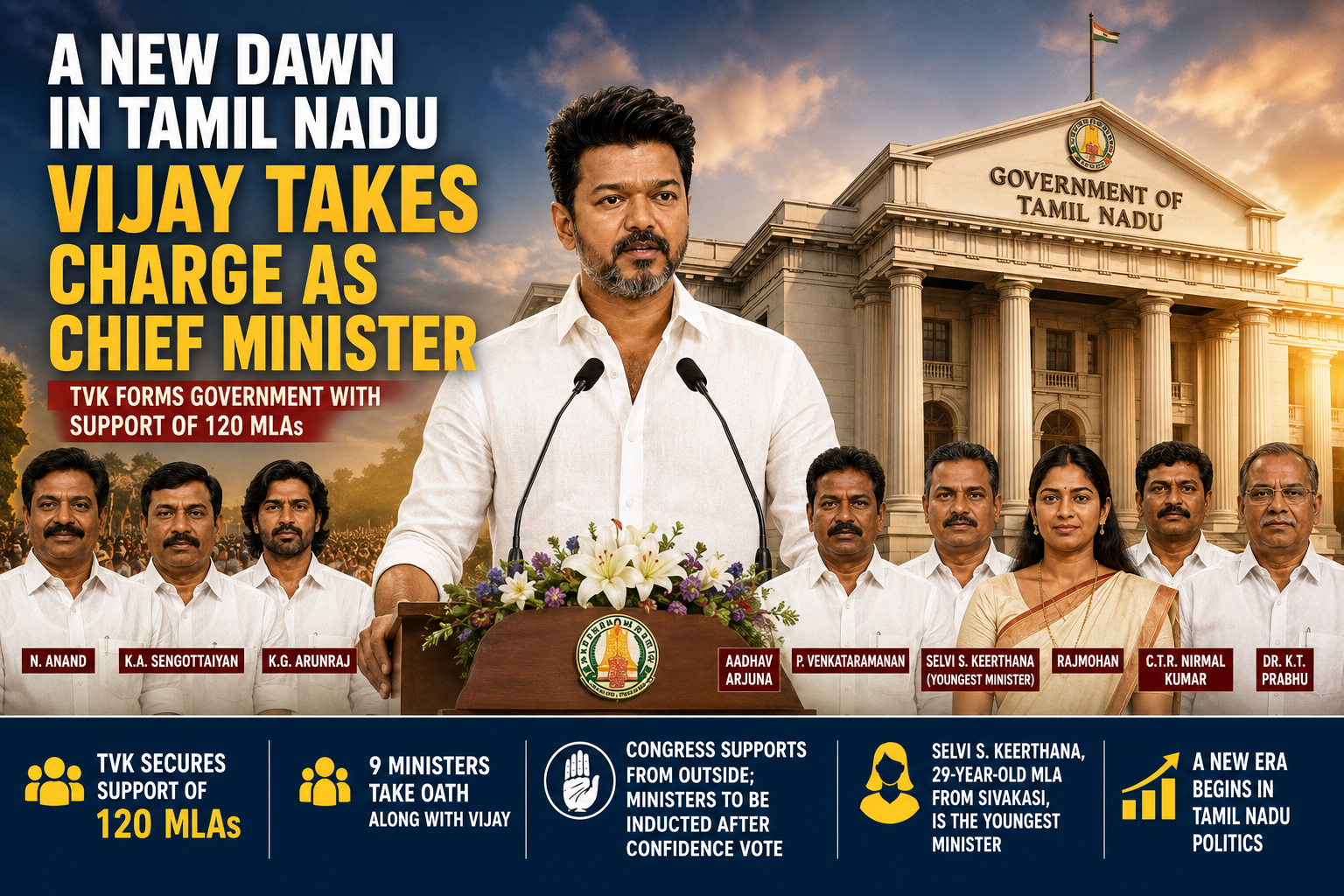
With the support of 120 MLAs, Vijay has taken oath as the Chief Minister of Tamil Nadu, opening a new chapter in the state’s political history. The development has sparked intense debate: Is this merely a temporary electoral shift, or has the long-standing Dravidian political order begun to crack?
A Cabinet Blending Youth and Experience
Vijay’s first cabinet consists of nine ministers. Although the Congress party is supporting the government, its ministers are expected to be inducted only after the confidence vote.
The most talked-about name in the cabinet is 29-year-old Selvi S. Keerthana. MLA from Sivakasi, Keerthana is not only TVK’s youngest woman legislator but also the youngest minister in the current Tamil Nadu cabinet. A former political consultant, her inclusion is widely viewed as a message aimed at youth and women voters.
At the same time, Vijay has surrounded himself with experienced political figures.
- N. Anand — A trusted associate of Vijay since the days of Vijay Makkal Iyakkam.
- K. A. Sengottaiyan — A veteran politician and former AIADMK minister with decades of administrative experience.
- K. G. Arunraj — A former IRS officer who left government service to join politics and became one of TVK’s key strategists.
- Aadhav Arjuna — Known as the architect behind Vijay’s Perambur victory and a prominent election strategist.
- P. Venkataramanan — One of the party’s principal organisational and financial pillars.
- Rajmohan — A motivational speaker and the face behind TVK’s successful Gen Z digital outreach.
- C. T. R. Nirmal Kumar — Formerly associated with BJP and AIADMK, now overseeing TVK’s digital campaigns.
- Dr. K. T. Prabhu — A dentist-turned-politician who secured a surprise victory from Karaikudi.
The cabinet reflects a deliberate attempt to balance social representation, youth appeal, and administrative experience.
What Happened to Dravidian Politics?
Dravidian politics in Tamil Nadu was built on the pillars of language identity, social justice, anti-Brahmin mobilisation, and regional pride. Leaders such as M. Karunanidhi and J. Jayalalithaa transformed these ideas into powerful mass movements that dominated the state for decades.
However, after the passing of both towering leaders, the Dravidian movement gradually lost its emotional centre.
While the DMK remains a strong organisation, critics argue that M. K. Stalin has struggled to command the same mass charisma as Karunanidhi. The AIADMK, meanwhile, has been weakened by factionalism and leadership crises following Jayalalithaa’s death.
It was into this political vacuum that Vijay entered.
Beyond his star power, Vijay successfully connected with young voters and first-time voters through social media-driven campaigns and a carefully crafted outsider image. That combination proved crucial in TVK’s rise.
Who Benefits From the Weakening of Dravidian Politics?
The immediate beneficiary is undoubtedly TVK. But in the long term, the political consequences may extend far beyond Vijay’s party.
1. An Opening for National Parties
For decades, national parties found it nearly impossible to grow independently in Tamil Nadu. The Congress was reduced to a junior ally of Dravidian parties, while the BJP struggled to convert its vote share into real political power.
But if Dravidian identity politics weakens further, national parties could gain fresh opportunities. The BJP, in particular, appears to be reframing its approach by combining “Tamil pride” with development politics instead of relying solely on Hindutva narratives.
2. Congress at a Crossroads
The Congress, currently extending outside support to the TVK government, may attempt to rebuild its independent relevance in Tamil Nadu. However, doing so could require redefining its long-standing political relationship with the DMK.
3. BJP’s Long-Term Strategy
The BJP may still be far from capturing power in Tamil Nadu directly, but the decline of Dravidian dominance works in its favour. The fact that some leaders within TVK come from BJP and AIADMK backgrounds also reflects the fluidity of the emerging political landscape.
Challenges Before the Vijay Government
Winning power through popularity is only the first step. Governance is an entirely different challenge.
The Vijay government will be tested on:
- Employment generation
- Industrial investment
- Social justice policies
- Centre-state relations
- Sensitive issues such as the Cauvery dispute and language politics
Ultimately, Vijay’s success will depend on whether he can transform his cinematic “mass hero” image into credible political leadership.
A New Political Era for Tamil Nadu?
Many attempted to fill the political vacuum left behind by Karunanidhi and Jayalalithaa, but Vijay is the one who has succeeded in reaching power.
For that reason, this is not merely the formation of another government. It could mark the beginning of a profound transformation in Tamil Nadu’s political culture.
It may still be too early to declare the end of Dravidian politics. But the Tamil Nadu verdict certainly suggests that its era of unquestioned dominance may be coming to an end.