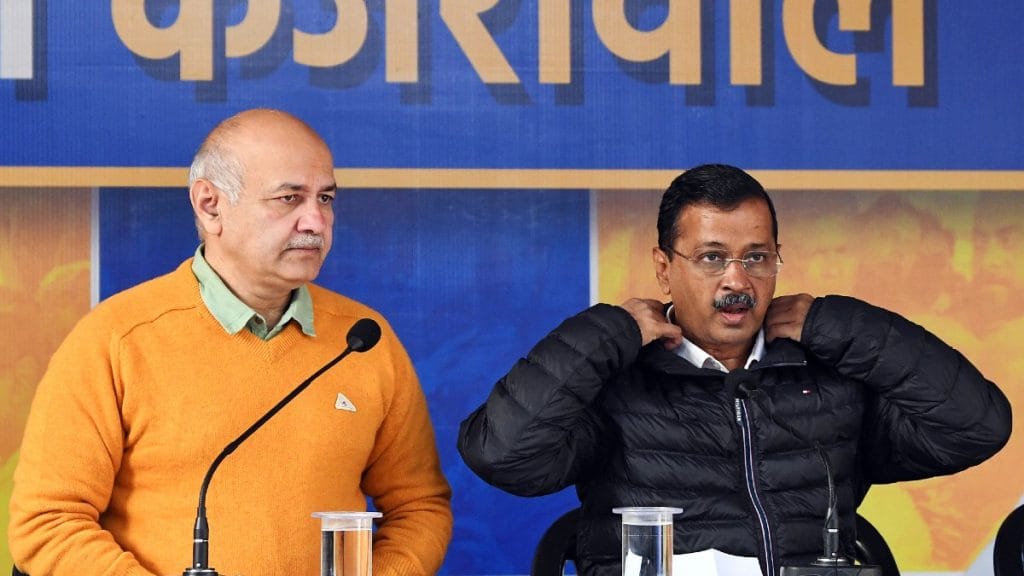
On 27 February 2026, a Rouse Avenue Court in New Delhi discharged all 23 accused, including former Delhi Chief Minister Arvind Kejriwal and former Deputy Chief Minister Manish Sisodia, in the high‑profile Delhi excise (liquor) policy corruption case, holding that the Central Bureau of Investigation (CBI) failed to produce credible evidence of criminal conspiracy or intent.
Background and Origin of the Case
- The controversy began after the Delhi government introduced a new Excise Policy for 2021–22 aiming to privatise liquor retail, increase revenue, and reform sales rules.
- In July‑August 2022, the Lieutenant Governor of Delhi, V.K. Saxena, recommended a CBI probe, alleging irregularities, financial mismanagement and possible corruption in how the policy was formulated and implemented.
- The CBI registered an FIR in August 2022, accusing several AAP leaders and private individuals of criminal conspiracy, favouring certain liquor license holders, creating a cartel and causing financial loss to the state.
- The Enforcement Directorate (ED) also launched a parallel investigation under the Prevention of Money Laundering Act (PMLA) based on CBI findings.
Investigation and Legal Proceedings
Arrests and Chargesheets
- The CBI filed its first chargesheet in 2022, alleging that approximately ₹100 crore was paid by a “south lobby” to influence policy decisions.
- There were several supplementary chargesheets naming 23 individuals, including Kejriwal, Sisodia and others.
- Manish Sisodia was arrested by the CBI in February 2023 and later also by the ED; he spent around 17 months in custody before getting bail from the Supreme Court.
- Arvind Kejriwal was arrested by the ED in March 2024, partly connected to this case and related PMLA allegations, and was in jail for several months until his bail in September 2024.
Arguments in Court
- The CBI argued that the policy was manipulated, that licence fees were reduced and that kickbacks were paid to favour specific private players, constituting a criminal conspiracy.
- The defence, however, maintained that Kejriwal’s name appeared very late in the chargesheets, with no direct evidence linking him to wrongdoing, and that there was no material to substantiate a conspiracy or criminal intent.
Judgment: Key Findings and Reasoning
In the 27 February 2026 order, Special Judge Jitendra Singh of the Rouse Avenue Court held:
No Prima Facie Case
- The chargesheet failed to show prima facie evidence of criminal conspiracy or criminal intent against any of the accused.
- The court refused to take cognisance of the CBI’s charge sheet on the basis that allegations were not backed by concrete evidence.
- As a result, the judge discharged all 23 accused, including Kejriwal, Sisodia and leaders like K Kavitha.
Judgment Criticisms of CBI Case
- The court criticised the CBI investigation, noting many “misleading averments” and gaps in evidence that were not corroborated by witness testimony.
- It observed that the prosecution’s theory of conspiracy could not be sustained where no coherent legal foundation was laid.
Immediate Reactions After the Verdict
Arvind Kejriwal
- Kejriwal became emotional, saying, “I am not corrupt” and describing the verdict as proof of truth prevailing.
AAP Leaders’ Response
- AAP leaders hailed the ruling as vindication and labelled the allegations politically motivated.
CBI’s Next Step
- The CBI announced it will appeal immediately to the Delhi High Court, saying the trial court ignored important aspects of its investigation.
Summary of What the Court Found
- No material evidence of criminal wrongdoing.
- Allegations did not meet the threshold for conspiracy.
- Chargesheet had gaps and misleading statements.
- Case effectively closed at trial court level, though appeals are expected.
Significance
This verdict marks a major turning point in a three‑year legal battle that influenced Indian political discourse, with broader implications about how high‑profile corruption cases are investigated and adjudicated.