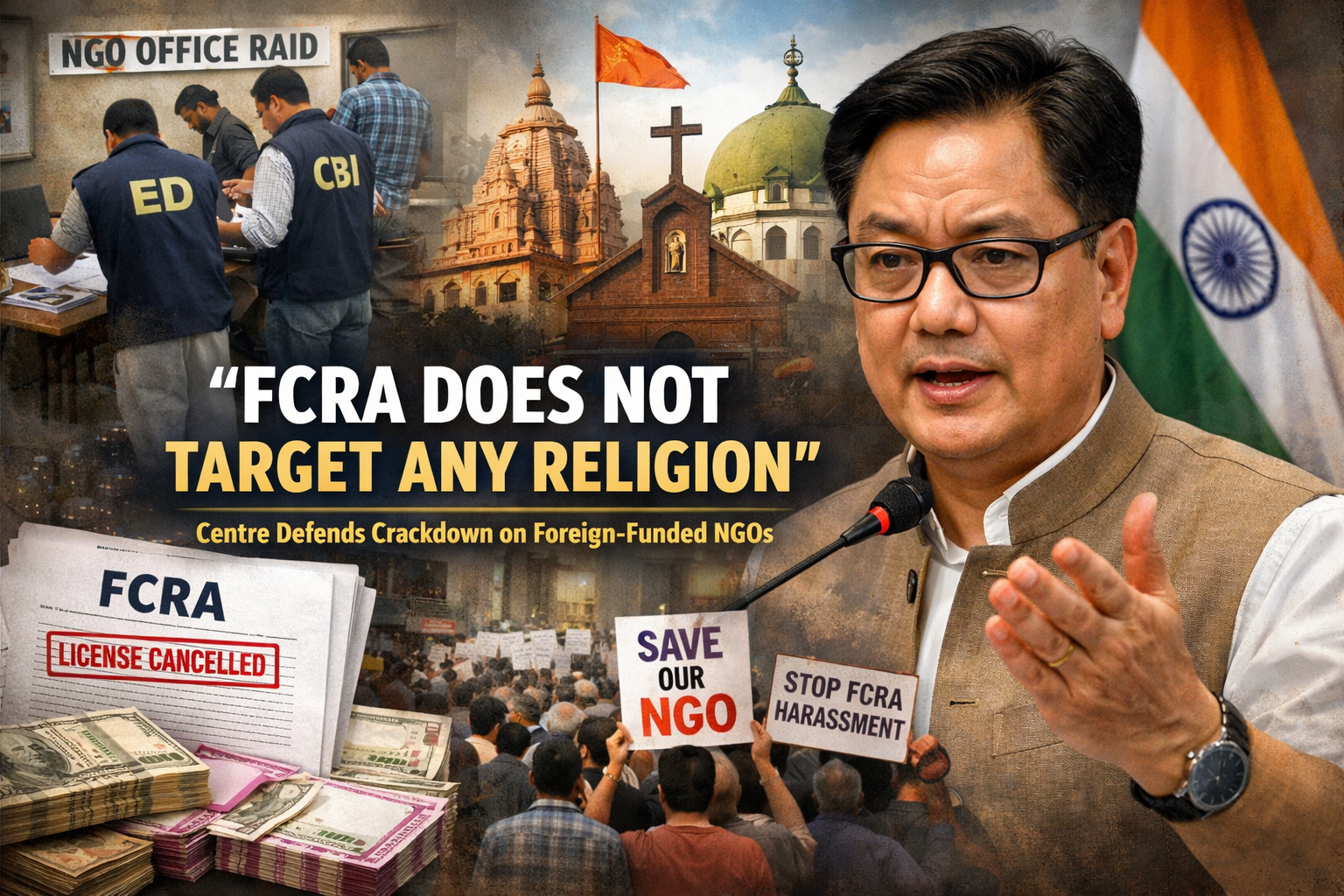
New Delhi: Amid intensifying debates over the regulation of foreign-funded organizations, Union Minister Kiren Rijiju has strongly defended the Foreign Contribution (Regulation) Act (FCRA), stating that the law “does not target any particular religious community” and is aimed solely at preventing illegal activities. He also accused political parties such as the UDF and CPI(M) of spreading “misinformation” on the issue.
The FCRA framework, NGO registrations, license cancellations, religious distribution, state-wise funding trends, and the role of major organizations have all come under renewed scrutiny, triggering a nationwide discussion.
What is FCRA? Background and Purpose
The Foreign Contribution (Regulation) Act (FCRA) was first enacted in 1976 and later comprehensively amended in 2010. The law was designed to regulate foreign donations and ensure that such funds do not adversely affect India’s political, social, or economic stability.
The key objectives include:
- Ensuring transparency in foreign funding
- Preventing foreign influence in domestic affairs
- Safeguarding national security
- Regulating politically sensitive funding
Key Provisions Under FCRA
To receive foreign contributions, organizations must:
- Register with the Ministry of Home Affairs (MHA)
- Maintain a designated bank account (SBI, New Delhi)
- Submit annual financial returns
- Use funds strictly for declared purposes
- Avoid using funds for political activities
FCRA Amendment 2020 Highlights
- Administrative expense limit reduced from 50% to 20%
- Sub-granting (transferring funds to other NGOs) prohibited
- Aadhaar identification made mandatory
Scale of NGOs in India
India has a vast NGO ecosystem:
- Total NGOs: Over 3 million (approx.)
- FCRA-registered NGOs: 22,000 – 23,000
This indicates that only a small fraction of NGOs are legally permitted to receive foreign funding.
Religious Distribution of NGOs (Approximate)
The government does not officially publish religion-wise NGO data. However, based on studies and estimates:
- Hindu-affiliated organizations: 50% – 60%
- Christian organizations: 15% – 25%
- Muslim organizations: 10% – 15%
- Sikh, Buddhist, Jain: 5% – 10%
- Secular NGOs: 20% – 30%
Why Exact Data is Unavailable
- Religion is not a mandatory reporting field
- Many NGOs are registered as “secular”
- Organizations often work across multiple sectors
Mass License Cancellations
Between 2011 and 2024:
👉 Approximately 20,000 – 22,000 NGO licenses were cancelled under FCRA
Year-wise Trends
- 2011–2015: 10,000+
- 2016: 11,000 (highest single-year cancellations)
- 2017–2019: 2,000–3,000
- 2020: 1,500+
- 2021–2023: 1,000+
Reasons for License Cancellation
- Failure to file annual returns
- Misuse of funds
- Violation of banking norms
- Unauthorized fund transfers
- National security concerns
Top States Receiving Foreign Funds
- Tamil Nadu: ₹6,000–₹8,000 crore
- Maharashtra: ₹5,000–₹7,000 crore
- Delhi: ₹3,000–₹5,000 crore
- Kerala: ₹2,000–₹4,000 crore
- Karnataka: ₹2,000–₹3,000 crore
Key Sectors
- Education
- Healthcare
- Social services
- Religious activities
- Human rights
Kerala: A Key Hub
- FCRA NGOs: 2,000 – 2,500
- Major sectors: Education, healthcare, welfare
Religious Trends (Approx.)
- Christian organizations: Significant share
- Muslim organizations: Education, charity
- Hindu trusts: Temple-based services
- Secular NGOs: Development, environment
Major NGOs Receiving Foreign Funds
- World Vision India – Child welfare
- Caritas India – Disaster relief
- CASA – Social development
- Ramakrishna Mission – Education & healthcare
- Mata Amritanandamayi Math – Large charity network
- Oxfam India – Rights-based work (faced scrutiny)
- Greenpeace India – Environmental activism
Controversies and Political Debate
Criticism
- Allegations of targeting dissenting NGOs
- Concerns over shrinking civil society space
- Impact on human rights work
Government’s Stand
- Law applies equally to all
- Focus on transparency and compliance
- Actions only against violations
Kerala-Specific Debate
- Allegations of targeting minority institutions
- Political polarization around NGO regulation
- Rising scrutiny of foreign-funded organizations
Kiren Rijiju’s Response
- “FCRA does not target any religion”
- “Only violators face action”
- “Opposition is spreading misinformation”
Major Source Countries for Funding
- United States
- United Kingdom
- Germany
- Canada
- Australia
Future Trends
- Increased digital monitoring
- Stricter compliance rules
- Possible decline in foreign funding
- Greater accountability for NGOs
Conclusion
The FCRA law remains a powerful regulatory tool shaping India’s NGO sector. While the government argues that it ensures transparency and national security, critics warn of its potential impact on democratic freedoms and civil society.
As debates continue, the evolving implementation of FCRA will play a crucial role in determining the future of foreign-funded organizations and civic engagement in India.
(Comprehensive News Analysis Report)