Two Hilsa found in Ghazipur raise a bigger question: Has a new fish passage finally reopened a migration route blocked for decades by the Farakka Barrage?
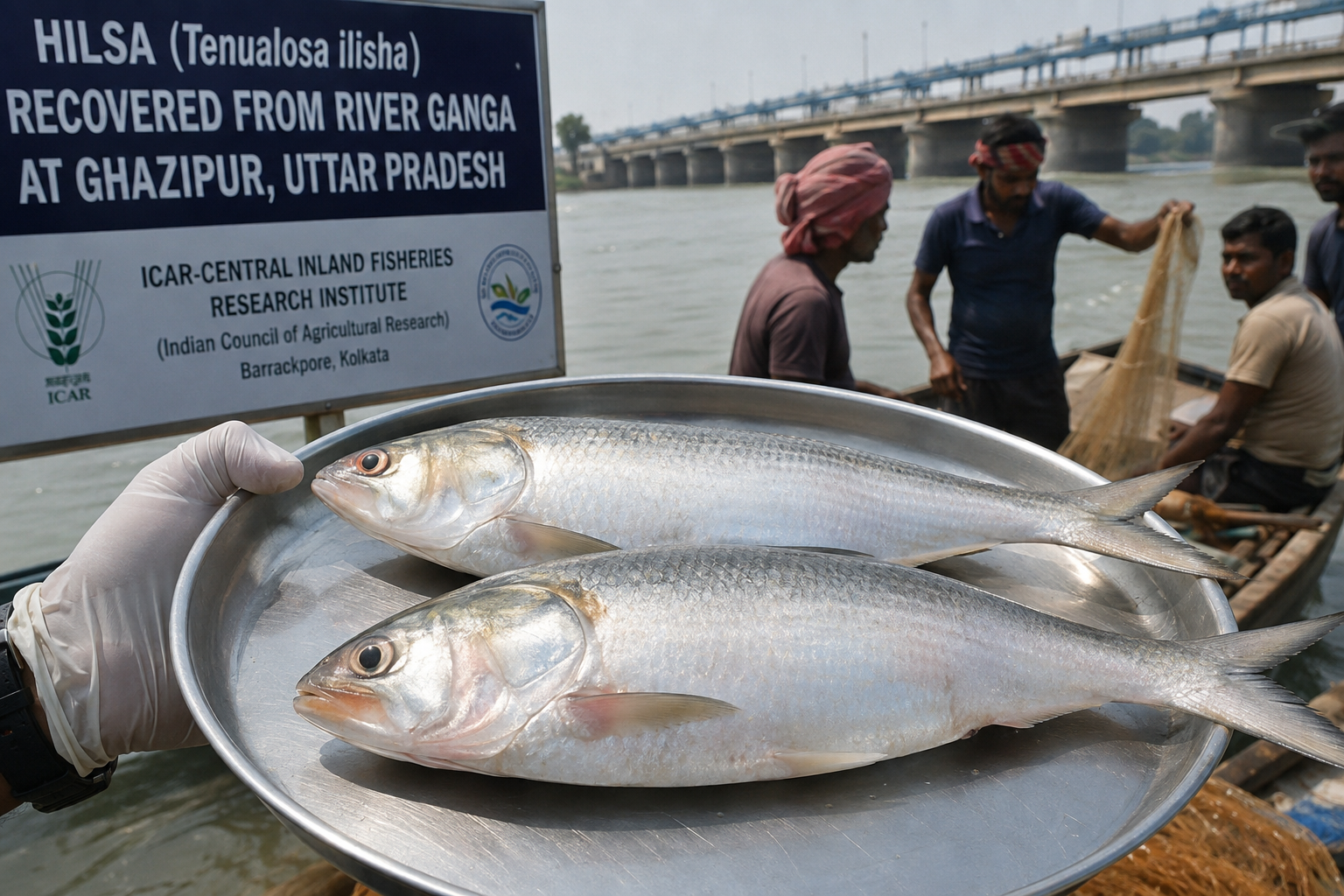
GHAZIPUR: The return of Hilsa to the upper reaches of the Ganga, after disappearing from the region for decades, is emerging as a potentially significant sign of ecological recovery. Two Hilsa caught by local fishermen in Ghazipur, Uttar Pradesh, have been identified by researchers, raising hopes that the fish may once again be able to navigate a historic migration route that was disrupted by the Farakka Barrage.
The two fish weighed approximately 450 grams and 510 grams respectively. Ghazipur lies nearly 700 kilometres upstream of the Farakka Barrage. If the fish migrated naturally through the barrage and reached Ghazipur, their presence could provide an important indication that the long-blocked upstream migration route is becoming accessible again.
But scientists are unlikely to regard two fish as proof of a complete recovery. The real test begins now.
How many more Hilsa are reaching the upper Ganga? Are they breeding there? Can the new fish passage become a permanent migration corridor?
The answers could determine whether this is simply an isolated discovery—or the beginning of one of the most significant ecological recoveries in the river.
A barrage that changed the history of a fish
Hilsa’s life cycle makes it particularly vulnerable to man-made barriers in rivers. The fish grows in the sea but migrates into rivers for breeding, often travelling long distances upstream against the current.
The construction of the Farakka Barrage severely disrupted this natural migration. Government records have noted that Hilsa, which historically travelled as far upstream as Prayagraj, became largely restricted around the Farakka region after the barrage and associated structures disrupted its passage.
The consequences extended beyond ecology.
Communities of riverine fishermen who depended on Hilsa for their livelihoods also suffered as the fish became increasingly scarce in the upper reaches of the Ganga.
The disappearance of Hilsa, therefore, was not simply the loss of a fish species from a particular stretch of river. It was also the disruption of an entire economic chain built around the river.
That is why the discovery at Ghazipur matters.
It could represent not only the return of a species, but the potential return of a lost livelihood.
A new ‘door’ through the Farakka barrier
At the centre of the current effort is the fish passage—or fish-lock system—designed to help migratory fish cross man-made barriers.
When a barrage blocks the natural movement of fish, a specially designed passage provides an alternative route. By regulating water flow and creating conditions that attract migrating fish, the system is intended to allow them to move from one side of the barrier to the other.
The idea of helping Hilsa cross Farakka is not new. The Union government has previously highlighted the importance of fish-lock arrangements to facilitate Hilsa migration upstream.
But the discovery of Hilsa hundreds of kilometres upstream now provides an important real-world test.
Did the fish cross Farakka? How did they cross? And how many made the journey?
Those are the questions researchers must now answer.
Two fish—but a potentially important data point
From a purely numerical perspective, finding two Hilsa is hardly enough to establish the recovery of a population.
Their location, however, gives the discovery unusual significance.
If the fish migrated upstream naturally, their presence in Ghazipur suggests that the barrier at Farakka may no longer be an absolute obstacle.
Yet scientists must be cautious.
Two fish cannot establish that a sustainable Hilsa population has been restored. A much larger body of evidence will be required—including the number of fish migrating upstream, their size and age, breeding condition, genetic characteristics and seasonal movement patterns.
Researchers will also need to establish whether Hilsa eggs, larvae and juvenile fish are appearing in suitable upstream breeding habitats.
That distinction is crucial.
The Ghazipur discovery is therefore best understood as a scientific signal rather than a declaration of victory.
The fish passage is only one part of a much larger experiment
The restoration effort is not relying solely on fish passages.
ICAR-CIFRI has been involved in Hilsa stock enhancement and conservation efforts in the Ganga, including ranching, the release of eggs and larvae, tagging and habitat-related studies.
Government records released in 2026 indicate that large-scale Hilsa stock enhancement activities have been undertaken in the Ganga upstream of Farakka. These have included the release of adult Hilsa as well as substantial quantities of Hilsa eggs and spawn.
That introduces another important scientific question.
Are the Hilsa now appearing in places such as Ghazipur the result of natural migration through the fish passage? Are they connected to stock-enhancement programmes? Or are both factors contributing to their return?
Answering that question will be essential if authorities want to distinguish between short-term increases in fish abundance and genuine restoration of the species’ natural migration cycle.
Hilsa as a ‘living indicator’ of river health
The significance of Hilsa extends far beyond fisheries.
As a long-distance migratory species, Hilsa requires suitable river flow, breeding habitats and adequate water quality. Its ability to migrate deep into a river system depends on a combination of ecological conditions.
A sustained return of Hilsa could therefore become an important indicator of ecological recovery in the Ganga.
But a fish passage alone cannot guarantee that recovery.
Pollution, changes in river flows, degradation of breeding grounds, alterations to sediment and riverbed habitats, and uncontrolled fishing pressure can all undermine the long-term survival of the species.
For Hilsa to truly return, these issues will have to be addressed simultaneously.
From one fish to the ‘Blue Economy’
ICAR-CIFRI has described Hilsa restoration as a strategic step towards strengthening India’s Blue Economy.
The reason is straightforward: ecology and economics are closely connected.
A healthier Hilsa population would benefit the Ganga’s biodiversity. Greater availability of the fish could create new income opportunities for fishing communities. And healthier aquatic habitats could support fisheries productivity over the long term.
This makes the Ghazipur discovery more than an isolated wildlife story.
It could be the first visible sign of a larger process in which a damaged river system begins to recover some of the ecological functions it lost decades ago.
Now, the wait is for the third Hilsa—and the fourth
Decades ago, the Farakka barrier disrupted a migration route that had existed long before the barrage itself.
Today, humans are attempting to reopen that route through engineered fish passages, stock enhancement, scientific monitoring and habitat restoration.
The two Hilsa weighing 450 and 510 grams found in Ghazipur may be among the first pieces of evidence that the new route is being used.
But the real measure of success will not be the discovery of two fish.
More Hilsa must arrive. They must breed. Their offspring must survive in the Ganga. And, eventually, Hilsa must become a regular catch for the fishermen who once depended on it.
Only then will scientists and river communities be able to say that the journey interrupted by Farakka has truly begun again.
For now, two fish are carrying a much bigger message: the Ganga may be opening a door that has been closed for generations.