Why the Bengal Election Became an International Story
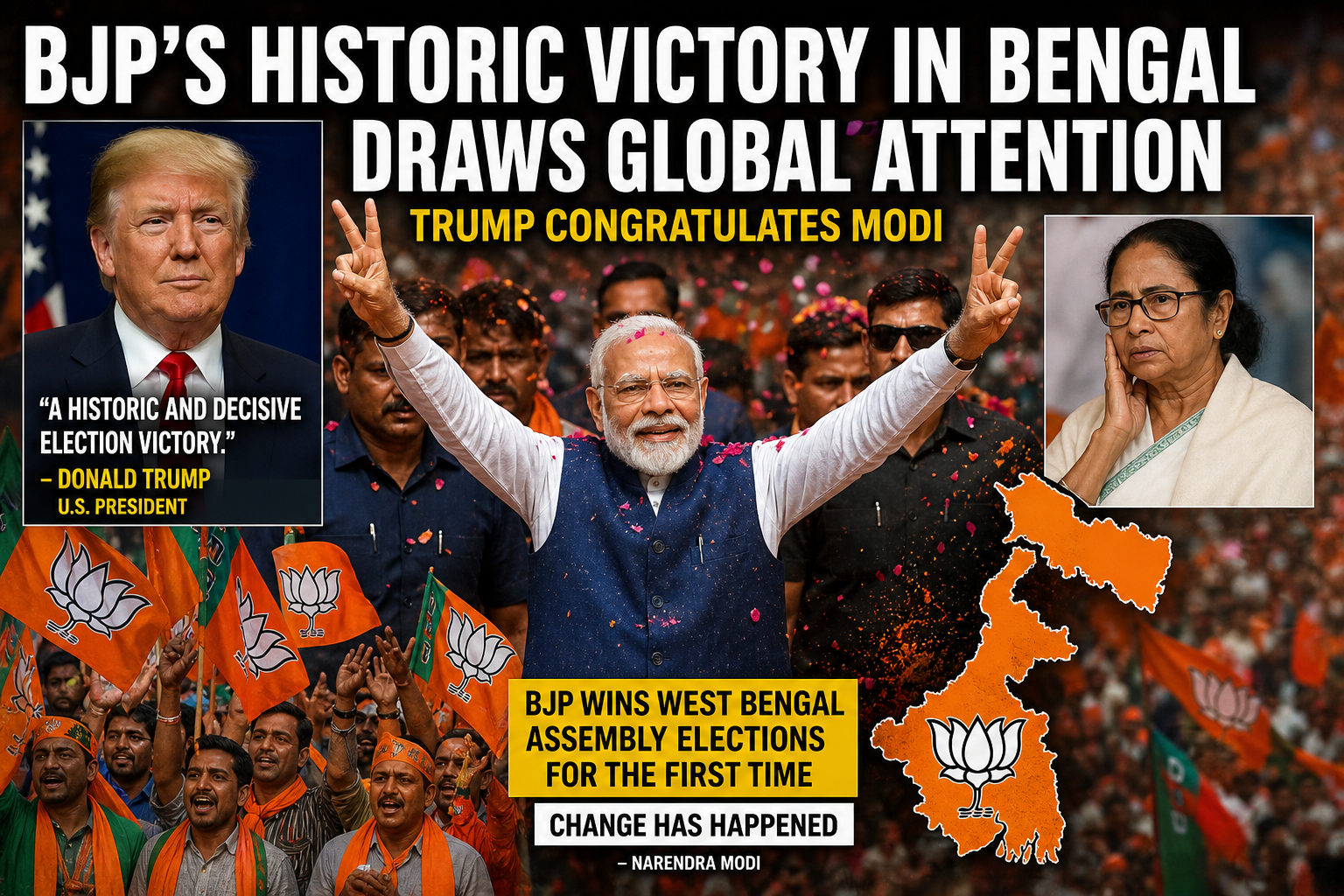
The 2026 West Bengal Assembly election is being described as one of the most symbolically important political victories in modern Indian politics. Prime Minister Narendra Modi’s Bharatiya Janata Party (BJP) captured power in West Bengal for the first time, ending 15 years of rule by Mamata Banerjee and turning a state election into a global political headline.
The BJP reportedly crossed 206 seats in the 294-member Assembly, securing a two-thirds majority and achieving one of the biggest electoral breakthroughs in eastern India.
The result gained even greater international attention after U.S. President Donald Trump congratulated Modi on what the White House called a “historic and decisive election victory.”
Trump’s Congratulations to Modi
According to White House spokesperson Kush Desai:
“The President congratulates Prime Minister Modi on this recent, historic, and decisive election victory.”
Desai also stated:
“India is lucky to have him as its leader.”
International analysts viewed Trump’s message as politically significant because it is unusual for a U.S. president to publicly react to an Indian state election. The remarks highlighted Modi’s growing international profile and the strategic importance of India-U.S. relations in Asia.
Why the Bengal Election Attracted Global Attention
1. Collapse of a Longstanding Political Fortress
For decades, West Bengal had been considered one of India’s strongest anti-BJP regions. The state was governed first by the Left Front and later by Mamata Banerjee’s Trinamool Congress.
International media described the BJP’s victory not merely as an election result, but as a major ideological transformation in Indian politics.
2. BJP Conquers “India’s Toughest Political Frontier”
British newspaper The Guardian described Bengal as:
“India’s toughest political frontier.”
The newspaper noted that Bengal had resisted BJP expansion for years, making the breakthrough especially significant.
American news agency Associated Press described the election as a “key state election” that could strengthen Modi’s national political standing ahead of future elections.
3. A Major Blow to Mamata Banerjee
According to Reuters:
- Trinamool Congress fell dramatically from 215 seats to around 80
- Mamata Banerjee reportedly lost her own constituency
- Banerjee later alleged irregularities in the election process
Reuters described the defeat as one of the most serious setbacks for India’s opposition politics in recent years.
4. Expansion of Hindutva Politics
Several international observers linked the BJP victory to the growing influence of Hindutva-oriented politics in eastern India.
Analysts pointed to:
- Consolidation of Hindu votes
- Immigration and border-security narratives
- Modi’s personal popularity
- Organizational strength of BJP workers
as major factors behind the victory.
International Media Reactions
The Guardian
The Guardian called the BJP victory:
“a historic first-time victory”
“a major political shift”
The paper argued that the outcome further strengthened Modi’s national dominance after the 2024 parliamentary elections.
Associated Press
Associated Press described West Bengal as a:
“key state election”
and said the result could:
“enhance his political standing.”
American media broadly portrayed the Bengal result as a major political boost for Modi’s third term.
Reuters
Reuters focused on:
- BJP’s first-ever government in Bengal
- Mamata Banerjee’s refusal to resign immediately
- Allegations and controversies surrounding the election process
The agency emphasized the broader implications for opposition politics in India.
Bangladesh Reaction
Political and Strategic Concerns
Bangladesh closely followed the Bengal election because West Bengal shares deep cultural, linguistic, and border connections with Bangladesh.
Political observers in Dhaka reportedly viewed the BJP victory through the lens of:
- Border security policies
- Immigration debates
- Citizenship politics
- India-Bangladesh diplomatic relations
Bangladeshi analysts expressed concern that stronger nationalist politics in Bengal could influence discussions around migration and border management in the region.
However, some strategic experts in Bangladesh also argued that a politically stable Indian government could ensure continuity in trade, connectivity, and bilateral agreements between the two countries.
Pakistan Reaction
Media and Political Commentary
Pakistani media outlets highlighted the Bengal result as another sign of Modi’s continued political dominance in India.
Several commentators connected the outcome to:
- The rise of Hindu nationalist politics
- Modi’s personal popularity
- Weaknesses within India’s opposition parties
Some Pakistani analysts argued that the BJP’s expansion into eastern India demonstrated the party’s ability to move beyond its traditional northern and western strongholds.
At the same time, critical voices in Pakistan expressed concern about increasing political polarization and the growing influence of Hindutva ideology in Indian politics.
China’s View
Strategic Stability
Chinese strategic observers reportedly interpreted the result as evidence of political stability under a strong central leadership in India.
Analysts noted that a politically stronger Modi government could influence:
- Asian geopolitics
- Border diplomacy
- Trade competition
- Regional power dynamics
European Reactions
Democracy and Polarization
European media focused heavily on:
- Electoral controversies
- Democratic processes
- Religious polarization
- Minority politics
during the Bengal election campaign.
Several European commentators described the election as a reflection of India’s changing political and ideological landscape.
Modi’s Response
After the victory, Modi declared:
“Poriborton hoye gechhe”
(“Change has happened.”)
He described the result as a victory for “good governance” and thanked the people of West Bengal for their support.
Conclusion
The 2026 West Bengal election became a global political story because it represented:
- The fall of a major anti-BJP stronghold
- BJP’s historic expansion into eastern India
- Modi’s increasing national and international influence
- The continued rise of Hindutva politics
- Growing geopolitical interest in India’s political direction
With reactions coming from the United States, Europe, Bangladesh, Pakistan, and China, the Bengal election evolved far beyond regional politics and became a subject of worldwide political discussion.