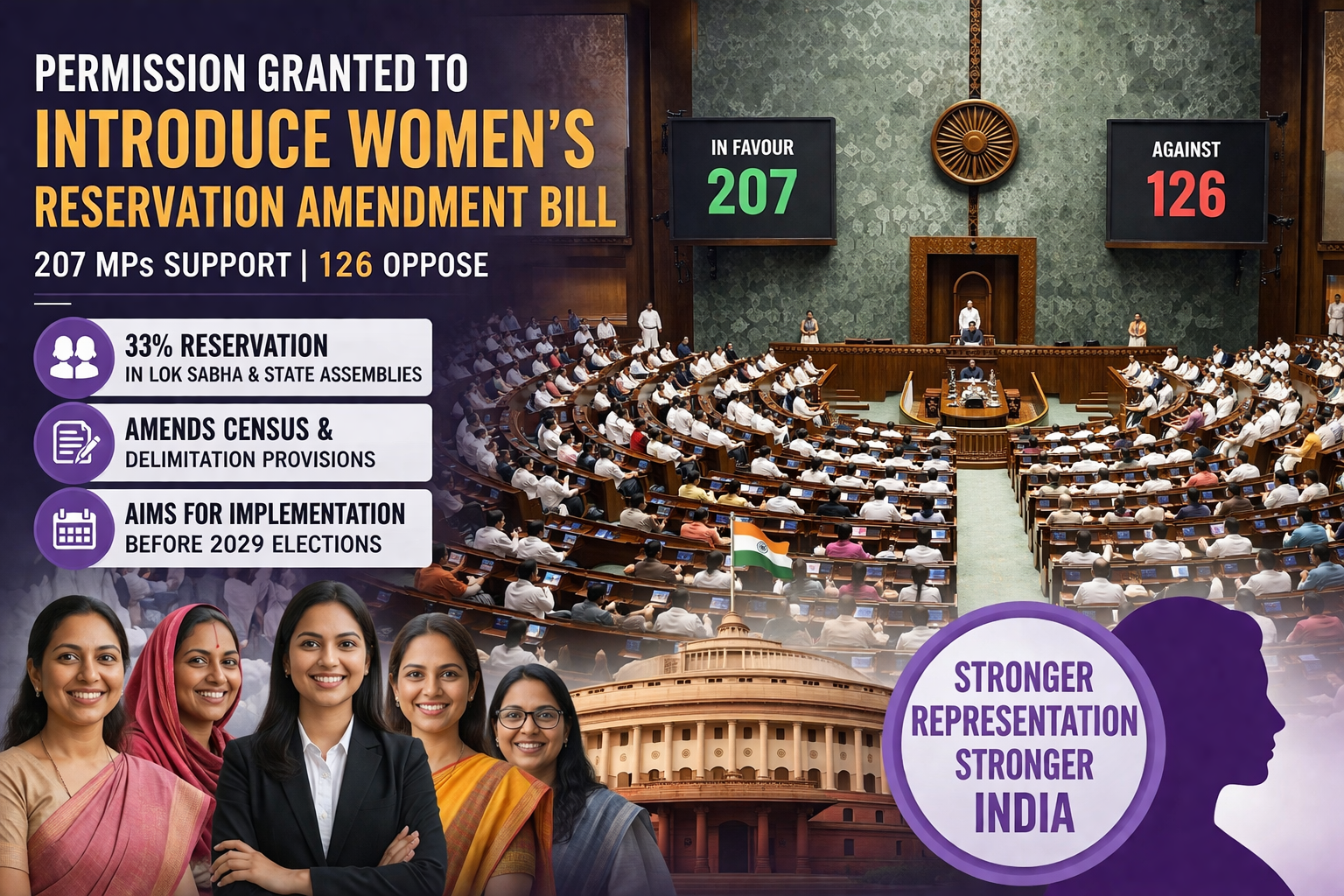
New Delhi, April 16, 2026: In a significant development aimed at enhancing women’s representation in Indian politics, permission has been granted to introduce the Women’s Reservation Amendment Bill in Parliament. During the voting process, 207 Members of Parliament voted in favor, while 126 opposed the motion to introduce the bill.
Approval to Introduce the Bill
The government moved to introduce the amendment during a special session of Parliament. The required permission was secured through a majority vote, enabling the bill to be formally presented for consideration.
The primary objective of this amendment is to expedite the implementation of the existing women’s reservation law, the Nari Shakti Vandan Adhiniyam (2023 Constitutional Amendment).
Key Objectives of the Bill
- Ensuring 33% reservation for women in the Lok Sabha and State Legislative Assemblies.
- Amending provisions related to the Census and delimitation, which currently delay the implementation of the reservation.
- Facilitating the implementation of women’s reservation before the 2029 general elections.
The proposed amendment also includes the possibility of increasing the number of Lok Sabha seats from 543 to more than 800, as part of the delimitation process.
Political Reactions
🔹 Support from the Ruling Party
- The ruling Bharatiya Janata Party (BJP) strongly supported the bill.
- The government emphasized that the legislation is crucial for ensuring greater political participation of women in the country.
🔹 Criticism from the Opposition
- Several opposition parties, including the Indian National Congress, questioned the timeline and implementation mechanism of the bill.
- Concerns were also raised that the delimitation process could be used for political advantage.
Controversial Issues
- Concerns over implementing the reservation before the completion of the national Census.
- The possibility of changes in seat distribution among states following delimitation.
- Criticism regarding the absence of a separate quota for Other Backward Classes (OBCs) within the women’s reservation.
Historical Background
- The Women’s Reservation Law was first passed in 2023.
- It received overwhelming support in the Lok Sabha, with 454 votes in favor and only 2 against.
- However, its implementation has been delayed due to provisions linking it to the completion of the Census and subsequent delimitation.
Political Significance
This amendment bill is expected to:
- Bring about a transformational increase in women’s political participation.
- Spark major political debates ahead of the 2029 general elections.
- Influence Centre–State political dynamics and electoral strategies.
Conclusion
The approval to introduce the Women’s Reservation Amendment Bill marks a crucial milestone in Indian politics. While the bill has secured majority support, debates and controversies surrounding its implementation and political implications continue.
All eyes are now on Parliament to see whether the bill will be passed and how soon it will be implemented.