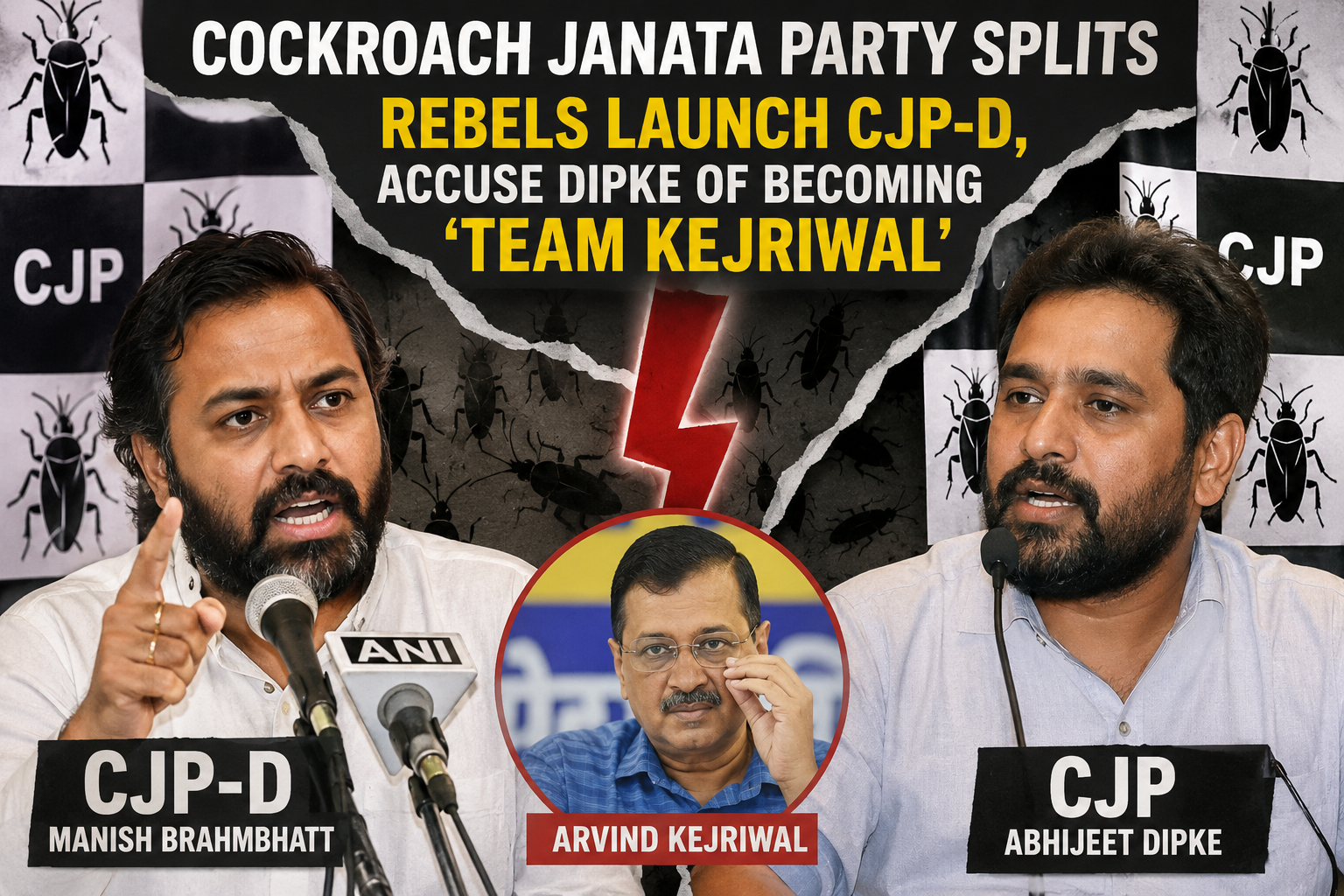
New Delhi, September 3, 2026: The Cockroach Janata Party (CJP), which shot into the national spotlight through its youth-led protest movement, is facing its first major internal rebellion. Former CJP volunteer Manish Brahmbhatt has broken away from the organisation and announced the formation of a new faction called the Cockroach Janata Party-Democratic (CJP-D).
Brahmbhatt has launched a direct political challenge to CJP founder Abhijeet Dipke, accusing the existing leadership of centralising power, sidelining grassroots volunteers and turning what began as a youth movement into a politically driven organisation.
The most serious allegation is that the Dipke-led CJP has allegedly become “Team Kejriwal”, with Brahmbhatt claiming that people with links to the Aam Aadmi Party (AAP) have gained disproportionate influence within the organisation. These are allegations made by the rebel faction and have not been independently established as facts.
Why Did CJP Split?
The immediate trigger appears to be a dispute over the formation of CJP’s national working structure.
According to Brahmbhatt and his supporters, the national team was formed without adequate consultation with the volunteers and activists who had participated in the movement. They allege that people close to Dipke were given preference.
Brahmbhatt argues that the movement originally belonged to ordinary students and citizens, but that its leadership subsequently became increasingly centralised.
He has described the new CJP-D as an attempt to restore transparency, accountability and democratic decision-making within the organisation.
Brahmbhatt’s ‘Team Kejriwal’ Allegation
The sharpest criticism has been directed at Dipke’s alleged political proximity to Arvind Kejriwal and the AAP.
Brahmbhatt claims that the CJP leadership contains several people with previous AAP links and that the organisation’s political activity has increasingly been directed towards opposing the BJP.
He has accused the leadership of transforming a broad-based youth movement into a political platform controlled by a small group.
“The movement was started for the interests of the nation, but after achieving success, it was politicised.”
Brahmbhatt has also questioned why several sections of the volunteer base were not adequately represented in the national leadership. Reports say he specifically raised concerns about the representation of students, women and members of minority communities.
CJP-D Says It Will Follow a Different Model
Brahmbhatt says CJP-D will focus on democratic participation rather than personality-driven politics.
The new faction plans to build its organisation through volunteers and citizens, with major organisational decisions being taken through a transparent process. It has also announced social-media, WhatsApp and missed-call channels to attract supporters.
The stated objective is to fight corruption and raise public issues irrespective of which political party is in power.
Will CJP’s Strength Decline After the Split?
The split could become a significant challenge for CJP, but it is too early to conclude that the organisation has lost its political strength.
CJP’s biggest asset has been its youth and volunteer network. If a substantial number of grassroots activists move towards CJP-D, the original organisation could lose some of the momentum it gained through its protest movement.
There are three major risks for CJP:
1. Loss of grassroots support
If volunteers who were active during the protests identify with Brahmbhatt’s allegations, CJP could face an organisational setback.
2. Damage to its independent image
The “Team Kejriwal” allegation could create the perception that CJP is politically aligned with the AAP. Whether that allegation is ultimately proven or rejected, it could become a major political talking point.
3. Leadership credibility
The dispute over how the national working committee was formed raises questions about internal democracy and the concentration of decision-making within the organisation.
However, CJP still has an important advantage: it is the original organisation associated with the movement, while CJP-D is only now beginning to build its own political and organisational structure.
Who Is Behind the Split?
At present, there is no verified evidence that another political party is directly behind the creation of CJP-D.
The immediate evidence points to an internal leadership dispute between the Dipke-led CJP and a section of activists led by Brahmbhatt.
The AAP connection is at the centre of the allegations, but it is important to distinguish between an allegation and an established fact. Brahmbhatt claims that the CJP leadership has become closely aligned with Kejriwal and the AAP; the available reports do not independently establish that Kejriwal or the AAP orchestrated the split.
The controversy comes amid increased scrutiny of CJP leadership and its political positioning. Recent media reports have also highlighted debates over the previous political associations of some CJP figures.
The Bigger Political Question
The CJP split is significant because it comes at a crucial stage for the organisation.
CJP recently gained national visibility through its student-led agitation and had announced a September 5 protest march in Delhi. The organisation subsequently called off the march following developments concerning cases against protesters and the Supreme Court’s intervention.
The internal split therefore comes at a moment when CJP is attempting to convert protest-movement momentum into a more permanent political organisation.
What Happens Next?
The real test for both factions will be their ability to mobilise volunteers.
If Brahmbhatt succeeds in attracting a significant portion of CJP’s grassroots network, CJP-D could emerge as a serious challenger to Dipke’s leadership.
If CJP retains most of its volunteer base and successfully answers the allegations of political capture and centralisation, the rebellion could remain a limited factional dispute.
For now, the central battle is not simply CJP vs CJP-D. It is a contest over who can claim ownership of the original youth movement — the existing leadership around Abhijeet Dipke or the rebel camp led by Manish Brahmbhatt.
One thing is clear: the first major split has transformed CJP’s internal disagreement into an open political battle, and the next few weeks will determine whether CJP-D becomes a serious alternative or remains a breakaway faction.