New Delhi: The 2016 demonetisation of ₹500 and ₹1,000 currency notes caused a severe disruption to the cash-based financial networks of Maoist groups and other underground organisations, while also delivering a sharp short-term shock to India’s real estate market, according to a former Intelligence Bureau officer and government data released in the aftermath of the currency ban.
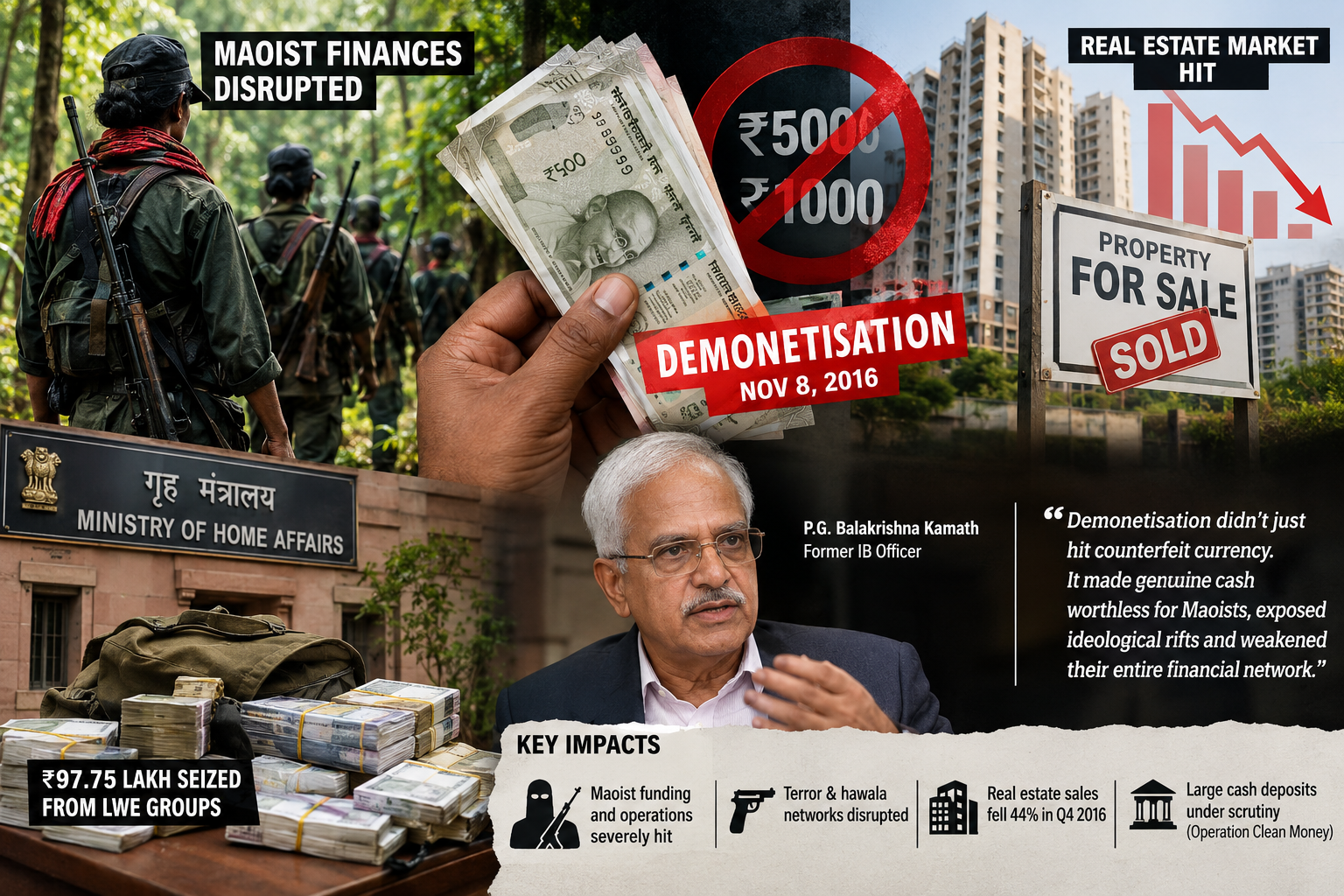
Former IB officer P.G. Balakrishna Kamath, who says he spent nearly five decades in the intelligence establishment, has provided a detailed account of the impact of demonetisation on Maoist finances in an episode of The Prakhar Gupta Xperience (PGX) podcast.
Kamath’s account is particularly significant because he argues that the most damaging aspect of demonetisation for Maoists was not the loss of counterfeit currency, but the sudden invalidation of large stocks of genuine cash accumulated through extortion and illegal levies.
Government records released after the currency ban independently confirm that Left-Wing Extremist (LWE) groups attempted to move demonetised cash through sympathisers and ordinary villagers’ bank accounts and that nearly ₹97.75 lakh was seized from LWE groups.
At the same time, independent real-estate data shows that the cash shortage produced a dramatic contraction in property sales and new project launches in major Indian cities.
Maoist finances depended heavily on cash
According to Kamath, Maoist formations operating in areas including Maharashtra and the Dandakaranya region accumulated substantial amounts of cash through levies imposed on villagers, traders and contractors.
He said the Maoists did not depend exclusively on counterfeit currency. A substantial part of their financial reserves consisted of genuine ₹500 and ₹1,000 notes.
Kamath estimated that an individual Maoist dalam, or armed field unit, could hold between ₹5 lakh and ₹10 lakh in cash.
Such cash holdings were particularly vulnerable to the government’s November 8, 2016 announcement because the old ₹500 and ₹1,000 notes ceased to be legal tender.
For Maoist units operating largely outside the formal banking system, converting large cash reserves into usable money became a major logistical problem.
“The real problem was genuine currency”
The former intelligence officer’s central argument is that the Maoist financial system was hit because its working capital suddenly became unusable.
Rather than merely losing counterfeit money, Maoist units found themselves holding large quantities of genuine currency that they could no longer spend without entering the formal financial system.
This distinction is important because the government itself later said that illegally held cash constituted a major component of terrorist financing and that most cash held by terrorists became worthless after demonetisation.
Maoists tried to use bank accounts of sympathisers
Government records provide strong evidence of the financial disruption described by Kamath.
In a January 2018 parliamentary response, the Ministry of Home Affairs said that LWE cadres deposited illegal money into the accounts of sympathisers or ordinary villagers following demonetisation.
The government also reported that approximately ₹97.75 lakh was seized from various LWE groups after the currency ban.
The Home Ministry said:
“LWE cadres have deposited illegal money into the accounts of the sympathizers or simple villagers.”
The same government response said demonetisation had a significant positive impact in most theatres of violence and that Left-Wing Extremists had protested against the currency ban, which the government interpreted as evidence of their discontent.
The government also said the measure adversely affected hawala operators and immediately rendered Pakistani-printed high-quality fake Indian currency notes obsolete.
A dilemma for Maoist leadership
Kamath’s account goes beyond the government’s published statistics.
He argues that the cash crisis created a political and ideological dilemma for Maoist leaders.
According to him, leaders who needed to convert old currency were forced to approach people whom the Maoist movement traditionally regarded as “class enemies” — including landlords and wealthy businessmen.
For a movement built around opposition to landlords, wealthy traders and other sections of the economic elite, seeking help from such groups created an ideological contradiction.
Kamath says this generated resentment among hardline cadres and contributed to ideological divisions and disillusionment within the movement.
Some cadres, according to his account, eventually left the organisation.
A necessary qualification
The claims concerning ₹5–10 lakh per dalam, approaches to landlords and businessmen, and cadre defections caused specifically by this contradiction are Kamath’s intelligence assessment and field account.
Those specific details have not been independently quantified in the public Home Ministry data cited in this report.
The government evidence does, however, independently establish that LWE groups attempted to use other people’s bank accounts to deal with demonetised cash.
Financial pressure affected Maoist operations
Kamath further argues that the loss of usable cash affected the operational capacity of Maoist formations.
Cash was required for:
- purchasing weapons and ammunition;
- paying informants and couriers;
- transporting cadres;
- obtaining food and other supplies;
- maintaining safe houses;
- financing local networks; and
- paying levies and organisational expenses.
A sudden shortage of liquid funds therefore had implications beyond accounting.
It affected the organisation’s ability to maintain its underground infrastructure.
Government data from the period shows that LWE activity declined after demonetisation, although it would be incorrect to attribute the entire decline to the currency ban.
The number of LWE incidents fell from 1,078 between November 1, 2015 and October 31, 2016 to 857 during the corresponding period in 2016–17.
The government also reported 564 surrenders of LWE cadres and sympathisers between November 8 and November 29, 2016.
The decline, however, also reflected counter-insurgency operations, intelligence activity, surrenders and other government measures.
Terror financing and hawala networks also came under pressure
The impact of demonetisation extended beyond Maoist groups.
The Home Ministry said illegally held cash formed a major part of terrorist financing and that much of the cash held by terrorist organisations became worthless after the withdrawal of the old notes.
It also said demonetisation had an adverse impact on hawala operators, whose underground money-transfer networks depended heavily on physical cash.
The government further said the move immediately extinguished high-quality counterfeit Indian currency printed in Pakistan.
The Finance Ministry later reported that 157,818 Fake Indian Currency Notes with a face value of about ₹112.4 crore were reported by police authorities between November 9, 2016 and July 14, 2017.
The figure demonstrates that counterfeit currency continued to be detected after demonetisation; however, the old ₹500 and ₹1,000 counterfeit notes themselves had lost their legal-tender value.
Kashmir: financial disruption but not the end of militancy
The government also reported a decline in some forms of unrest in Jammu and Kashmir following demonetisation.
Stone-pelting incidents fell from 2,653 in 2016 to 1,412 in 2017, a decline of approximately 47 per cent.
However, the broader terrorism figures show why demonetisation should not be described as the sole cause of the decline in militancy.
Terrorist incidents were reported at 322 in 2016 and 342 in 2017, before falling to 256 during the first part of 2018.
The evidence therefore supports a more cautious conclusion: demonetisation disrupted the cash component of underground financing, but it did not eliminate terrorism or separatist activity.
Real Estate: the other major casualty of the cash ban
While Maoist and terrorist networks faced a liquidity crisis, one of the most visible economic effects of demonetisation appeared in India’s real estate sector.
Real estate had long been regarded as a major destination for unaccounted wealth.
The government’s Economic Survey 2016–17 said demonetisation caused property prices to decline because wealth fell and cash shortages impeded transactions.
The Survey also noted that investing undeclared income in real estate could become more difficult as financial transactions became increasingly formalised.
The Survey specifically identified real estate as one of the cash-intensive sectors most affected by demonetisation.
Property sales plunged 44 per cent
The impact was quantified by Knight Frank.
In the fourth quarter of 2016, residential sales across the eight major cities monitored by the consultancy fell 44 per cent year-on-year.
New launches fell an even sharper 61 per cent.
Only 40,940 residential units were sold during the quarter, the lowest quarterly sales volume since 2010, according to Knight Frank.
The eight cities covered were:
- Mumbai
- Delhi-NCR
- Bengaluru
- Pune
- Chennai
- Hyderabad
- Kolkata
- Ahmedabad
Knight Frank estimated that the fall in sales represented a notional revenue loss of more than ₹22,600 crore for the residential real estate industry across these cities.
The consultancy also estimated a notional ₹1,200-crore loss in stamp-duty revenue for governments.
It is important to clarify that these were estimated/notional losses, not direct cash losses suffered by developers or governments.
Developers postponed launches
The shock was particularly severe for new housing supply.
Knight Frank reported that new launches fell 61 per cent in the fourth quarter of 2016.
In Delhi-NCR, demand declined by about 29 per cent while supply fell approximately 73 per cent.
In the Mumbai Metropolitan Region, launches declined 53 per cent and sales fell 26 per cent.
Even Bengaluru, considered one of India’s more resilient residential markets, recorded a 17 per cent decline in new launches and a 7 per cent decline in sales during the quarter.
Knight Frank’s assessment was blunt: the sudden currency withdrawal pulled the property market into a near standstill.
Why real estate was particularly vulnerable
The Economic Survey offered a structural explanation.
Property is a high-value asset, and transactions — especially in some secondary and luxury segments — could involve substantial cash components.
When high-denomination notes were suddenly withdrawn, buyers dependent on cash could no longer complete transactions in the same way.
The result was a combination of:
cash shortage → fewer buyers → delayed transactions → lower demand → pressure on property prices.
The Economic Survey said:
“Prices declined, as wealth fell while cash shortages impeded transactions.”
It also suggested that making it harder to invest undeclared income in property could have a longer-term effect on real estate prices and tax compliance.
The cash economy and “black money”
The Economic Survey made an important distinction between cash and black money.
Not all cash is illegal or undeclared.
Cash can represent legitimate savings, business working capital or household emergency funds.
However, cash can also represent income deliberately kept outside the tax system.
The Survey argued that demonetisation effectively imposed a shock on people holding large quantities of undeclared cash and could encourage greater formalisation.
This distinction is critical when assessing the claim that demonetisation “destroyed black money.”
It did not automatically destroy all unaccounted wealth.
Instead, it forced much of the cash component into the banking system, where it became potentially traceable.
Operation Clean Money: following the cash trail
The government’s next major step was Operation Clean Money, launched by the Income Tax Department on January 31, 2017.
The objective was to identify taxpayers whose cash deposits following demonetisation appeared inconsistent with their tax profiles.
During the first phase:
- around 18 lakh people were identified;
- more than 9.72 lakh taxpayers submitted online responses;
- responses covered 13.33 lakh bank accounts;
- the accounts involved cash deposits of approximately ₹2.89 lakh crore.
The Income Tax Department subsequently used data analytics to identify additional cases and high-risk clusters.
This represented an important shift in the fight against unaccounted wealth.
Instead of trying only to locate physical cash, authorities could now examine the financial trail created when that cash entered the banking system.
Tax investigations intensified
The Income Tax Department also reported a substantial increase in searches and surveys following demonetisation.
Government figures cited in 2017 showed:
- searches in 102 groups during the first part of the 2017–18 financial year;
- assets worth about ₹103 crore seized;
- undisclosed income of approximately ₹2,670 crore admitted by persons searched;
- surveys that detected another ₹150 crore in undisclosed income.
The government subsequently reported that Operation Clean Money had identified millions of transactions requiring verification.
Did demonetisation destroy the real estate black economy?
The evidence does not support such a sweeping conclusion.
Demonetisation clearly caused a major short-term disruption to cash-intensive property transactions.
It reduced the ability of buyers to use unaccounted cash and forced large amounts of money into formal financial channels.
But the underlying incentives for property-related tax evasion did not disappear.
The Economic Survey itself cautioned that the permanence of the impact on the housing market remained uncertain.
The distinction is important:
Demonetisation disrupted the cash mechanism; it did not eliminate every form of tax evasion or undeclared wealth.
The longer-term formalisation effect
One of the government’s arguments in favour of demonetisation was that it would accelerate the formalisation of the economy.
The Economic Survey recorded an increase in the number of new individual taxpayers.
The number of new individual taxpayers based on returns filed rose from 63.5 lakh in 2015–16 to 80.7 lakh in 2016–17. The Survey estimated that approximately 5.4 lakh additional taxpayers could be associated with growth above the previous year’s trend during the relevant period.
The government later cited further increases in tax-return filings after demonetisation.
However, these changes cannot be attributed exclusively to demonetisation because other tax reforms and enforcement measures were introduced around the same period.
Maoist economy and real estate economy: a common vulnerability
At first glance, Maoist financing and India’s real estate sector appear unrelated.
But demonetisation exposed a common vulnerability:
dependence on high-value cash.
For Maoist groups:
extortion/levy → cash accumulation → underground storage → sudden currency invalidation → liquidity crisis.
For cash-heavy property transactions:
unaccounted income → cash component → property purchase → demonetisation → cash shortage → delayed/cancelled transactions.
In both cases, the immediate impact came from the same source: the sudden removal of high-denomination currency from circulation.
What the evidence establishes — and what it does not
The available evidence supports several conclusions.
Strongly supported
Maoist/LWE financial networks were disrupted.
The Home Ministry documented the seizure of nearly ₹97.75 lakh from LWE groups and attempts by cadres to deposit illegal money through sympathisers and ordinary villagers.
Terrorist and hawala cash networks were affected.
The government explicitly stated that much terrorist-held cash became worthless and that hawala operators were adversely affected.
Real estate suffered a severe immediate shock.
Knight Frank recorded a 44 per cent fall in residential sales and a 61 per cent fall in new launches in the top eight cities in Q4 2016.
Large cash deposits became visible to tax authorities.
Operation Clean Money identified about 18 lakh persons for verification, involving 13.33 lakh accounts and approximately ₹2.89 lakh crore in cash deposits.
Claims that require caution
There is insufficient public evidence to independently quantify:
- the total amount of cash held by Maoist dalams;
- the precise ₹5–10 lakh average per dalam cited by Kamath;
- the number of Maoist leaders who approached landlords or wealthy businessmen;
- the exact number of cadres who left the movement specifically because of the demonetisation-related ideological contradiction.
These should therefore be attributed directly to Kamath’s intelligence assessment, rather than presented as established government statistics.
Conclusion
The evidence suggests that demonetisation was a powerful short-term financial shock to several parts of India’s underground cash economy.
For Maoist organisations, the withdrawal of ₹500 and ₹1,000 notes disrupted the cash accumulated through extortion and illegal levies. Government records confirm attempts by LWE cadres to move the old currency through sympathisers and villagers’ bank accounts and document seizures of nearly ₹97.75 lakh.
For terrorist and hawala networks, the government reported a similar disruption, including the immediate invalidation of old counterfeit currency.
For real estate, the consequences were visible in market data: residential sales in the eight major cities fell 44 per cent and new launches 61 per cent in the fourth quarter of 2016.
The longer-term significance of demonetisation, however, may have been less about physically destroying every rupee of black money and more about forcing cash into the formal financial system and creating a data trail.
Operation Clean Money subsequently gave tax authorities access to information on millions of potentially suspicious accounts and deposits.
The most defensible conclusion, therefore, is not that demonetisation single-handedly destroyed Maoism, terrorism or the real-estate black economy.
Rather, it severely disrupted cash-dependent underground networks, weakened the liquidity of extremist organisations, temporarily depressed property markets and expanded the government’s ability to trace previously opaque financial flows.
Kamath’s account adds a significant intelligence perspective to that picture, particularly his contention that the loss of cash did not merely create a financial crisis for Maoist groups but also exposed ideological contradictions within their leadership.
Sources
- Ministry of Home Affairs, Government of India — Sources of Funding of Naxalism and Terrorism (January 3, 2018): LWE cash seizures, use of sympathisers’ accounts, impact on terrorist cash and hawala.
- Ministry of Home Affairs, Government of India — Curtailing Money Supply to Anti-India Activists: LWE cash seizures and post-demonetisation financial disruption.
- Ministry of Finance / Income Tax Department — Operation Clean Money: 18 lakh identified persons, 13.33 lakh accounts and ₹2.89 lakh crore in deposits subject to verification.
- Economic Survey of India 2016–17: demonetisation’s impact on real estate, black money, cash-intensive sectors, tax compliance and formalisation.
- Knight Frank India — Demonetisation Impact on India Real Estate: 44% fall in Q4 residential sales, 61% fall in new launches and estimated ₹22,600-crore notional revenue loss across eight major cities.
- Prakhar Gupta Xperience — P.G. Balakrishna Kamath interview: primary source for Kamath’s account of Maoist finances and the alleged internal ideological impact of demonetisation.