Cairo, Egypt:
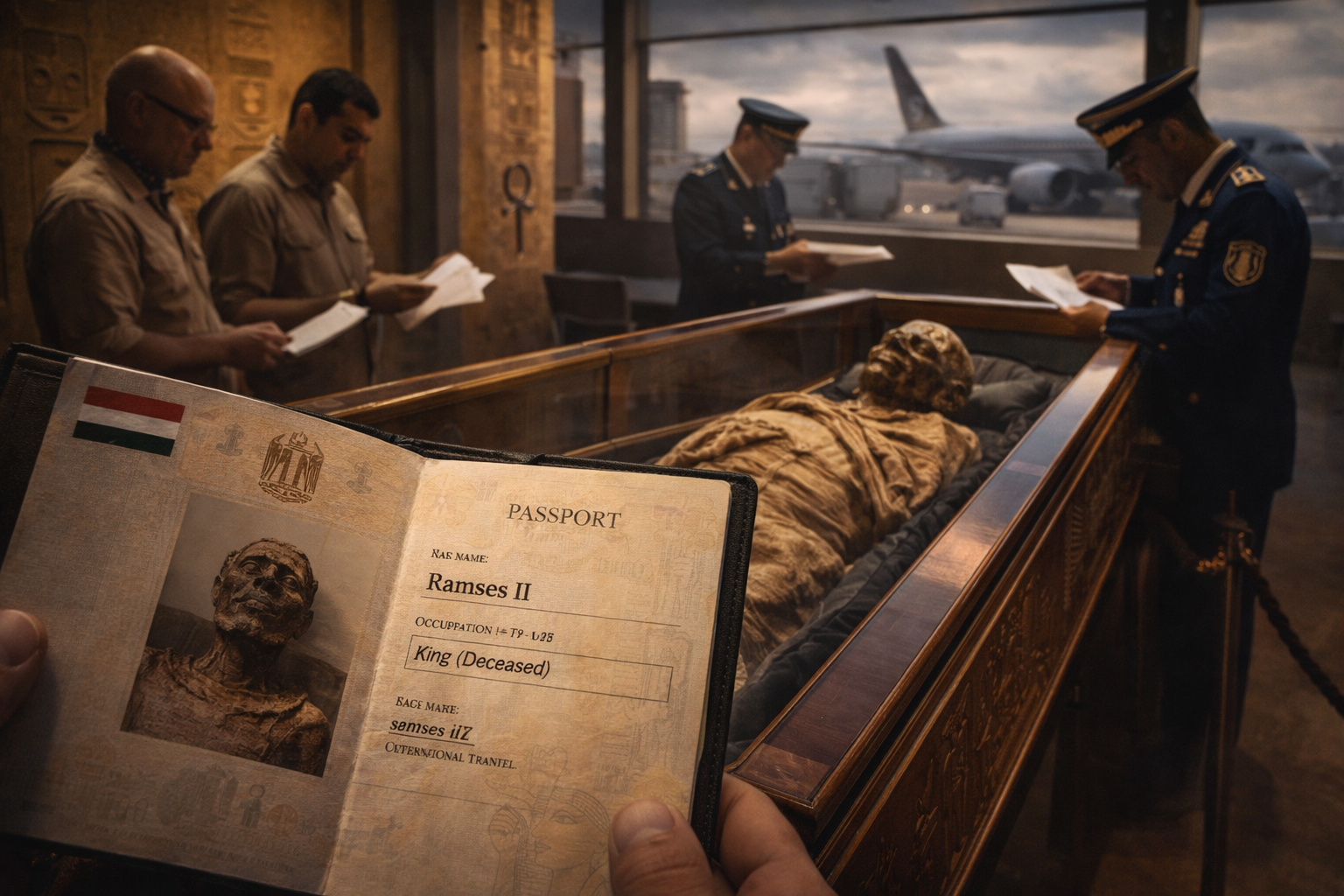
In one of the most extraordinary episodes in modern history, the mummified remains of the ancient Egyptian pharaoh Ramses II—who died over 3,000 years ago—were issued an official Egyptian passport in 1974. The unprecedented move allowed the royal mummy to travel legally to France for urgent scientific examination and preservation.
Who Was Ramses II?
Ramses II, also known as Ramses the Great, ruled Egypt from 1279 BCE to 1213 BCE during the 19th Dynasty. He is widely regarded as one of Egypt’s most powerful and celebrated pharaohs, known for his military campaigns, monumental architecture, and long reign.
His mummy has been preserved for centuries and is currently housed in the National museum of Egyptian civilization , after previously being kept at the Egyptian Museum in Cairo.
Discovery of Fungal Deterioration
During the early 1970s, scientists observed signs of fungal infection on the mummy, posing a serious threat to its preservation. To prevent irreversible damage, Egyptian authorities decided to send the remains to France for specialized conservation treatment.
French physician and researcher Maurice Bucaille played a key role in examining the mummy. The conservation and scientific studies were conducted at institutions in Paris, where experts used advanced techniques to halt the deterioration and study the pharaoh’s health and cause of death.
According to historical records, the research revealed that Ramses II likely died from complications related to arthritis and dental infections, rather than violent causes.
The Passport for a Mummy
To comply with international travel regulations, the Egyptian government issued an official passport in 1974 in the name of Ramses II. Remarkably, the passport listed his occupation as:
“King (Deceased)”
This made Ramses II the first known mummy in history to receive a passport, ensuring legal and secure transportation while affirming his royal status.
An official from the Egyptian Antiquities Organization reportedly stated:
“Ramses II is still considered a sovereign figure of Egypt’s heritage, and all formalities were observed to ensure his safe journey.”
Royal Reception in France
Upon arrival at Le Bourget Airport , the mummy was welcomed with full military honors, a gesture traditionally reserved for visiting heads of state. French authorities treated the pharaoh with the respect accorded to a foreign monarch.
A French cultural official was quoted as saying:
“France welcomed Ramses II with the honors due to a king, acknowledging his immense historical and cultural significance.”
Scientific Findings
The examinations conducted in Paris provided valuable insights into the life and health of the ancient ruler. Researchers identified:
- Severe dental abscesses
- Arthritis affecting mobility in his later years
- Evidence suggesting natural causes of death rather than assassination or warfare
The conservation efforts successfully eliminated the fungal threat, ensuring the mummy’s long-term preservation.
Return to Egypt
After the completion of the restoration and research, Ramses II’s mummy was safely returned to Egypt, where it continues to be preserved under controlled conditions. Today, it remains one of the most visited and studied relics of ancient Egyptian civilization.
Sources
- National geographic– Coverage on the scientific examination of Ramses II’s mummy.
- Smithsonian Magazine– Historical accounts of the passport issued to the pharaoh.
- BBC– Reports on the mummy’s journey to France and the honors received.
- Egyptian Ministry of Tourism And Antiquities– Official information on Ramses II and the preservation of Egyptian mummies.
Summary
| Aspect | Details |
|---|---|
| Pharaoh | Ramses II |
| Reign | 1279–1213 BCE |
| Year of Passport | 1974 |
| Occupation Listed | “King (Deceased)” |
| Destination | Paris, France |
| Purpose | Scientific study and conservation |
| Reception | Full military honors |
| Current Location | National Museum of Egyptian Civilization, Cairo |
Notable Quotes
“King (Deceased)” – Entry listed under occupation in Ramses II’s passport.
“France welcomed Ramses II with the honors due to a king.” – French cultural authorities.
“The conservation efforts ensured the survival of one of Egypt’s most valuable historical treasures.” – Statement attributed to Egyptian antiquities officials.
Conclusion
The issuance of a passport to Ramses II stands as one of the most fascinating intersections of ancient history and modern bureaucracy. It highlights the immense respect afforded to cultural heritage and underscores international cooperation in preserving humanity’s shared past.