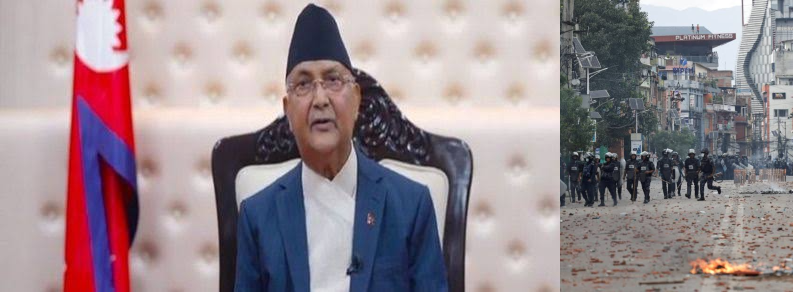
The resignation of Prime Minister KP Sharma Oli, prompted by a youth-led protest movement, has ignited a debate about whether Nepal’s political upheaval follows a pattern seen in other South Asian nations, particularly the “Bangladesh model.” The term refers to a recent political crisis where student-led protests, fueled by a specific grievance but tapping into deeper public frustration, ultimately brought down a long-standing government.
The parallels between the recent events in Nepal and the 2024 uprising in Bangladesh are striking.
- Student-Led Protests: In both countries, “Gen Z” youth were at the forefront of the protests. In Bangladesh, students initially mobilized against a controversial government job quota system, while in Nepal, the initial spark was a government ban on social media. In both cases, these specific issues became a catalyst for broader anger against corruption, nepotism, and a lack of opportunities.
- Deep-seated Grievances: The protests in both nations were not simply about a single policy. They were an expression of years of pent-up frustration. In Bangladesh, public discontent had been simmering over what was widely seen as an increasingly authoritarian government and a political system riddled with corruption. In Nepal, similar sentiments were at play, with protesters demanding an end to systemic corruption and political instability.
- Communication as a Trigger: The role of social media was critical. While the governments of both Bangladesh and Nepal attempted to curb dissent by imposing internet and social media restrictions, these measures backfired. Instead of quelling the unrest, they fueled public outrage and served as a powerful symbol of the governments’ repressive and authoritarian tendencies.
- Brutal Crackdown and Escalation: In both instances, the government’s heavy-handed response to the protests, which included the use of live ammunition and mass arrests, led to a high number of casualties. This violence further enraged the public and galvanized the movement, turning a protest into a full-blown regime-shaking crisis.While the “Bangladesh model” describes an internal, organic uprising driven by the people, some analysts in India and elsewhere have raised questions about external influence. Sanjeev Sanyal, a member of the Prime Minister of India’s Economic Advisory Council, has suggested that a “suspiciously similar toolkit” is being used in these South Asian protests, hinting at a possible external hand.
However, the dominant view remains that while geopolitical rivalries may be a factor in the background, the primary drivers of these crises are homegrown. The collapse of the Oli government, much like the fall of the government in Bangladesh, is seen as a powerful example of a new, digitally connected generation of citizens who are no longer willing to tolerate the same old political order.