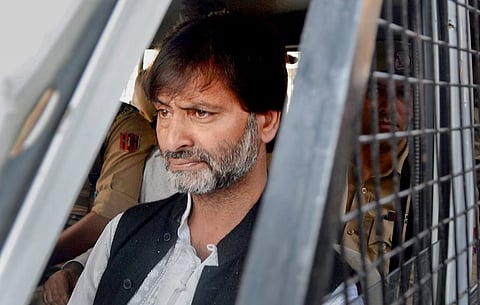
New Delhi: In a sensational affidavit submitted to the Delhi High Court, Kashmiri separatist leader Yasin Malik has claimed that six successive central governments, from V.P. Singh to Manmohan Singh, had a “working relationship” with him and sought his assistance in resolving the Kashmir issue. The claims were made in a written submission as part of Malik’s response to the National Investigation Agency’s (NIA) plea to enhance his life sentence to the death penalty.
Malik, who is the chairman of the banned Jammu and Kashmir Liberation Front (JKLF), asserted that he was “actively roped in time and again” by various governments and was persuaded to speak on international platforms. He stated that in 1994, he unilaterally declared a ceasefire and adopted peaceful means, and in return, successive Indian governments kept their “promise” by not pursuing stringent cases against him. He claimed that this arrangement even continued under Prime Minister Narendra Modi’s first term until 2019.
Among the specific claims, Malik alleges that in 2006, he was invited for a formal dialogue with then-Prime Minister Manmohan Singh. He also claimed that the Intelligence Bureau (IB) arranged his controversial meeting with Lashkar-e-Taiba founder Hafiz Saeed in Pakistan in 2006 as part of a back-channel peace process. According to Malik, upon his return, he briefed Manmohan Singh and then National Security Advisor M.K. Narayanan, who expressed their gratitude for his efforts.
Malik also mentioned engaging with leaders of the Rashtriya Swayamsevak Sangh (RSS) and meeting with two Shankaracharyas at his residence in Srinagar.
Previous History:
1987: Malik entered the political scene during the controversial state assembly elections.
1990: He led the JKLF, an armed militant group, in the Kashmir Valley. He was also allegedly involved in the killing of four Indian Air Force (IAF) officers in Srinagar and the kidnapping of Rubaiya Sayeed, the daughter of then Union Home Minister Mufti Mohammad Sayeed.
1994: Malik renounced violence and adopted a “Gandhian” approach to the Kashmir issue, and his group declared a ceasefire.
2017: He was arrested in a terror funding case filed by the NIA. The agency accused him of conspiring with Pakistan-based groups to fuel unrest in Kashmir.
2022: Malik pleaded guilty to charges under the Unlawful Activities (Prevention) Act (UAPA), including terror funding and criminal conspiracy. A trial court sentenced him to life imprisonment, stating that his case did not fall into the “rarest of rare” category for a death sentence.
The BJP has responded to Malik’s claims by citing them as proof of the previous Congress-led government’s “soft corner” for Pakistan. However, none of the leaders or organizations mentioned by Malik have officially acknowledged or responded to his claims. The Delhi High Court is currently hearing the NIA’s appeal for the death penalty.