Background
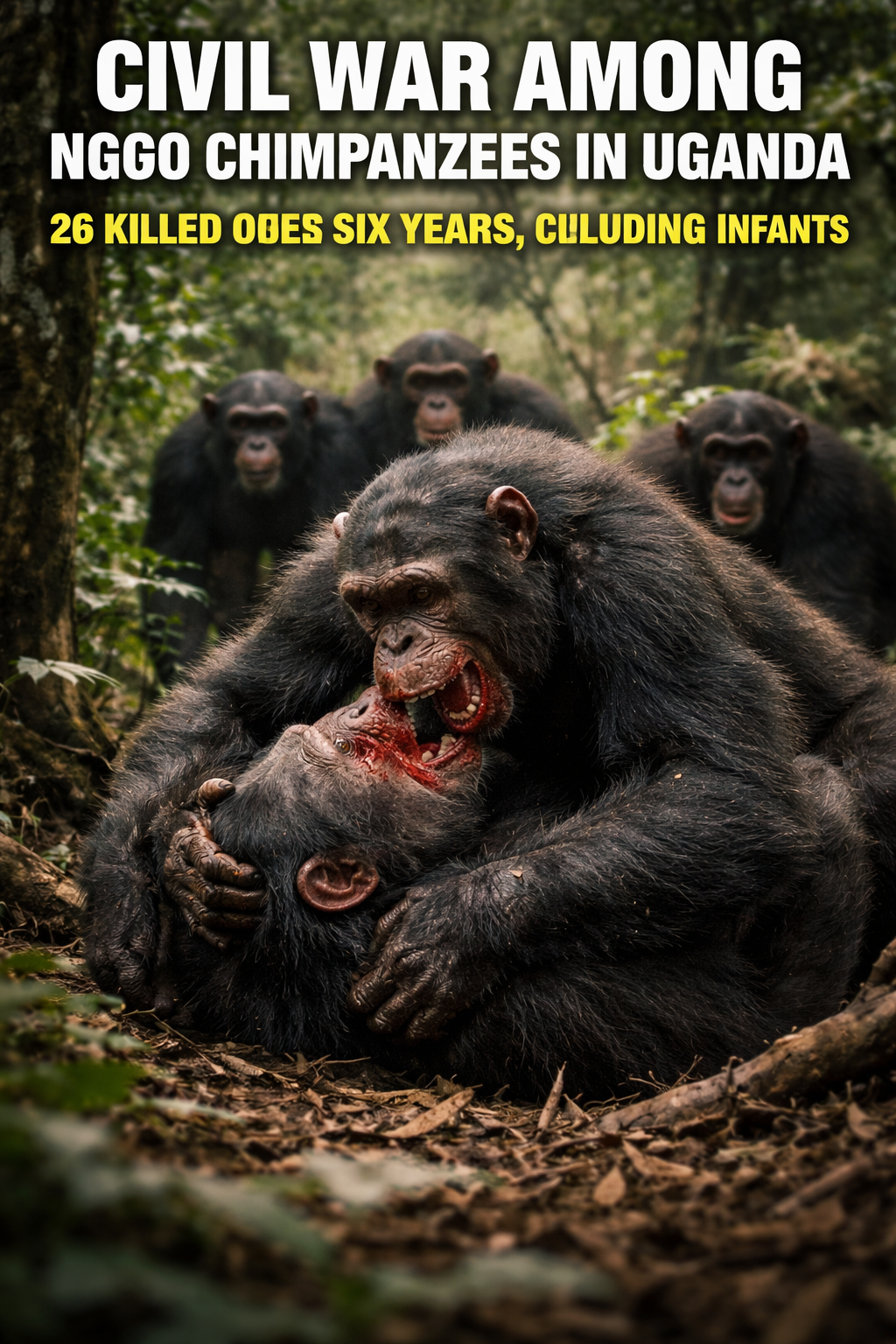
Kibale National Park in western Uganda is home to one of the largest populations of wild chimpanzees in the world. Within this forest lies the Ngogo chimpanzee community, a once-unified group numbering more than 200 individuals. Since around 2015, the community has undergone a dramatic social split that escalated into a prolonged and deadly conflict between rival factions.
The Outbreak of Conflict
Researchers observed that the deaths of key adult males, increasing competition for food and territory, and shifts in social leadership contributed to tensions within the group. These pressures eventually led to the community dividing into two factions: the Central group and the Western group.
According to The Guardian, “A once unified group turned on itself.” This internal fragmentation is considered highly unusual, as chimpanzee violence is more commonly directed toward neighboring communities rather than former members of the same group.
Casualties and Nature of the Attacks
At least 28 chimpanzees have been killed over a six-year period. The victims included adult males as well as infants. Attacks were often coordinated and strategic, typically targeting isolated individuals. Researchers suggest that the killing of infants may be linked to territorial dominance and reproductive competition.
Live Science reported, “The attacks were coordinated and sustained, resembling a form of civil war among chimpanzees.” Similarly, The Wall Street Journal noted, “They will do this even when those neighbors are former friends.”
These observations highlight the complex and sometimes violent social dynamics within chimpanzee societies.
Scientific Significance
The Ngogo conflict offers valuable insights into the evolutionary roots of human warfare and social behavior. While intergroup aggression among chimpanzees has been documented before, sustained violence within a formerly unified community is rare and scientifically significant.
This event has drawn comparisons with the Gombe Chimpanzee War of the 1970s in Tanzania, making the Ngogo conflict one of the most notable cases of chimpanzee social warfare ever recorded.
Timeline of Key Events
Year – Major Developments
2015 – Initial signs of social tension within the Ngogo community
2016–2017 – Increasing factionalism and territorial disputes
2018 – Formal split into Central and Western groups
2019–2024 – Series of coordinated and lethal attacks
2025–2026 – Death toll reported to have reached 28
About Chimpanzees
Scientific Classification
Kingdom: Animalia
Phylum: Chordata
Class: Mammalia
Order: Primates
Family: Hominidae
Genus: Pan
Species: Pan troglodytes (Common Chimpanzee)
Other Species: Pan paniscus (Bonobo)
Distribution and Habitat
Chimpanzees are distributed across Central and West Africa, including Uganda, Tanzania, the Democratic Republic of the Congo, Cameroon, Gabon, Nigeria, Sierra Leone, and Guinea. Their habitats include tropical rainforests, woodland savannas, and forest–savanna mosaics. Bonobos are found only south of the Congo River in the Democratic Republic of the Congo.
Physical Characteristics
Chimpanzees typically stand between 1 and 1.7 meters tall and weigh between 32 and 60 kilograms. They have a lifespan of approximately 33 to 50 years in the wild and share about 98 to 99 percent of their DNA with humans. Their primary mode of movement is knuckle-walking.
Intelligence and Social Behavior
Chimpanzees are among the most intelligent non-human animals. They use tools, maintain complex social relationships, communicate through vocalizations and facial expressions, and engage in cooperative hunting. Their societies follow a fission–fusion structure, where subgroups frequently split and reunite. Territorial defense and occasional infanticide are also observed.
Diet
Chimpanzees are omnivores. Their diet mainly consists of fruits, along with leaves, seeds, honey, insects, and small mammals such as colobus monkeys.
Threats and Conservation Status
Both the common chimpanzee and the bonobo are classified as Endangered on the IUCN Red List. Major threats include deforestation and habitat loss, illegal hunting for the bushmeat trade, infectious diseases such as Ebola, mining activities, human encroachment, and illegal wildlife trade.
Role of the World Wide Fund for Nature (WWF)
The World Wide Fund for Nature plays a significant role in chimpanzee conservation. Its key initiatives include habitat protection, expansion of protected areas, creation of wildlife corridors, community engagement, support for anti-poaching patrols, research and monitoring, and environmental education. WWF aims to increase chimpanzee populations, protect critical habitats, reduce human–wildlife conflict, and preserve global biodiversity.
Scientific Research Sources
Wilson, M. L., and Wrangham, R. W. (2003). Intergroup relations in chimpanzees. Annual Review of Anthropology, 32, 363–392.
Mitani, J. C., Watts, D. P., and Amsler, S. J. (2010). Lethal intergroup aggression leads to territorial expansion in wild chimpanzees. Current Biology, 20(12), R507–R508.
Watts, D. P., Muller, M. N., and Mitani, J. C. (2006). Lethal intergroup aggression by chimpanzees in the Kibale National Park, Uganda. American Journal of Primatology, 68, 161–180.
Mitani, J. C., and Watts, D. P. (2005). Correlates of territorial boundary patrol behaviour in wild chimpanzees. Animal Behaviour, 70, 1079–1086.
Ngogo Chimpanzee Project – Long-term research initiative on chimpanzee behavior and ecology in Kibale National Park.
Summary
Location: Kibale National Park, Uganda
Community: Ngogo chimpanzees
Conflict: Split into Central and Western factions
Death Toll: 28 individuals, including infants
Species: Pan troglodytes
Conservation Status: Endangered
Conservation Organization: World Wide Fund for Nature (WWF)
Conclusion
The deadly conflict within the Ngogo chimpanzee community provides a rare and compelling window into the evolutionary roots of social conflict and cooperation. While chimpanzees share remarkable similarities with humans in intelligence and social organization, their survival is increasingly threatened by human activities. Conservation efforts led by organizations such as the World Wide Fund for Nature are essential to ensuring the long-term future of these remarkable primates.