1. Sunni vs. Shia Views on Temporary Marriage
Shia Perspective
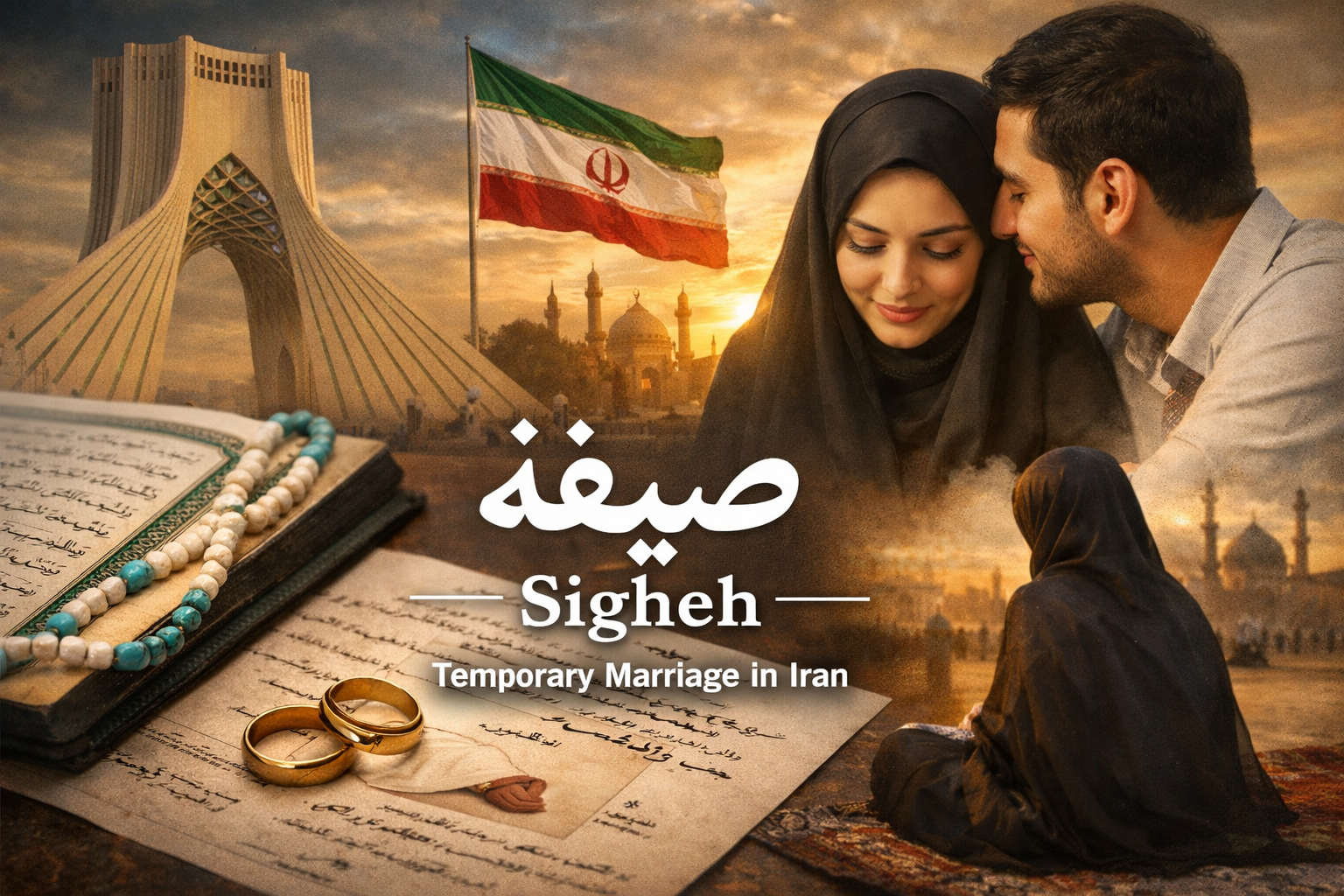
- Terminology: Known as Nikah Mut’ah or Sigheh in Iran.
- Legality: Considered religiously permissible within Twelver Shia Islam.
- Scriptural Basis: Shia scholars cite Qur’an 4:24 as justification.
- Key Features:
- Fixed duration (from hours to years).
- Mandatory mahr (dower).
- Automatically dissolves after the specified period.
- No requirement for divorce.
- Limited inheritance and maintenance rights unless specified in the contract.
- Geographical Presence: Practiced mainly in Iran, parts of Iraq, and among Shia communities worldwide.
Sunni Perspective
- Prohibition: Sunni Islam generally considers Mut’ah forbidden (haram).
- Historical Reasoning:
- Initially permitted during early Islamic periods, particularly in wartime.
- Later prohibited by Prophet Muhammad, according to Sunni hadith traditions.
- Alternative: Sunni jurisprudence recognizes only permanent marriage (Nikah).
- Scholarly Consensus: The four major Sunni schools (Hanafi, Maliki, Shafi’i, Hanbali) reject temporary marriage.
Summary Table
| Aspect | Shia Islam | Sunni Islam |
|---|---|---|
| Legality | Permitted | Prohibited |
| Duration | Fixed | Permanent only |
| Divorce Needed | No | Yes |
| Inheritance | Usually not | Yes |
| Maintenance | Limited | Mandatory |
| Regions | Iran, Iraq | Most Muslim-majority countries |
2. Legal Status of Temporary Marriage in India
Recognition Under Indian Law
India’s legal system recognizes personal laws for different religious communities:
- Shia Muslim Personal Law:
- Courts in India have acknowledged the validity of Mut’ah marriages among Shia Muslims.
- Children born from such unions are considered legitimate.
- Sunni Muslim Personal Law:
- Mut’ah marriages are not recognized and are considered void.
Important Judicial References
- Luddun Khan v. Saeedunnisa (1888, Allahabad High Court)
- Recognized the legitimacy of children born from a Mut’ah marriage.
- Sarabai v. Rabiabai (1905, Bombay High Court)
- Affirmed the validity of Mut’ah marriage under Shia law.
- Mohammed Abdul Kadir v. Salima (1886)
- Though primarily about Muslim marriage, it clarified contractual aspects of Islamic marriages, influencing later interpretations.
⚖️ Legal Characteristics in India
| Feature | Status |
|---|---|
| Validity (Shia) | ✔️ Recognized |
| Validity (Sunni) | ❌ Not recognized |
| Legitimacy of Children | ✔️ Recognized |
| Inheritance Rights | ✔️ From father |
| Maintenance for Woman | Limited |
| Registration | Not mandatory |
3. Real-Life Social Implications in Iran
Women’s Perspectives
Supportive Views:
- Provides a lawful framework for relationships.
- Offers financial security through mahr.
- Seen as a solution for widows and divorcees.
- Helps individuals who cannot afford permanent marriage.
Critical Views:
- Often associated with social stigma.
- May expose women to economic exploitation.
- Limited legal protections compared to permanent marriage.
- Sometimes used to circumvent restrictions on premarital relationships.
Impact on Children
- Children born from Sigheh marriages are legally legitimate in Iran.
- They have rights to identity and inheritance from the father.
- Social stigma can still affect their upbringing.
Societal Context in Iran
- Urban vs. Rural Divide: More discreetly practiced in urban areas.
- Clerical Involvement: Religious authorities may oversee contracts.
- Digital Platforms: In recent years, online services have facilitated arrangements, sparking ethical debates.
4. Historical Evolution of Sigheh in Iran
Early Islamic Period (7th Century)
- Temporary marriage was practiced during the time of the Prophet Muhammad.
- Shia scholars maintain that it was never permanently abrogated.
Safavid Era (1501–1736)
- Establishment of Twelver Shia Islam as Iran’s state religion led to institutional acceptance of Sigheh.
Post-1979 Islamic Revolution
- The Iranian government formally incorporated Sigheh into its legal and social framework.
- Policies were introduced to regulate and sometimes encourage the practice as a means of addressing social issues.
5. Contemporary Debates and Human Rights Concerns
Arguments in Favor
- Prevents illicit relationships.
- Offers flexibility in marital arrangements.
- Provides legal recognition to children.
- Aligns with Shia religious doctrine.
Criticisms
- Described by critics as “legalized prostitution.”
- Potential for gender inequality.
- Risk of exploitation of economically vulnerable women.
- Concerns about early or coerced marriages.
International Human Rights Perspective
Organizations such as and have highlighted broader concerns regarding women’s rights and legal protections in Iran, within which the practice of Sigheh is often discussed.
Conclusion
Sigheh (Temporary Marriage) is a complex institution that sits at the intersection of religion, law, and social norms. While it holds religious legitimacy within Shia Islam and legal recognition in Iran, it remains controversial due to ethical, gender, and human rights concerns.
Key Takeaways
- ✔️ Permitted in Shia Islam, prohibited in Sunni Islam.
- ✔️ Legally recognized in Iran and among Shia Muslims in India.
- ✔️ Children are legitimate with inheritance rights.
- Social stigma and potential for misuse remain significant concerns.
- Continues to be a subject of global debate balancing religious freedom and human rights.