C Mahesh
Cao Viejo Pyramid, El Brujo, Peru — In 2006, deep within the sun-baked adobe walls of the El Brujo archaeological complex, scientists uncovered a secret that would rewrite the history of ancient Peru: the mummified remains of a woman who wielded extraordinary power in Moche civilization, nearly 1,500 years ago. She is now celebrated worldwide as the “Lady of Cao.”
The discovery stunned the archaeological world. Until then, scholars believed that formal political and religious leadership in the Moche world was dominated by men. But the funerary bundle of this young woman — preserved with precious metals, ritual weapons, and sacred regalia — told an entirely different story.
A Burial Fit for a Ruler
The Lady of Cao was found inside a massive funerary bundle made of dozens of textile layers. When conservators painstakingly unwrapped it, they found a set of objects that spoke unmistakably of power:
- Gold and silver ornaments of master craftsmanship
- A ceremonial headdress, used only by elite leaders
- Two war clubs, symbols of martial authority
- Ritual staffs of rulership
- Necklaces made of shells, gemstones, and gold
- A delicately preserved, elaborately tattooed body
According to Dr. Regulo Franco, the chief archaeologist who led the El Brujo excavations:
“No ordinary noblewoman would ever be buried this way. The presence of war clubs and the royal diadem shows she held political authority — and religious power — equal to the greatest Moche rulers.”
The funerary bundle was so large and complex that it took nearly a year of laboratory conservation to reach the mummy at its center.
Tattooed with Power: A Priestess, a Shaman, or a Ruler?
The Lady of Cao’s skin — astonishingly well preserved due to the region’s dry climate — revealed intricate tattoos of serpents, falcons, and geometric symbols that covered her arms, hands, and even her fingers.
These designs are not decorative. They are spiritual.
Dr. César Gálvez Mora, a Peruvian anthropologist, explains:
“In Moche iconography, serpents and felines often represent supernatural power. Only ritual specialists — priests or shamans — were tattooed in such patterns. The tattoos indicate she was a woman who mediated between the human and divine worlds.”
This is why scholars now believe she may have been:
- A high priestess,
- A healer-shaman, and
- Possibly a political ruler — or even a queen.
Her status challenges long-held assumptions about gender roles in ancient Andean civilizations.
A Face from the Past: Scientific Reconstruction
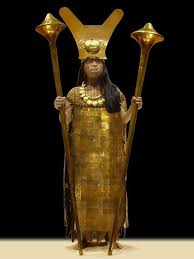
The image often seen today — a poised, regal woman with strong features, adorned in gold — is the result of modern forensic artistry. Using 3D scans of her skull and facial tissues, international experts digitally recreated her appearance.
The reconstruction, displayed today at the Museo Cao in Magdalena de Cao, shows a young woman, likely around 25 years old, with piercing eyes and the commanding presence befitting a leader.
Who Were the Moche? A Civilization of Art, Ritual, and Power
The Moche culture flourished between 100–800 CE along Peru’s north coast. Known for its striking ceramics, monumental pyramids, and sophisticated irrigation systems, the Moche were also a society deeply rooted in ritual warfare and ceremonial sacrifice.
Most rulers were depicted in murals as men — until the Lady of Cao proved otherwise.
Her burial was located in the ancient ceremonial pyramid Huaca Cao Viejo, one of the most sacred ritual centers of the Moche. Only a very small elite could be interred here — an unmistakable signal of her immense status.
A Discovery That Changed Peru’s National Identity
The Peruvian Ministry of Culture hailed the Lady of Cao as one of the most transformative archaeological discoveries since Machu Picchu.
Her finding reshaped the understanding of gender, leadership, and power in pre-Columbian societies. She has since become a cultural symbol, celebrated in exhibitions, documentaries, and artistic portrayals worldwide.
Dr. Franco summarised her importance eloquently:
“She is not just a mummy. She is the voice of a forgotten queen. Through her, we now know that women shaped the political and sacred world of the Moche just as strongly as men.”
A Legacy Preserved
Today, the Lady of Cao rests in a climate-controlled chamber, protected yet proudly displayed in the museum that bears her name. Visitors to El Brujo can stand face-to-face with her reconstructed likeness — a rare opportunity to meet a woman whose power transcended her time.
More than a millennium after her death, the Lady of Cao remains a symbol of mystery, authority, and the enduring strength of ancient Peru’s forgotten queens.