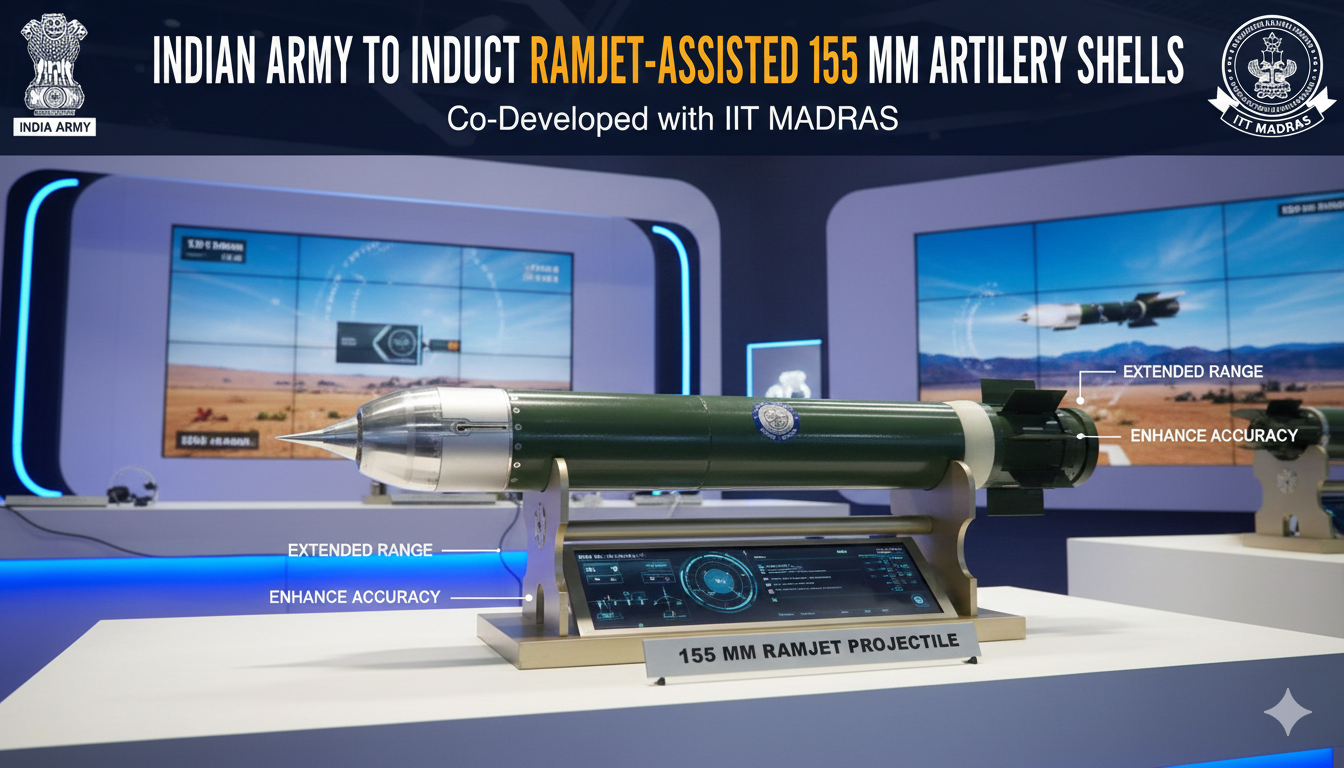
New Delhi, January 2026: The Indian Army is poised to become the world’s first military force to deploy ramjet-assisted 155 mm artillery shells, marking a significant leap in indigenous defence technology and artillery firepower. The project — co-developed with the Indian Institute of Technology Madras (IIT-M) and sanctioned by the Army Technology Board (ATB) — aims to substantially extend the range and lethality of standard artillery ammunition.
Breakthrough in Artillery Capability
Ramjet-assisted shells use an air-breathing propulsion system, a technology traditionally confined to missiles, to sustain thrust after firing. Once the shell is fired from a standard 155 mm artillery gun and reaches high supersonic speeds (around Mach 2), ambient air is compressed into the ramjet intake. Mixed with onboard fuel, this air sustains combustion — producing thrust that dramatically extends the projectile’s range.
Unlike conventional rounds that rely solely on the initial explosion for momentum, this “air-breathing” ramjet system enables continuous acceleration during flight, increasing the effective range by approximately 30–50 percent without reducing lethality. Conventional 155 mm shells typically reach 30–40 km (or up to 60 km with base-bleed designs); with ramjet assistance, the extended range can fall in the 60–80 km bracket, with future variants targeting over 100 km.
Development and Trials
The ramjet shell programme represents a major push under India’s Atmanirbhar Bharat (self-reliant India) defence initiative. Approved by the Army Technology Board, the technology underwent successful developmental firing trials at the Pokhran Field Firing Ranges in Rajasthan, demonstrating feasibility and performance.
The initiative is being led by Professor P. A. Ramakrishna of IIT Madras’ Aerospace Engineering Department, with close coordination between academic researchers and military engineers. Importantly, prototypes are designed to be retrofit modules — meaning they can be integrated onto existing 155 mm shells without the need to develop new guns or artillery platforms.
Operational Impact
Once inducted, ramjet-assisted shells will significantly enhance the Indian Army’s tube artillery strike capability, allowing long-range precision fires previously possible only with rockets or missiles. Their compatibility with current artillery guns — including howitzers such as the M777 ultra-light howitzer, ATAGS, Dhanush, and K9 Vajra-T — promises seamless integration across diverse terrains and operational environments.
Moreover, retaining lethality while extending range provides tactical advantages in deep-strike operations, counter-battery engagements, and deterrence along contested borders. The ability to hit targets well beyond traditional artillery reach enhances battlefield flexibility and could reduce reliance on more expensive rocket artillery systems.
Strategic Significance
India’s development of ramjet-assisted artillery rounds places it at the forefront of next-generation cannon artillery technology globally. While defence forces in the U.S. and Europe have explored similar concepts, India’s operationalisation of this technology — especially with indigenous development and retrofittable design — stands out as a major milestone.
As the programme advances toward full production and induction, likely through Munitions India Limited and partner facilities, this breakthrough is expected to redefine India’s artillery doctrine, significantly enhancing long-range strike power under the broader goal of self-reliant defence innovation.