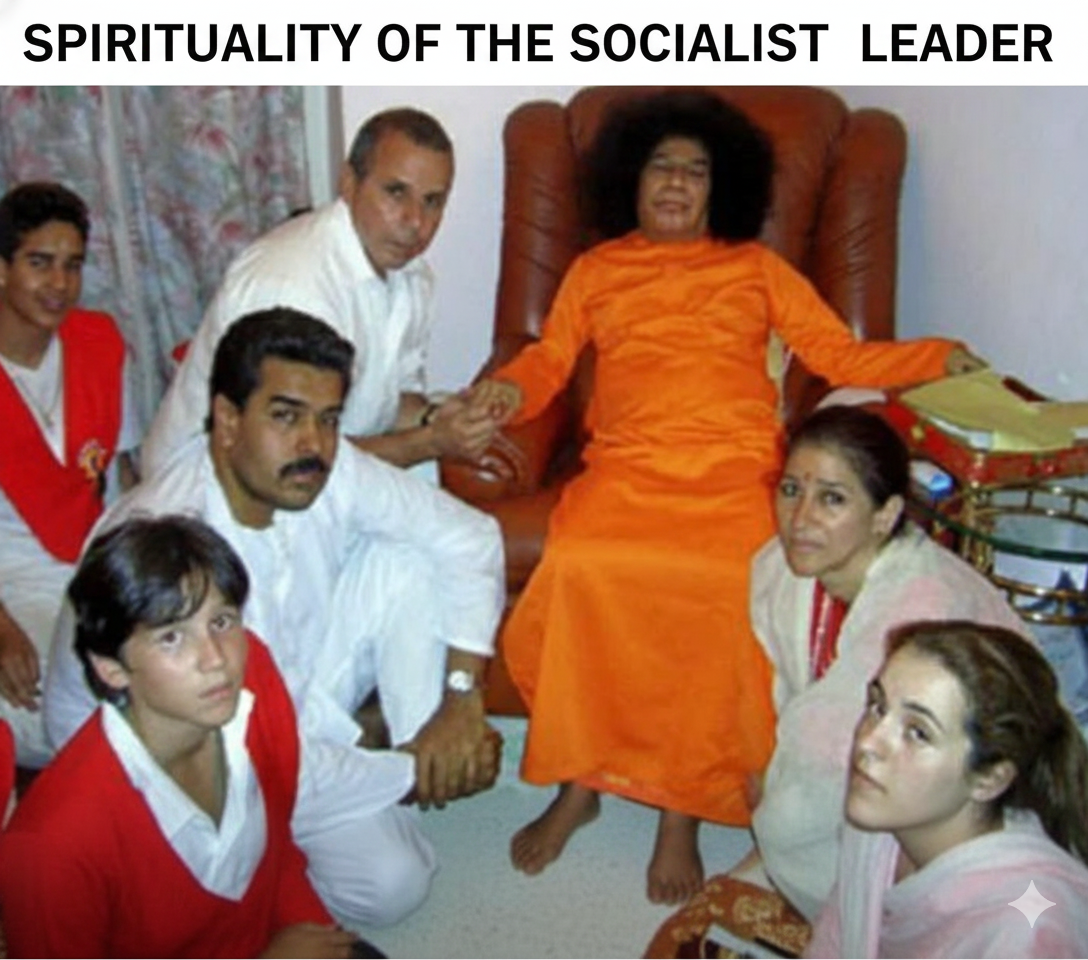
Venezuelan President Nicolás Maduro is widely known on the global stage as a hardline socialist leader shaped by revolutionary politics and ideological confrontation with the West. Yet beyond his political persona lies a lesser-known but deeply personal dimension of his life—his strong spiritual devotion to India’s revered spiritual leader, Sri Sathya Sai Baba of Puttaparthi.
Maduro has often spoken about how the teachings of Sathya Sai Baba—love, selfless service, and inner peace—have profoundly influenced his worldview and personal discipline. According to those close to him, he does not see spirituality and socialism as contradictory; rather, he views Sai Baba’s philosophy as a moral compass that strengthens his commitment to social justice and service to the poor.
A defining moment in this spiritual journey came in 2005, when Maduro, accompanied by his wife and current Venezuelan First Lady Cilia Flores, travelled to Puttaparthi in Andhra Pradesh. The visit, during which he personally received Sathya Sai Baba’s blessings, is often described by Maduro as a major turning point in his life. He has since referred to the experience as one that reshaped his inner strength and sense of purpose.
Even today, a large portrait of Sathya Sai Baba occupies a prominent place in Maduro’s office, symbolising the enduring influence of the Indian spiritual guru on Venezuela’s most powerful political figure. The image, aides say, is a constant reminder of humility, restraint, and service amid the pressures of governance.
In November 2025, marking the centenary celebrations of Sathya Sai Baba’s birth, Maduro delivered an emotional tribute, publicly acknowledging his spiritual roots and expressing gratitude to India for shaping his inner life. In that address, he declared that his spiritual foundations were firmly anchored in India, a statement that drew international attention and sparked discussion about the unusual intersection of Latin American leftist politics and Indian spirituality.
Observers note that this spiritual faith has played a crucial role in sustaining Maduro during periods of intense international pressure, sanctions, and political isolation. For Maduro, Sai Baba’s teachings are not merely symbolic; they are, by his own account, a source of mental resilience and emotional balance in times of crisis.
As Venezuela continues to navigate economic hardship and diplomatic turbulence, Nicolás Maduro’s spiritual connection to Sathya Sai Baba remains a striking and often overlooked aspect of his leadership—one that reveals how faith, ideology, and personal belief can converge in unexpected ways on the world stage.