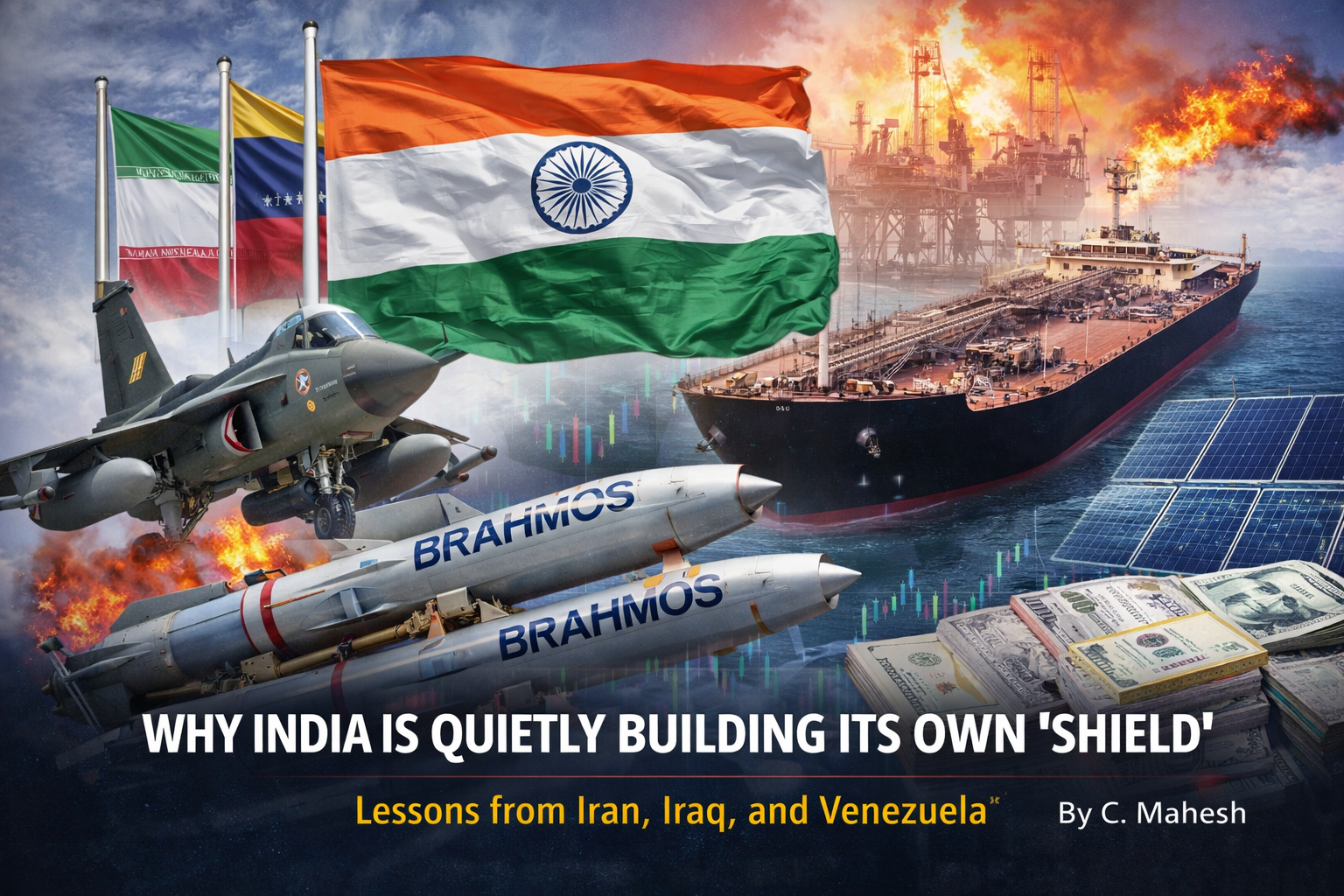
By C. Mahesh
History rarely collapses nations overnight. More often, it tightens a noose slowly—through sanctions, supply-chain choke points, financial isolation, and strategic dependency. Iran, Iraq, and Venezuela are stark reminders that having resources is not enough if the systems that control money, trade, defense, and energy are owned by others.
India has studied these failures closely. What is unfolding today is not mere politics or headline-driven nationalism, but a calculated survival strategy. Below are the four major pillars of India’s quiet but decisive self-protection plan, explained with data, context, and credible global references.
1. The Financial Trap: How Sanctions Cripple Economies
What Went Wrong for Iran and Venezuela
Iran and Venezuela depended heavily on the US dollar–centric global financial system, particularly:
- SWIFT (Society for Worldwide Interbank Financial Telecommunication)
- Dollar-clearing banks based in the US and Europe
When US-led sanctions were imposed:
- Iranian banks were cut off from SWIFT (2012, again in 2018).
- Venezuela’s overseas assets were frozen.
- Even when oil was sold, payments could not be received or used.
According to the International Monetary Fund (IMF), Venezuela’s economy contracted by over 75% between 2013 and 2021, one of the worst peacetime collapses in modern history.
Banks had money on paper—but no access to it.
India’s Counter-Strategy
India has actively reduced this vulnerability through:
a) Rupee Trade Settlement
- India now allows international trade settlements in Indian Rupees.
- Operational with Russia, UAE, Sri Lanka, Bangladesh, and under discussion with several African and ASEAN nations.
Source: Reserve Bank of India (RBI) circular, July 2022.
This ensures:
- Trade can continue even if dollar channels are blocked.
- Lower foreign exchange risk for Indian importers/exporters.
b) UPI: A Sovereign Payment Infrastructure
- UPI processes over 12 billion transactions per month (2024 data).
- Operates independently of Visa and Mastercard.
- Being adopted in UAE, Singapore, France, Sri Lanka, and Nepal.
Source: National Payments Corporation of India (NPCI), World Bank Global Payment Systems Report.
Lesson applied:
Never let another country control your money switch.
2. Choking the Supply Chain: When Goods Can’t Move .
Venezuela’s Oil Paradox
Venezuela has the largest proven oil reserves in the world (over 300 billion barrels).
Yet:
- Western insurers refused to insure tankers carrying Venezuelan oil.
- Without insurance, ports denied entry.
- Oil literally sat unsold, collapsing national revenue.
Source: US Energy Information Administration (EIA), Lloyd’s Market Association.
India’s Counter-Strategy
a) Strengthening the Merchant Navy
- India is among the top 15 maritime nations by seafarer supply.
- Government-backed plans to expand Indian-flagged vessels under Maritime India Vision 2030.
b) Sovereign Insurance Backstops
- India has used government-backed insurance guarantees to import oil from Russia despite sanctions.
- This bypasses Western insurance monopolies.
Source: Ministry of Shipping, Bloomberg Energy Reports (2023).
Message is clear:
If the world won’t ship it for us, we will ship it ourselves.
3. Defense Dependency: When Weapons Become Scrap .
Iraq’s Costly Lesson
During the Gulf War:
- Iraq had advanced weapons.
- But sanctions cut off spare parts, ammunition, and maintenance support.
- Entire divisions became unusable within months.
Source: Stockholm International Peace Research Institute (SIPRI).
Weapons without supply chains are museum pieces.
India’s Counter-Strategy
a) Indigenous Manufacturing
- Defense production crossed ₹1.27 lakh crore in 2023–24.
- Over 65% of equipment is now sourced domestically.
Key projects:
- Tejas Light Combat Aircraft
- INS Vikrant (indigenous aircraft carrier)
- Arjun tanks, Akash & BrahMos missiles
Source: Ministry of Defence, SIPRI India Fact Sheet.
b) Porcupine Strategy
India’s doctrine is defensive deterrence:
- Not expansionist
- But cost-imposing for any aggressor
A porcupine doesn’t attack—but hurts badly if touched.
Core idea:
Never depend on a foreign country for survival tools.
4. Breaking the Oil Chain: Escaping Energy Blackmail .
Why Oil Destroyed Iran and Venezuela
- Over 90% of export revenue came from oil.
- A single price crash or embargo meant national bankruptcy.
Source: World Bank Commodity Markets Outlook.
India’s challenge is different:
- India imports over 85% of its crude oil.
- Oil imports account for nearly 25–30% of total imports.
Any shock = inflation, currency pressure, political instability.
India’s Counter-Strategy
a) Solar Power Expansion
- India is the world’s 3rd-largest solar power producer.
- Target: 500 GW of non-fossil capacity by 2030.
Source: International Energy Agency (IEA).
b) Green Hydrogen Mission
- ₹19,700 crore National Green Hydrogen Mission.
- Aim: reduce fossil fuel imports by ₹1 lakh crore annually by 2030.
This is not environmental idealism—it is economic warfare prevention.
Bottom line:
Energy independence equals political independence.
Conclusion: The Real Lesson from Failed States
Iran, Iraq, and Venezuela teach one brutal truth:
“If your money, weapons, energy, and trade routes are controlled by others, your sovereignty is an illusion.”
India’s strategy—often misunderstood or underreported—is about owning the keys:
- To its money
- To its security
- To its supply chains
- To its energy future
This is the essence of Atmanirbhar Bharat—not isolation, but resilience.
Or as history warns us:
Never hand your house keys to the neighbor—no matter how friendly they seem.