An International Historical Report on 1,500 Years of Continuous Human Occupation
Executive Summary
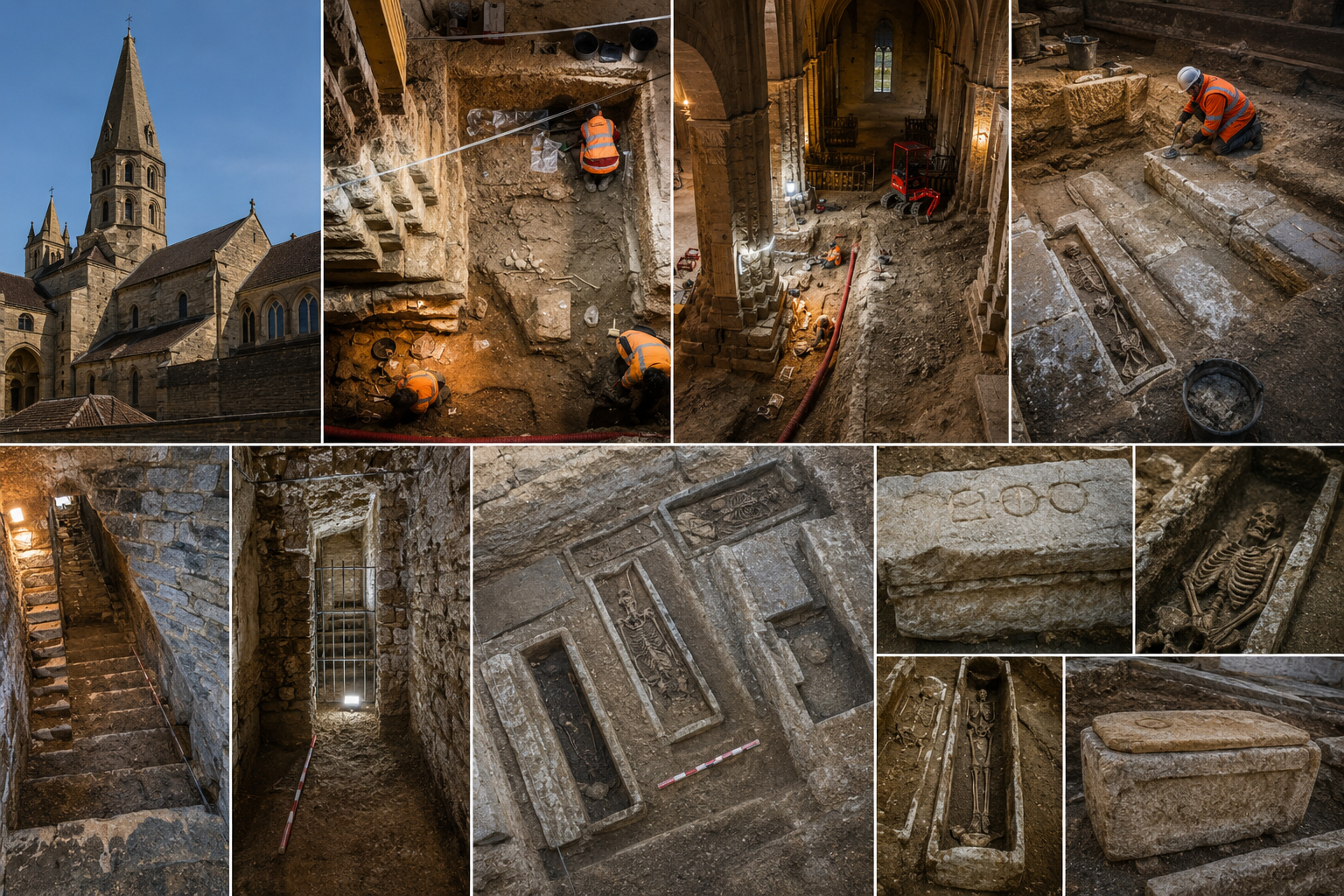
A restoration project at the medieval Church of Saint-Philibert in Dijon, France, unexpectedly revealed one of the most important recent archaeological discoveries in French urban archaeology. What began as an attempt to repair damage caused by a 1970s renovation uncovered a sequence of burials, churches, tombs, and stone sarcophagi spanning more than fifteen centuries. Archaeologists effectively exposed a vertical timeline of European history extending from the Late Roman world through the Merovingian era, the early Middle Ages, the Romanesque period, and into the modern age.
Chapter I
The Problem That Started Everything
The excavation was not initially intended as an archaeological project.
Saint-Philibert Church had suffered decades of structural deterioration because of a restoration carried out in 1974. During the 18th and 19th centuries the building had been used as a salt warehouse. Salt accumulated in the ground beneath the church. When a heated concrete slab was installed in the 1970s, repeated heating cycles caused the trapped salts to migrate and expand, gradually damaging the stone structure.
ScienceAlert summarized the situation:
“A heated concrete slab was installed” and “splitting stones apart.”
By the 2020s the damage had become serious enough that restoration work was unavoidable. Archaeologists from the French National Institute for Preventive Archaeological Research (INRAP) were called in before repairs began. That decision transformed a conservation project into a major historical investigation.
Chapter II
The Forgotten Staircase
The first surprise emerged when workers lifted part of the church floor.
Beneath the stone pavement lay a staircase absent from modern architectural plans. The stairway descended into a sealed funerary chamber that had remained hidden for centuries.
Daily Galaxy reported:
“The staircase led to a sealed burial vault.”
The vault dates to approximately the 15th or 16th century and contained burials of both adults and children. Most individuals had been wrapped in burial shrouds. Only a small number of objects accompanied the dead, including rosaries and coins.
These findings already represented a significant medieval discovery, but the excavation had only begun.
Chapter III
Beneath the Vault
As archaeologists dug deeper, they discovered numerous later medieval graves arranged beneath the church floor.
These burials dated primarily between the 14th and 18th centuries and reflected centuries of Christian funerary practice within the same sacred space. Many graves were carefully aligned east-west, following traditional medieval Christian customs associated with resurrection beliefs.
The excavation revealed that Saint-Philibert had functioned not merely as a church but as a major burial center for generations of local inhabitants.
Chapter IV
The Earlier Church
The next layer changed historians’ understanding of the site.
Below the medieval burials archaeologists identified remains of an earlier church. Evidence included masonry built using a distinctive herringbone technique known as Opus Spicatum. This construction style is frequently associated with early medieval architecture. Archaeologists believe these remains date to approximately the 10th century, at least two centuries before the current Romanesque church was constructed.
Popular Mechanics noted:
“Dates it to the 10th century.”
This demonstrates that the location had already been an established religious center long before the surviving 12th-century structure was built.
Chapter V
The Merovingian Dead
The most significant discovery emerged at still greater depth.
Archaeologists uncovered six stone sarcophagi dating to Late Antiquity and the Merovingian period. One coffin possessed a sculpted lid, suggesting particularly high status.
Popular Mechanics reported:
“Six sarcophagi from the Late Antiquity and Merovingian periods.”
The Merovingian period (approximately AD 500–750) occupies a critical place in European history. It bridges the collapse of Roman authority in Western Europe and the emergence of medieval kingdoms.
For historians, this period remains one of the least understood eras of European civilization because written records are relatively scarce. Archaeological evidence therefore becomes exceptionally important. The Dijon sarcophagi provide rare physical evidence from a transformative age when Roman traditions, Christian practices, and emerging medieval cultures overlapped.
Chapter VI
The Roman Connection
Evidence suggests that the deepest archaeological layers may extend into the Late Roman world itself.
The succession of burials indicates that the site was already important before the Merovingian era. Archaeologists believe some of the earliest funerary activity may belong to the final centuries of Roman Gaul.
This possibility makes the site especially valuable because it preserves archaeological evidence across one of the most important transitions in European history:
- Roman Empire
- Late Antiquity
- Merovingian Kingdoms
- Early Medieval Europe
- Romanesque Christianity
- Modern France
All within a single location.
Chapter VII
Why Sacred Places Survive
The discoveries at Saint-Philibert illustrate a broader historical pattern visible across Europe.
Communities frequently built new religious structures atop older sacred spaces. Historians once interpreted this mainly as religious replacement. Modern scholarship increasingly suggests practical reasons were equally important.
Sacred sites already possessed:
- Community recognition
- Existing infrastructure
- Burial grounds
- Pilgrimage traditions
- Social importance
As political systems changed, the location itself retained its significance. New generations inherited the place and adapted it to new beliefs and institutions. This continuity explains why a 12th-century church can stand directly above earlier medieval structures and much older burials.
Chapter VIII
Historical Importance
According to INRAP researchers, the sequence of discoveries demonstrates that Saint-Philibert served as a major funerary center during the transition from the Roman world into the early Middle Ages.
Popular Mechanics quoted the archaeological interpretation:
“An important funerary center.”
The significance extends far beyond Dijon.
The site offers historians a rare uninterrupted archaeological record showing how European society evolved over approximately 1,500 years. Instead of reconstructing history from isolated finds scattered across different regions, researchers can examine multiple eras preserved one directly above another.
Chronological Timeline
| Period | Approximate Date | Evidence Found |
|---|---|---|
| Late Roman Period | 4th–5th centuries | Earliest funerary activity |
| Merovingian Era | 6th–8th centuries | Stone sarcophagi |
| Early Medieval Period | 10th century | Opus Spicatum church remains |
| Romanesque Period | 12th century | Present church foundation |
| Late Medieval Period | 14th–16th centuries | Burial vault and tombs |
| Early Modern Period | 17th–18th centuries | Continued burials |
| Modern Era | 1974–present | Restoration and excavation |
Conclusion
The Saint-Philibert excavation is not merely the discovery of old graves. It is a physical archive of European civilization preserved beneath a single building. Each layer represents a different society, different beliefs, and different understandings of death and sacred space.
Few archaeological sites provide such a clear sequence from the Roman world to modern Europe. What began as a repair project beneath a church floor has become one of the most vivid archaeological records of historical continuity yet uncovered in France.
Principal Sources
- INRAP (French National Institute for Preventive Archaeological Research), via media reports.
- Popular Mechanics, Archaeologists Followed a Forgotten Staircase—and Uncovered a 400-Year-Old Burial Vault.
- ScienceAlert, Burial Vault Sealed For 400 Years Found at End of Long-Forgotten Staircase.
- Daily Galaxy, Archaeologists Followed a Forgotten Staircase in an Old Church and Found a 400-Year-Old Burial Vault Hidden Beneath the Floor.
- La Brújula Verde, Beneath a Romanesque church in France archaeologists uncovered an earlier one….