Vijayapura (Bijapur), Karnataka
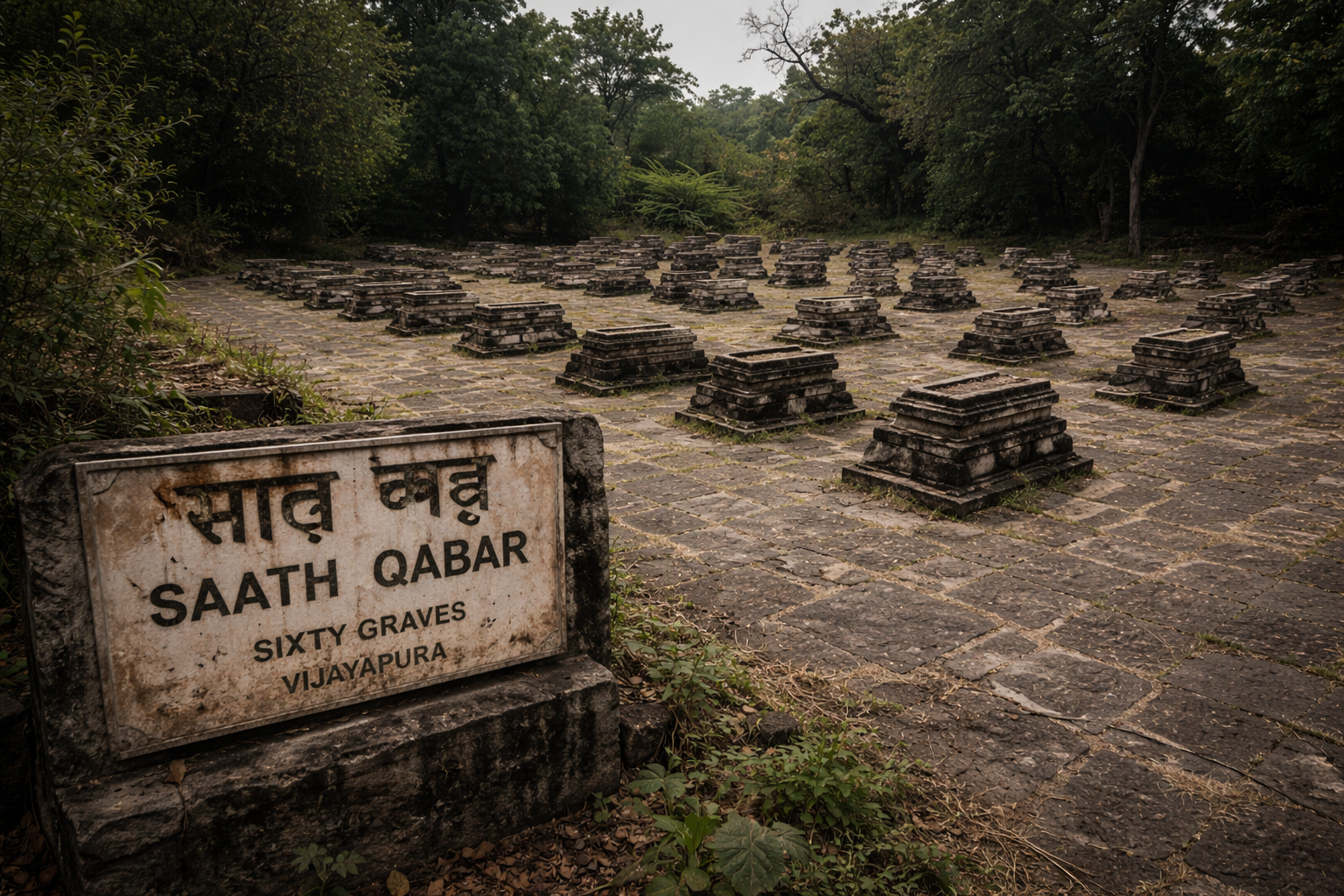
On a lonely stretch of land nearly eight kilometres from the historic city of Vijayapura lies a burial complex that has unsettled travellers, historians, and locals alike for generations. Spread across nearly five acres, the site known as “Saath Qabar” (Sixty Graves) stands as one of the most haunting and debated monuments of the Deccan—caught somewhere between documented history, oral tradition, and chilling legend.
At the heart of this narrative is Afzal Khan, a powerful 17th-century general of the Bijapur Sultanate, remembered across India primarily for his fatal encounter with Chhatrapati Shivaji Maharaj at Pratapgad in 1659. Yet beyond the battlefield, Afzal Khan’s name is inseparably linked in local memory to a far darker story—one involving cruelty within the walls of power itself.
Afzal Khan in Historical Records
Afzal Khan held the title of Sar-i-Lashkar (Commander-in-Chief) under Sultan Ali Adil Shah II of Bijapur. Persian chronicles of the Deccan describe him as a formidable, feared, and uncompromising military commander, entrusted with sensitive campaigns against the rising Maratha power.
Historian Jadunath Sarkar notes:
“Afzal Khan was chosen not merely for his military strength, but for his reputation as a man who would stop at nothing to fulfil the Sultan’s command.”
His final mission—to subdue Shivaji—ended dramatically. Contemporary accounts agree that Afzal Khan attempted diplomacy as a ruse, inviting Shivaji to a personal meeting. The encounter ended with Afzal Khan’s death, an episode that permanently altered the balance of power in the Deccan.
The Legend of the 63 Wives
What history books mention only in passing, local tradition amplifies into legend.
According to widely circulated oral accounts, Afzal Khan was intensely superstitious and deeply reliant on astrology. Before setting out to meet Shivaji, he allegedly consulted an astrologer who foretold his death.
The legend claims Afzal Khan responded with a decision of extreme cruelty: if he was destined to die, his wives would not be allowed to live beyond him.
Local narrators recount that:
- Afzal Khan gathered 63 of his wives at a remote hill near Bijapur
- One by one, they were allegedly pushed into a deep pit and killed
- Two women who attempted to escape were captured and executed
Their bodies, the legend says, were buried side by side—forming the 63 graves that still stand today.
A local elder, quoted by regional researchers, once remarked:
“These graves are not silent. They speak of fear, power, and women who had no choice.”
Counter-Narratives and Scholarly Doubts
Modern historians urge caution.
No contemporary Persian chronicle explicitly records the killing of 63 wives. An alternative explanation suggests that the graves may belong to women who died during a palace collapse or accident at a royal event, later buried together. Over time, the association with Afzal Khan may have grown through oral retelling.
Archaeologist B. L. Rice, writing on Deccan monuments, observed:
“In the absence of inscriptions or state records, Saath Qabar must be approached as a site of memory rather than certainty.”
The graves themselves bear no names, dates, or inscriptions, leaving their origins unresolved.
A Forgotten Monument
Despite its historical and emotional weight, Saath Qabar remains shockingly neglected:
- No paved access road
- No informational boards
- No protection under major heritage schemes
Visitors often reach the site only after repeatedly asking locals for directions, many turning back due to the isolation.
Heritage activist voices have repeatedly warned that without documentation, myth may be lost along with history.
Why Saath Qabar Still Matters
Whether literal truth or symbolic narrative, Saath Qabar represents something enduring:
the consequences of unchecked power and patriarchal control in feudal societies.
Standing before the silent rows of graves, visitors frequently report a sense of unease—a feeling that transcends academic debate.
As one visitor wrote in a travel journal:
“Even if the story is half-legend, the silence of these graves tells a full story of fear.”
The Need for Serious Historical Study
Scholars agree that Saath Qabar demands:
- Archaeological surveys
- Study of Bijapur court records
- Cross-examination of Persian, Marathi, and oral sources
Only through such work can history be separated from legend—or understood as a fusion of both.
Until then, Saath Qabar remains suspended between fact and folklore, a stark reminder that history is not only written in books, but also whispered by forgotten stones.