How the Akali intervention in the Vaikom Satyagraha helped create a short-lived but remarkable Sikh community in Alappuzha — and how Teja Singh’s story survived in the name of Singukandam
“The flag of Guru Nanak and Guru Gobind Singh shall be reached to another extent of India.”
— attributed to Master Tara Singh while addressing people in Kerala in 1936.
AMRITSAR/CHANDIGARH:
More than a century ago, a social struggle taking place in the princely state of Travancore brought together two regions separated by thousands of kilometres: Punjab and Kerala.
The connection began during the Vaikom Satyagraha of 1924–25, when Akali Sikhs from Punjab travelled to Kerala and established a langar for the protesters campaigning against caste-based restrictions on access to roads surrounding the Vaikom Mahadeva Temple. That encounter would have consequences far beyond the satyagraha itself. Within little more than a decade, members of Kerala’s Ezhava community began embracing Sikhism, supported by Sikh organisations in Punjab.
Among those who made this journey was Teja Singh, born Ramankutty in Cherthala in present-day Alappuzha district. His life would eventually connect the Sikh movement in Kerala with the history of the hill settlement of Singukandam in Idukki.
The Akalis arrive in Vaikom
The Vaikom Satyagraha was launched to challenge restrictions that prevented members of oppressed castes from using roads surrounding the Vaikom temple.
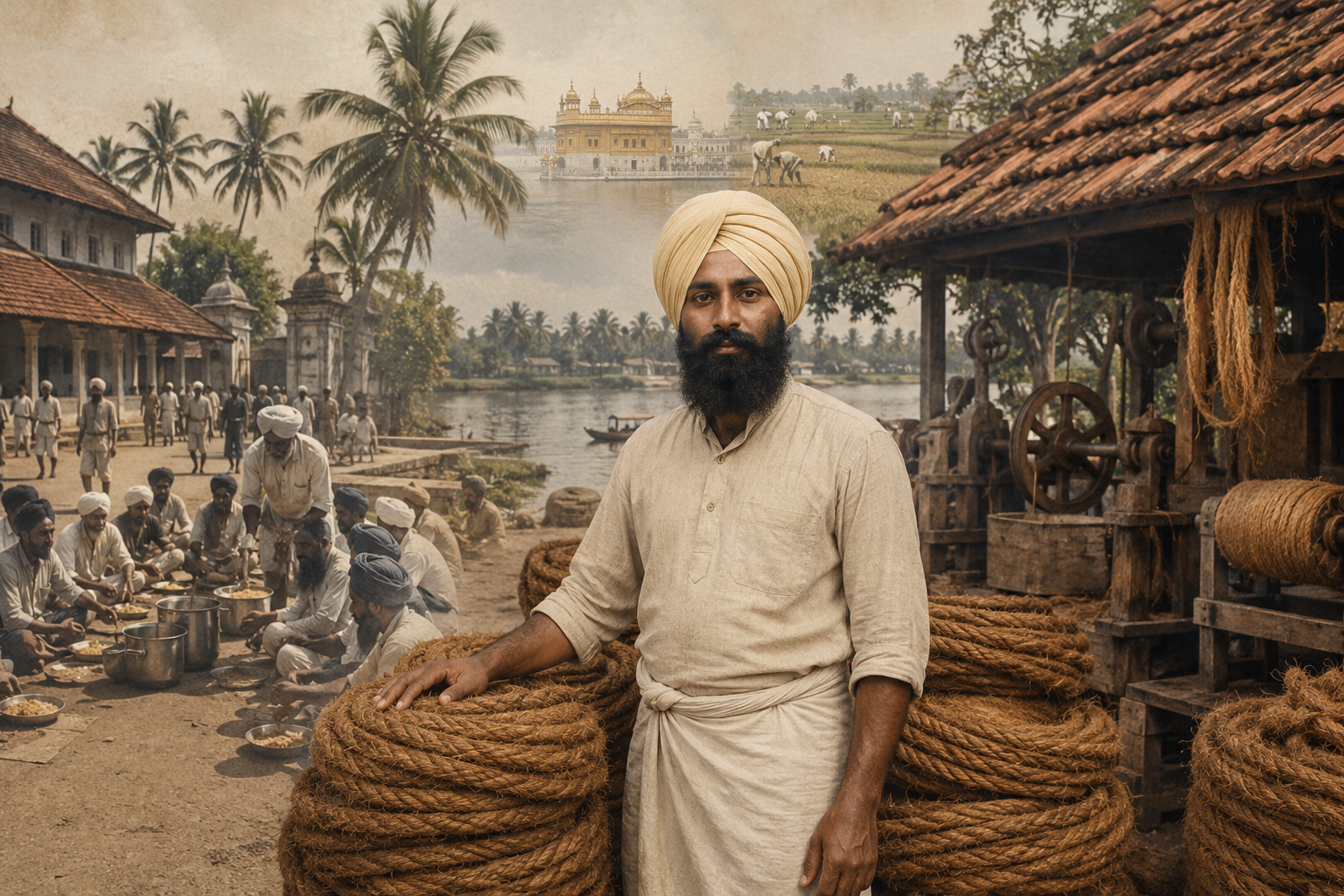
At the time, Punjab’s Akali movement was itself engaged in a major struggle over Sikh religious institutions and against British rule. A contingent of Akali Sikhs travelled to Vaikom and organised a langar for the satyagrahis. The kitchen operated only for a limited period, but its social message made a lasting impression on sections of Kerala’s Ezhava community.
The significance of the encounter went beyond food.
The Sikh langar represented a radically egalitarian social practice: people of different social backgrounds eating together without caste distinctions.
For Ezhavas confronting severe restrictions in Travancore, this provided a tangible example of a religious community that publicly rejected caste hierarchy.
A search for a new identity
The 1920s and 1930s were a period of intense debate among Kerala’s Ezhavas about religion and social identity.
Some leaders explored Buddhism, Islam and Christianity. Others argued that the Ezhavas should develop an independent religious identity.
The question was not simply theological. It was closely connected with social dignity, access to public spaces and resistance to caste discrimination.
Sikhism offered another possibility.
Its emphasis on equality, the langar, the Khalsa tradition and the right of initiated Sikhs to carry the kirpan attracted some Ezhava activists. Contemporary and later accounts particularly emphasise the attraction of Sikhism’s martial tradition to leaders who regarded it as a symbol of dignity and self-respect.
1936: Punjab reaches out to Kerala
The relationship between Sikh organisations and Kerala’s Ezhavas became more organised in 1936.
On 6 April 1936, a Sikh delegation led by Sardar Kartar Singh arrived in Kerala. The delegation was received by the Thiyya Political Congress and stayed at the residence of Dr. Thaiyil, according to accounts of the period. Its principal objective was to introduce Sikhism among the Ezhava community.
The Shiromani Gurdwara Parbandhak Committee (SGPC) and the Sarb Hind Sikh Mission subsequently expanded their activities in Kerala. Mission offices were established in places including Ernakulam and Ranni, while Sikh religious work reached areas such as Maravanthuruthu, Karappuram and Muhamma.
This was no longer simply a legacy of the Vaikom Satyagraha.
Punjab’s Sikh institutions were now actively engaging with a social movement in Kerala.
K.C. Kuttan becomes Jaya Singh
One of the most prominent Ezhava leaders to embrace Sikhism was K.C. Kuttan.
In 1936, he travelled to Punjab with other Kerala activists and embraced Sikhism, taking the name Jaya Singh. Other converts included men who adopted names such as Harnam Singh, Renjith Singh, Kripal Singh, Uday Singh and Bhupender Singh. The Travancore government itself used the term “Ezhava Sikhs” to describe the new community.
The Patiala Maharaja and the SGPC reportedly provided financial support to the early converts. Several Ezhavas, including Bhupender Singh and Teja Singh, travelled to Punjab to learn about Sikhism.
For the Sikh leadership in Punjab, Kerala had become an important field of social and religious engagement.
Teja Singh: From Cherthala to Punjab
Among those who travelled north was Teja Singh, originally known as Ramankutty.
According to family accounts reported by The Hindu, Ramankutty came from Cherthala in Alappuzha district. His grandson N.M. Sreekumar later recalled that Ramankutty encountered caste discrimination in Kerala, eventually travelled to Punjab and embraced Sikhism.
The available sources differ on some details of his chronology, but they agree on the essential outline:
Ramankutty became Teja Singh, embraced Sikhism and returned to Kerala as a Sikh.
His story would later become one of the clearest examples of how the Ezhava-Sikh movement moved beyond religious conversion into economic and geographic transformation.
The Kirpan and the roads of Vaikom
On 11 May 1936, Jaya Singh and other Ezhava Sikhs, together with Akali activists, attempted to walk along roads near the Vaikom temple.
These were roads from which Ezhavas had historically been excluded.
The Travancore authorities debated whether Sikhs should be permitted to use the roads. Surviving confidential correspondence indicates that the Maharaja’s administration ultimately instructed officials to open the relevant roads to non-caste Hindus and not allow the presence of the Ezhava Sikhs to become a reason for maintaining restrictions.
Yet another conflict emerged.
Some Sikhs were carrying the kirpan, an essential article of Sikh identity. According to Sikh historical accounts, police in parts of Alappuzha questioned and physically assaulted Sikhs over the carrying of the kirpan.
One account specifically names Jagat Singh and Teja Singh, saying that the Alappuzha Reserve Police detained them while they were travelling towards Kalavoor, took them to Alappuzha and confiscated their kirpans before subsequently returning them.
The episode illustrates the complicated position of the new converts.
They had changed their religion to escape caste-based restrictions, but their new religious identity brought another challenge: recognition of Sikh religious practice by the Travancore authorities.
25 converts at Cherthala
On 15 June 1936, another major Sikh conversion ceremony took place at Jaya Singh’s residence in Cherthala.
According to Sikh Review, 25 people embraced Sikhism at the ceremony, which began around midnight. Professor Gurdas Singh had been appointed for Sikh missionary work in Kerala, while senior Sikh leaders were involved in organising the ceremony.
The movement spread beyond Cherthala.
Sikh missionary activity reached areas around Vaikom, including Maravanthuruthu, Karappuram and Muhamma, while contemporary newspaper reports gave widely varying estimates of the number of converts.
Some reports mentioned around 300, while others gave figures as high as 800.
Because the contemporary figures vary considerably, historians should treat 300–800 as a reported range rather than a verified census figure.
The Temple Entry Proclamation changes everything
Then came a turning point.
On 12 November 1936, the Maharaja of Travancore, Sri Chithira Thirunal, issued the historic Temple Entry Proclamation, opening Travancore’s temples to communities previously excluded because of caste.
The proclamation achieved a central objective for which Kerala’s anti-caste movements had campaigned.
But it also weakened one of the strongest motivations behind the Ezhava conversion movement.
According to accounts cited in Sikh Review, many of the Malayalee converts lost interest in Sikhism after the proclamation and returned to the Hindu fold. Only a small number of families continued to identify strongly as Sikhs.
Thus emerged one of the great ironies of this history:
The social reform that helped remove the conditions driving religious conversion also contributed to the decline of the new Sikh community.
From a community of hundreds to a handful of families
The Ezhava Sikh community did not disappear immediately.
Figures such as Bhupender Singh, Kirpal Singh, Renjith Singh, Karthar Singh and Bhagawan Singh continued to identify with the Sikh faith. Some became involved in Sikh missionary activity through organisations such as the Kerala Sikh Mission.
But the community faced structural difficulties.
There were relatively few Sikh families in Kerala. Intermarriage became difficult, religious institutions were limited, and some children of Sikh converts grew up within families where Hindu and Sikh practices coexisted.
Over time, some descendants returned to the social networks of the Ezhava community, while others migrated or married into larger Sikh communities elsewhere in South India and beyond.
Teja Singh and the Guru Ramdas Coir Works
For Teja Singh, however, Sikh identity became intertwined with economic enterprise.
After returning to Kerala, he established a coir business known as Guru Ramdas Works, according to accounts of the Ezhava Sikh movement. The enterprise was associated with the coir economy of the Alappuzha region.
The Second World War subsequently damaged the economic prospects of the business, according to later accounts.
Teja Singh then moved towards the highlands of Idukki, where his story entered a new chapter.
Singukandam: where a Sikh’s name became a place
Today, Singukandam, in Chinnakanal panchayat of Idukki district, carries an unusual historical memory.
A report based on The Hindu records that the village’s name is associated with Teja Singh, who lived in the area for decades. His grandson N.M. Sreekumar identifies him as Ramankutty from Cherthala who later embraced Sikhism.
The report says Teja Singh reached the Munnar region around 1947 and later settled at Singukandam. Local people reportedly referred to him as “Singh Achan”, and the locality eventually became known as Singukandam.
The precise chronology and some details of his settlement differ between sources, so the story is best understood as a combination of documentary evidence and local family memory.
But the central fact remains striking:
A Kerala-born Sikh convert left his name on the map of Idukki.
A forgotten Sikh chapter of Alappuzha
The story of Teja Singh also brings the history back to Alappuzha.
The district was not simply the place where some Ezhavas converted to Sikhism. It became one of the principal geographical centres of the movement.
Cherthala witnessed the 1936 conversion ceremony.
Alappuzha’s police became involved in the controversy surrounding Sikh religious symbols.
And Teja Singh later established a coir enterprise associated with the region.
The history therefore links religious reform, caste politics, Punjab’s Sikh institutions and Kerala’s coir economy in one narrative.
1984 and the later decline
The story suffered another setback after the assassination of Prime Minister Indira Gandhi in 1984 and the subsequent anti-Sikh violence across India.
Later Sikh historical accounts describe attacks and intimidation involving members of Kerala’s small Sikh community, including Kirpal Singh and Bhupender Singh.
These accounts are important oral and community-history sources, but individual incidents should ideally be cross-checked against contemporary police records, newspaper archives and court documents before being presented as fully established facts.
The broader consequence is clearer: the already fragile Sikh identity of several Kerala families weakened further.
What Punjab left behind in Kerala
The story of the Ezhava Sikhs is important for Punjab because it demonstrates how far the influence of Sikh social institutions travelled beyond Punjab.
The Akalis came to Vaikom.
They established a langar.
Sikh organisations later sent missionaries and representatives.
Kerala’s Ezhavas travelled to Punjab.
Some returned as Sikhs.
And one of them — Teja Singh — established a new life in Alappuzha before eventually becoming associated with Singukandam in Idukki.
The relationship was therefore not one-way.
Punjab went to Kerala, but Kerala also came to Punjab.
A historical bridge between two regions
Seen from Kerala, this is the story of Ezhava converts who searched for dignity and equality through Sikhism.
Seen from Punjab, it is the story of Akali volunteers and Sikh organisations extending the ideals of the Khalsa beyond Punjab.
Seen from the perspective of Indian social history, it is something larger:
a rare experiment in religious conversion as a response to caste oppression.
And seen through the life of Teja Singh, it becomes a deeply personal story — a journey from Cherthala to Punjab, from Punjab back to Kerala, from the coir factories of Alappuzha to the hills of Idukki.
His name survives in Singukandam.
His community largely disappeared.
But the history did not.
“At Vaikom, Punjab offered a langar. In Cherthala, Ezhavas became Singhs. In Alappuzha, Teja Singh built a livelihood. In Idukki, his name became a place.”
That is perhaps the most enduring legacy of the forgotten Ezhava Sikhs of Kerala.
Data Sources / Research Base
- Sikh Review — “The Sikhs of Kerala”: provides detailed material on the 1936 conversions, the 25-person Cherthala ceremony, reported conversion figures, the use of the term “Ezhava Sikhs” by Travancore authorities, and the community’s decline after the Temple Entry Proclamation.
- SikhChic — “The Sikhs of Kerala”: contains historical material on the Vaikom movement, Master Tara Singh, K.C. Kuttan/Jaya Singh, the 1936 conversions, police action involving Teja Singh, and Travancore government correspondence.
- The Khalsa Chronicle — “The Forgotten Sikhs of Kerala: The Ezhavas”: provides a recent synthesis of the Ezhava-Sikh movement, Sikh missionary activity, Teja Singh and the Singukandam connection.
- The Hindu report on Singukandam: provides family testimony concerning Teja Singh/Ramankutty, Cherthala, his settlement in Idukki and the origin of the name Singukandam.
- Sikh Review archival material: preserves references to Travancore confidential correspondence concerning Sikh access to roads near temples and the treatment of Sikhs carrying the kirpan.
- Vaikom Satyagraha historical synthesis: documents the connection between the Akali intervention, Sikh missionary work in Kerala and the subsequent Ezhava conversions.
note
Some claims in the wider Ezhava-Sikh narrative — particularly the exact number of converts, certain details of Teja Singh’s early life, and specific accounts of anti-Sikh violence in Kerala in 1984 — come from later Sikh community histories, family testimony or secondary publications. They should therefore be distinguished from claims supported by surviving Travancore administrative records. This distinction is important if the article is intended for academic publication, a newspaper, or a historical research journal.