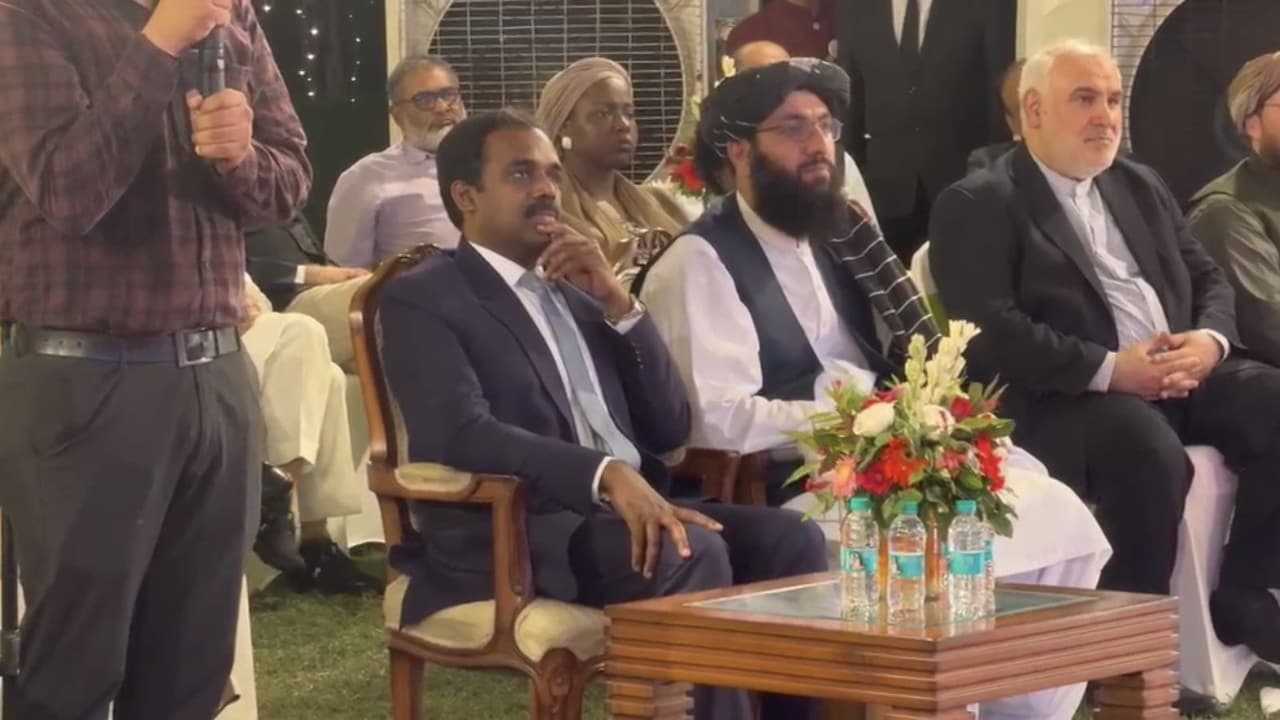
India has signalled a further shift towards closer engagement with Afghanistan’s Taliban rulers, with a senior Indian foreign ministry official attending a “Victory Day” reception hosted by the Taliban’s diplomatic mission in New Delhi. The event, held on August 17, marked the fifth anniversary of the Taliban’s return to power in Afghanistan.
The presence of Anand Prakash, who heads the Pakistan-Afghanistan-Iran division in India’s Ministry of External Affairs, was particularly significant. His participation indicates that New Delhi’s engagement with the Taliban is moving beyond limited diplomatic contacts towards a more open and pragmatic relationship.
First such public event since Taliban takeover
The reception at the Afghan Embassy in New Delhi was reportedly the first public event of its kind hosted by the mission since the Taliban seized power in August 2021. The Taliban describes August 15, 2021, when its forces entered Kabul following the withdrawal of US and NATO troops, as a “Victory Day.”
India had initially maintained considerable distance from the Taliban after the takeover. However, New Delhi has gradually increased diplomatic contacts with Kabul, particularly over trade, connectivity, humanitarian assistance and regional security.
The Indian government still does not formally recognise the Taliban government, making the presence of a senior MEA official at the event diplomatically noteworthy.
Taliban calls for stronger ties with India
Taliban chargé d’affaires Noor Ahmad Noor used the New Delhi event to call for stronger political and economic relations between Afghanistan and India.
He argued that Afghanistan’s geographical position should serve as a bridge for connectivity, cooperation and shared prosperity, rather than becoming an arena for geopolitical competition. He also emphasised principles such as balanced engagement, mutual respect, non-interference and shared interests.
According to Afghanistan International, Noor also called for greater political trust and stronger economic engagement between India and the Taliban administration, saying closer ties could contribute to regional stability and expanded trade.
The Pakistan factor
The development comes at a time when relations between the Taliban and Pakistan have deteriorated significantly.
For India, maintaining a working relationship with Kabul has strategic importance. Greater engagement gives New Delhi an opportunity to retain influence in Afghanistan, protect its security interests and strengthen its position in a region where Pakistan, China, Russia and other powers are also seeking influence.
The Taliban’s increasingly strained relationship with Pakistan has also created additional space for India to expand its engagement with Kabul.
A significant diplomatic shift — but not recognition
India’s participation should not, however, be interpreted as formal recognition of the Taliban regime.
Instead, it reflects what Indian officials have described as pragmatic engagement with the authorities that currently control Afghanistan. India has increased contacts with Afghan officials over the past year, including discussions on trade, connectivity and development cooperation.
The shift is nevertheless notable because India had withdrawn most of its diplomatic presence from Afghanistan after the Taliban takeover and initially adopted a cautious approach towards the new rulers.
International reaction and wider context
The Taliban’s fifth year in power has been accompanied by growing diplomatic engagement from several countries, even though the regime continues to face international criticism over its restrictions on women and girls and other human-rights concerns.
Against this background, India’s decision to send a senior foreign ministry official to a Taliban-organised “Victory Day” event carries symbolic significance. It suggests that New Delhi increasingly sees direct engagement with the Taliban as necessary to protect Indian interests in Afghanistan, while stopping short of formally recognising the regime.
Bottom line
The New Delhi reception marks another step in the gradual transformation of India–Taliban relations. From cautious distance after 2021 to increasingly visible diplomatic engagement in 2026, New Delhi appears to be pursuing a pragmatic Afghanistan policy focused on security, connectivity, trade and strategic influence.
The participation of a senior Indian diplomat in the Taliban’s “Victory Day” celebration is therefore more than a ceremonial gesture. It is a clear signal that India is willing to engage the Taliban more openly—even while maintaining its position of not formally recognising the Taliban government.