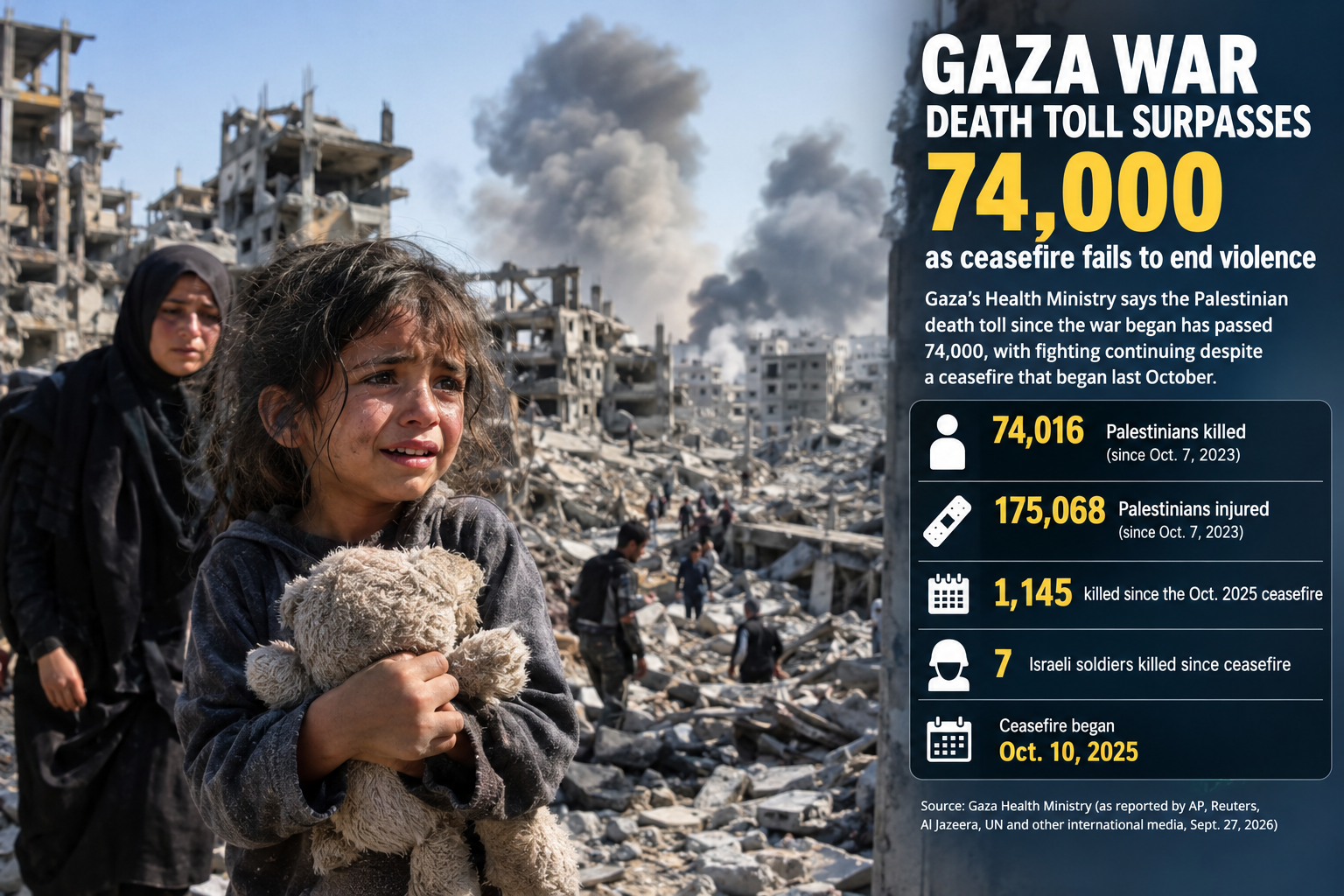
Gaza City | September 27, 2026 — The Palestinian death toll from the Israel–Hamas war has surpassed 74,000, according to Gaza’s Ministry of Health, nearly three years after the conflict began. The latest figures come as a ceasefire that took effect on October 10, 2025 has substantially reduced the intensity of the war but has not stopped Israeli airstrikes, shelling and other violence inside the Gaza Strip.
The Associated Press (AP) reported on September 27 that Gaza’s Health Ministry had recorded 74,016 Palestinian deaths and 175,068 injuries since the war began on October 7, 2023. AP noted that the ministry’s records are considered generally reliable by UN agencies and international organisations, although the ministry does not distinguish between civilians and combatants in its overall death tally. It says women and children constitute roughly half of those killed.
The figures are therefore a measure of total reported Palestinian deaths, rather than a separately verified count of civilian and military casualties.
Latest Gaza casualty figures
| Indicator | Latest reported figure |
|---|---|
| Palestinian deaths since Oct. 7, 2023 | 74,016 |
| Palestinians wounded | 175,068 |
| Deaths since Oct. 2025 ceasefire | 1,145 |
| Israeli soldiers killed since ceasefire | 7 |
| Approximate duration of war | Nearly 3 years |
| War began | October 7, 2023 |
| Ceasefire began | October 10, 2025 |
The figures above are from the latest AP report based on Gaza Health Ministry data.
Gaza’s own Health Ministry reported 73,910 deaths and 174,914 injuries as of September 19, while noting that additional victims remained beneath rubble or in areas that rescue teams could not reach. It also said 85 deaths had been added to the cumulative total after previously incomplete records were reviewed and approved.
The ceasefire has not ended the violence
The October 2025 ceasefire brought an end to the largest-scale fighting, but according to AP, Israeli strikes have continued, with the Israeli military saying its operations have been responses to threats or attacks.
AP reported:
“While a ceasefire that took effect last Oct. 10 has halted the heaviest fighting, Israeli strikes have continued…”
The UN’s September 24 report similarly describes the ceasefire as fragile, saying Israeli airstrikes, shelling, drone attacks and ground operations have continued. The UN also reported that Hamas and other Palestinian armed groups had not disarmed and that large areas of Gaza remained inaccessible or subject to severe restrictions.
More than 1,000 Palestinians killed after the ceasefire
One of the most significant figures in the latest reporting is the number of Palestinians killed after the ceasefire itself began.
According to Gaza’s Health Ministry, 1,145 Palestinians had been killed since the October 2025 ceasefire, AP reported.
Earlier September reporting by Al Jazeera recorded 1,352 deaths since the ceasefire as of September 7, while the total war death toll at that point was 73,658.
The figures from different dates should not be directly combined because the Health Ministry regularly revises its database as deaths are identified and records are verified.
Al Jazeera’s ceasefire tracker, updated September 25, reported 73,928 confirmed deaths and 175,030 injuries through September 24. It also reported that Gaza’s Government Media Office had documented thousands of alleged ceasefire violations, although those figures are claims by Palestinian authorities rather than independently verified totals.
Israel’s explanation for continuing strikes
Israel maintains that its military operations are directed at Hamas and other armed groups and are intended to prevent them from rebuilding their military capabilities.
Reuters reported on September 23 that Israeli strikes killed at least four Palestinians that day, according to Palestinian health officials. Israel said one strike targeted Mohammad Abu Elwan, whom Israeli officials described as a senior Hamas finance official.
Prime Minister Benjamin Netanyahu and Defence Minister Israel Katz said:
“We will not allow Hamas to rebuild its strength, and we will not stop until Hamas no longer exists in Gaza.”
Israel and Hamas continue to accuse each other of violating the ceasefire, while negotiations over the next phase of the agreement remain unresolved. Reuters reported that the outstanding issues include Hamas’ disarmament and an Israeli military withdrawal from Gaza.
Thousands of bodies may still be beneath the rubble
The official death toll may not represent the final number of people who have died during the conflict.
Gaza’s Health Ministry has repeatedly said that people remain trapped beneath collapsed buildings and that rescue teams face difficulties reaching them.
The UN reported this week that the destruction has left buildings throughout Gaza structurally unstable. It cited the September 16 collapse of a previously damaged building in Tal al-Hawa, which killed at least 21 people, including eight children. The UN said that after nearly three years of war, the recovery of tens of thousands of human remains and their identification and burial remain an urgent issue.
The Guardian reported on September 27 that the amount of rubble across Gaza is estimated at approximately 61 million tonnes, with aid workers facing the enormous task of clearing debris that may contain human remains as well as unexploded ordnance.
The humanitarian and health crisis
The casualty figures come on top of an extremely damaged healthcare system.
Al Jazeera reported in July that Gaza’s Health Ministry said laboratories and blood banks were facing severe shortages, with laboratory-material shortages estimated at 87% and essential diagnostic-test supplies at a 74% deficit.
The war has also severely disrupted education. Reuters reported on September 21 that approximately 98% of Gaza’s schools had been damaged or destroyed, while about 660,000 students had missed consistent classroom education. Reuters also reported estimates of around 22,000 students and more than 770 education workers killed during the conflict.
Despite the destruction, hundreds of thousands of children have begun returning to makeshift schools, including tent-based classrooms and temporary learning centres.
How the war began
The current war began following the October 7, 2023 Hamas-led attack on southern Israel. AP reports that approximately 1,200 people were killed, mostly civilians, and 251 people were taken hostage. Israel subsequently launched its military campaign in Gaza.
The Palestinian death toll has since risen above 74,000 according to Gaza’s Health Ministry.
Importantly, the Gaza Health Ministry’s cumulative figures do not provide a complete civilian-versus-combatant breakdown. AP specifically notes that women and children account for approximately half of the reported deaths, but the ministry does not classify the remaining deaths by combatant status in its overall tally.
International response
The continuing violence has kept Gaza at the centre of international diplomatic efforts.
A September report by the UN Special Coordinator for the Middle East Peace Process said the ceasefire had stopped large-scale hostilities but that “the ceasefire remains fragile.” The UN said reconstruction and recovery have not yet progressed at the scale required, while the political arrangements intended to govern post-war Gaza have not fully taken effect.
International reporting also highlights the unresolved political and security questions: whether Hamas will disarm, whether Israeli forces will withdraw, who will govern Gaza, how reconstruction will be financed and how civilians will be protected during the transition.
What the latest numbers mean
The most recent AP figure — 74,016 Palestinian deaths and 175,068 injuries — represents the Gaza Health Ministry’s cumulative reported toll as of September 26/27, 2026.
However, the number should not be interpreted as a fully independently verified civilian death count. It is a health-authority tally that includes deaths without distinguishing combatants from civilians, and the ministry says some victims remain unrecovered. At the same time, international organisations and major news agencies have continued to use the ministry’s records as an important source for tracking casualties.
The central development now is therefore not simply that the cumulative death toll has crossed 74,000. It is that a ceasefire has substantially reduced large-scale fighting without ending lethal violence, while reconstruction, disarmament, Israeli withdrawal and Gaza’s future governance remain unresolved.