C Mahesh
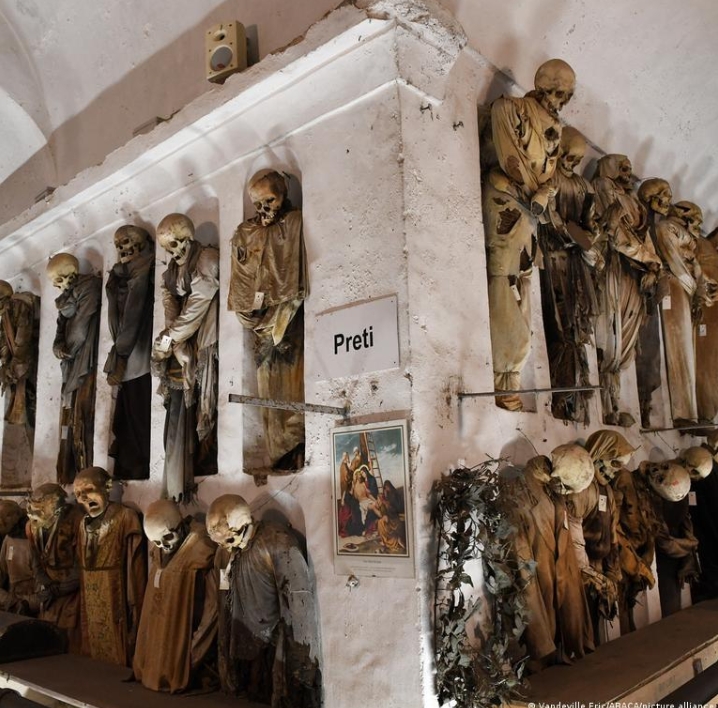
Rows of human remains dressed in centuries-old clothing. Mummified bodies with deteriorating skin and exposed bones. The remarkably preserved face of a little girl who appears to be peacefully asleep. These haunting sights belong to one of Europe’s most extraordinary historical burial sites: the Capuchin Catacombs of Palermo, located on the Italian island of Sicily.
Often described as an underground city of the dead, the catacombs contain a remarkable collection of human remains preserved over several centuries. Estimates frequently mention around 8,000 bodies, including those of monks, priests, soldiers, wealthy families, women and children. While some remains have deteriorated into little more than skeletons, others retain traces of their facial features, hair and clothing.

Yet the story of the Capuchin Catacombs extends far beyond their unsettling appearance. The site offers a rare glimpse into the religious beliefs, social divisions, burial customs and preservation techniques of earlier centuries. Today, it continues to attract historians, archaeologists, medical researchers and visitors from around the world.
The Beginning: How a Monastery Burial Ground Became a City of the Dead
The history of the Capuchin Catacombs dates back to the late 16th century, when Capuchin friars in Palermo needed additional space to bury their deceased brothers.
A new underground burial area was prepared, and the catacombs began to be used in 1599.

According to historical accounts, the monks discovered that some bodies transferred from an earlier burial ground had been naturally mummified. Rather than decomposing completely, the remains had retained much of their physical structure.
The discovery attracted considerable attention among the religious community. Over time, the monks began preserving the bodies of their deceased brothers, and the practice gradually expanded beyond the monastery.
Wealthy families in Palermo eventually sought permission to have their relatives preserved and placed in the catacombs. What began as a burial ground for a religious community gradually developed into an extensive collection of human remains.
Historical information about the site’s origins is available through Italy’s Ministry of Culture and the catacombs’ official website.
Death Did Not Erase Social Status
One of the most striking features of the Capuchin Catacombs is the way the bodies were arranged.

Rather than placing every deceased person in a common burial area, the remains were organised into different sections. Religious figures, men, women, children and people associated with particular occupations were displayed in designated areas.
Many bodies were dressed in clothing appropriate to their period. Some wore religious garments, while others were dressed in military uniforms or the everyday and formal clothing of their time.
These details provide valuable insights into the clothing, customs and social identities of people who lived centuries ago.
For some families, preserving a deceased relative’s body was a way to maintain a visible connection with the dead. Relatives could visit the remains, remember the deceased and retain a physical reminder of their family history.

However, the practice also reflected the social inequalities of the period.
Preserving a body required resources, and not everyone could afford the process. Wealthy families were therefore better positioned to secure this form of burial and remembrance.
The catacombs consequently reveal a society in which social distinctions could continue to influence how people were remembered even after death.
How Were the Bodies Mummified?
The preservation techniques used at the Capuchin Catacombs have attracted considerable scientific interest.
Not every body was preserved in the same way. Some underwent natural mummification, while others were subjected to deliberate preservation procedures.
Historical accounts describe how certain bodies were placed in specially prepared chambers for several months. After this process, they were cleaned, dressed and arranged in niches, displayed along the walls or placed inside coffins.
Drying the body helped slow decomposition, although the precise process varied between individuals.
Scientific investigations have since provided further information about these practices.
A study published in the medical journal Radiographics in 2010 examined ten mummies from the catacombs using radiological techniques. The researchers identified evidence consistent with artificial mummification in nine of the ten bodies examined.
The investigation also documented internal anatomical features and changes associated with the preservation process.
The findings suggest that the catacombs’ remains are not simply the result of unusual natural conditions. In many cases, people deliberately employed techniques intended to preserve human bodies for extended periods.
Why Are the Mummies Displayed Along the Walls?
Perhaps the most recognisable images of the Capuchin Catacombs show rows of human remains arranged vertically along the walls.
Some bodies stand upright in specially prepared niches, while others lie horizontally or rest inside coffins. Many retain portions of their original clothing.
This arrangement was not created solely to produce a dramatic visual effect.
The bodies were preserved in a manner that allowed families to identify and visit their deceased relatives. For some members of the community, maintaining a visible connection with the dead was an important part of religious observance and family remembrance.
The catacombs became a place where death remained physically present in everyday cultural memory.
The practice of preserving bodies eventually declined, and the burial site was officially closed to new burials in the late 19th century, although some exceptional later interments took place.
Today, the surviving remains provide a historical record of the burial customs and beliefs that shaped Palermo over several centuries.
The Mystery Behind the Figure of 8,000 Bodies
The number most frequently associated with the Capuchin Catacombs is approximately 8,000 human remains.
However, this figure should be treated as an estimate rather than a verified count of fully preserved mummies.
Different sources use different counting methods, and the total number of bodies historically associated with the site does not necessarily correspond to the number of individually documented mummies that remain identifiable today.
A report published by Smithsonian Magazine in January 2022 discussed a collection of 1,284 bodies, including 163 children.
The report focused on scientific efforts to investigate the remains and understand more about the lives and deaths of the children preserved there.
Cranfield University also reported on research involving the catacombs’ extensive collection of mummies and skeletal remains.
Meanwhile, Italy’s Ministry of Culture gives an approximate figure of 8,000 bodies in its description of the site.
These numbers are not necessarily contradictory. The larger figure represents a commonly cited estimate of the collection, while scientific investigations may focus on particular groups of remains that have been documented or selected for study.
It would therefore be misleading to suggest that all 8,000 bodies remain fully preserved or are displayed in the same condition.
Nevertheless, the scale of the collection makes the catacombs one of the most remarkable historical repositories of human remains in Europe.
Rosalia Lombardo: The Little Girl Who Appears to Be Sleeping
Among the thousands of remains preserved in the catacombs, one has achieved international recognition: Rosalia Lombardo.
Born in 1918, Rosalia died in 1920 at just two years of age.
Her grieving father commissioned Alfredo Salafia, an expert in embalming, to preserve her body.
The result was extraordinary. Rosalia’s face, hair and eyelashes remained remarkably well preserved, creating the impression that the child was sleeping peacefully.
Her body is kept inside a specially designed glass coffin, and she became widely known as the “Sleeping Beauty of Palermo.”
Rosalia’s remains are particularly significant because of the quality of their preservation. While many older mummies have suffered substantial deterioration, her facial features remain unusually recognisable.
It is important to note that Rosalia is not a centuries-old mummy. She died in 1920, much later than most of the people preserved in the catacombs.
Her preservation nevertheless represents one of the most notable examples of early 20th-century embalming.
For years, the precise details of Salafia’s technique remained obscure. Researchers later examined his notes to gain a better understanding of the methods used to preserve her body.
Beyond the scientific interest, Rosalia’s story remains deeply personal: it reflects a father’s attempt to preserve the memory of a child whose life ended far too early.
The Children’s Mummies: What Modern Science Is Discovering
The children’s remains have become a particularly important subject of modern research.
By examining the bodies, scientists hope to learn more about childhood health, growth, disease and mortality in earlier centuries.
In 2022, researchers associated with Cranfield University reported on a project involving the scientific investigation of children’s mummies in the catacombs. One part of the research focused on 41 children who died during the 19th century.
The researchers used non-invasive techniques, including X-ray imaging, to investigate the remains without causing unnecessary damage.
Such examinations can reveal information about bone development, certain diseases and other physical characteristics that may help researchers understand the lives of people from the past.
The findings could also contribute to a broader understanding of historical living conditions and childhood mortality.
However, the display of children’s remains raises ethical questions as well.
Should human bodies be displayed publicly for historical education? How can researchers balance scientific discovery with respect for the dead?
These questions are increasingly relevant to museums and heritage institutions that preserve human remains.
A 2024 study published in the International Journal of Heritage Studies examined cultural and social issues associated with displaying mummies, including the remains of children.
The debate highlights the need to consider not only the historical value of the catacombs but also the dignity of the people whose bodies are preserved there.
More Than a Tourist Attraction: A Window into Palermo’s Past
The Capuchin Catacombs are often described as a haunting tourist destination, but their historical significance extends much further.
The remains provide researchers with evidence about several aspects of life in earlier centuries.
Clothing and fashion: The garments preserved on some bodies offer clues about historical dress and social identity.
Social inequality: The organisation of the burial areas reflects differences in occupation, wealth and social status.
Religious beliefs: The preservation and display of the dead reveal attitudes towards death, remembrance and the afterlife.
Medical history: Scientific examinations can help researchers investigate diseases, physical development and historical health conditions.
Burial practices: The catacombs document preservation techniques and changing approaches to the treatment of the dead.
The remains are therefore not simply objects of curiosity. They are also historical evidence that can help reconstruct aspects of the society in which these individuals lived.
At the same time, their presence invites reflection on how people understand death and how different cultures seek to maintain connections with those who have died.
The Underground World That Continues to Fascinate Researchers
Today, the Capuchin Catacombs remain an important historical site and a subject of continuing scientific interest.
Visitors encounter a collection of human remains that spans different periods and social backgrounds. Some bodies have deteriorated considerably, while others retain striking details of their appearance.
The widely cited estimate of around 8,000 bodies captures the extraordinary scale of the collection, although the exact number and condition of all the remains require careful distinction from scientifically documented groups of mummies.
For historians, the site offers a rare opportunity to study burial traditions and social customs. For medical researchers, it provides evidence that can help explain aspects of historical health and preservation. For visitors, it offers a powerful encounter with the physical reality of death.
The catacombs also serve as a reminder that every preserved body once belonged to a living person, with a family, relationships and a place in society.
Some were wealthy and influential. Others were children whose lives ended before they had fully begun. Their circumstances differed, but their remains now form part of a shared historical record.
Human beings have never been able to defeat death. Yet, through preservation, they have sometimes managed to leave behind physical traces of their lives for future generations to study.
The Capuchin Catacombs of Palermo stand as one of the most extraordinary examples of that enduring human effort.
International Sources and Further Reading
The following sources provide historical, scientific and institutional information about the Capuchin Catacombs.
- Italy’s Ministry of Culture — Official historical information about the catacombs and the approximate number of remains.
- Smithsonian Magazine (2022) — A report on research into the children’s mummies preserved in Palermo.
- Cranfield University (2022) — Information about scientific investigations into the children’s mummies.
- Radiographics (2010) — A radiological investigation of mummies from the Capuchin Catacombs.
- Capuchin Catacombs of Palermo — Historical information about the site and Rosalia Lombardo.