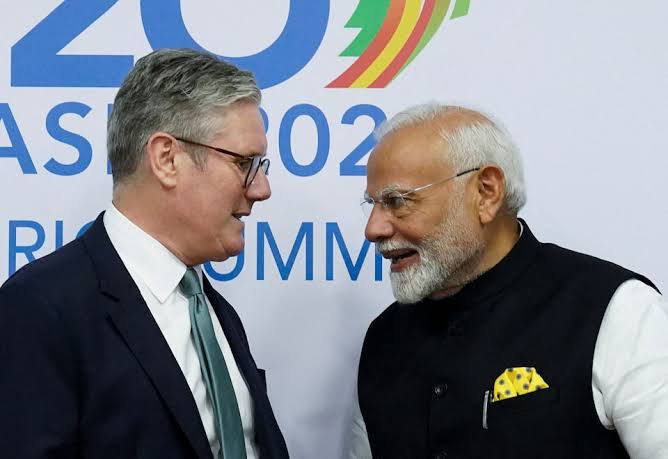
LONDON – India and the United Kingdom on Thursday signed a historic Free Trade Agreement (FTA), hailed as a significant step towards bolstering economic ties and aiming to substantially increase bilateral trade. The Comprehensive Economic and Trade Agreement (CETA) was formally inked during Indian Prime Minister Narendra Modi’s official visit to the UK, where he met with British Prime Minister Keir Starmer.
The agreement, which had been under negotiation for an extended period, is projected to boost bilateral trade by approximately $34 billion annually and set a joint goal of doubling current trade to $120 billion by 2030. The signing marks a pivotal moment for both nations, solidifying their “Comprehensive Strategic Partnership.”
Key provisions of the landmark deal include substantial tariff reductions and eliminations across a wide range of goods and services. For India, nearly 99% of its exports to the UK will gain duty-free access, particularly benefiting labor-intensive sectors such as textiles, leather, footwear, gems and jewelry, and various agricultural products like turmeric, pepper, and mango pulp. This move is expected to significantly enhance the competitiveness of Indian goods in the British market.
Conversely, India will also see reductions in tariffs on key British exports. Tariffs on iconic British products like Scotch whisky and gin are set to be halved immediately from 150% to 75%, with a further reduction to 40% within a decade. Duties on British automobiles will also see a significant drop from over 100% to 10% under a quota system, making luxury and other vehicles more affordable for Indian consumers.
Beyond goods, the FTA also addresses services, aiming to facilitate market access and promote digital trade. A crucial element for Indian professionals is the Double Contribution Convention (DCC), which will exempt Indian workers and their employers from social security contributions in the UK for up to three years, providing substantial savings.
The agreement comes amidst a push by both countries to strengthen economic resilience and diversification of supply chains. Both Prime Ministers expressed confidence that the FTA would unlock new opportunities for businesses, foster growth, and create jobs in both economies.
While the deal has been signed, it still requires ratification by the British Parliament before it officially comes into force. However, the move has been widely welcomed by industry leaders and business associations in both India and the UK, who see it as a transformative milestone for their respective economies.