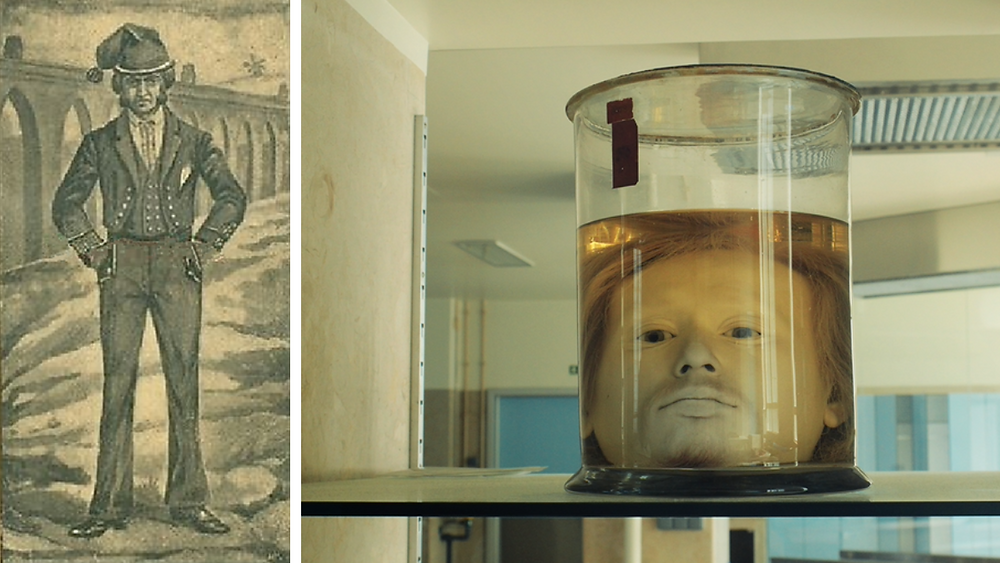
Lisbon: In the annals of Portugal’s history, there is no figure more bizarre and terrifying than Diogo Alves, a notorious 19th-century Spanish criminal. Known as the ‘Aqueduct Killer,’ his legacy extends far beyond his heinous crimes, as his severed head remains a subject of endless fascination and research, preserved in a flask at the Faculty of Medicine at the University of Lisbon. It serves as a grim artifact, a remnant of a bygone era’s attempt to understand the criminal mind through the now-discredited pseudo-science of “criminal physiognomy.”
From Farmhand to Feared Killer
Born in 1810 in Galicia, Spain, to a peasant family, Alves earned the nickname “Blunt” after a childhood incident where he fell from a horse and hit his head. At the age of nine, his parents sent him to Lisbon for work, where he initially found a job as a stable boy. However, his path soon took a darker turn. He abandoned his work and correspondence with his family, succumbing to a life of drinking and gambling.
A Reign of Terror at the Aqueduct
Alves’s reign of terror began in 1836, centered around the Águas Livres Aqueduct, a magnificent architectural feat that provided Lisbon with water. Targeting poor rural laborers and merchants traveling alone, Alves would rob them and then push them from the 60-meter-high aqueduct bridge to their deaths. He staged the murders to look like suicides, a common occurrence at the time due to the country’s economic crisis. It is estimated that he murdered more than 70 people in this manner.
After a few years, Alves formed a criminal gang, escalating his crimes from robbery to home invasions and more brutal murders. As his notoriety grew, he became widely known as “The Aqueduct Murderer.”
Capture, Conviction, and a Macabre End
The police intensified their investigation, and Alves was finally apprehended after his gang committed a series of home robberies, unrelated to the aqueduct murders.
The court’s proceedings were heavily reliant on the testimony of a young girl named Maria da Conceição, whose mother was a victim of the gang. Although the aqueduct murders were never officially proven against him, Alves was convicted of other crimes and sentenced to death.
On February 19, 1841, Diogo Alves was hanged. In a macabre twist of fate, his head was severed from his body and placed in a flask. This act was driven by the then-popular science of phrenology, which posited that a person’s character and criminal tendencies could be determined by the shape of their skull. This grim relic was intended for scientific study at the University of Lisbon’s Faculty of Medicine, where it remains to this day.
Authenticity and Academic Value: Expert Opinion.
While the story of Diogo Alves is often sensationalized, his case holds significant historical and academic value. The preservation of his head is a tangible link to a period when scientists were exploring the connection between physical features and criminal behavior.
“Diogo Alves’s head is a unique and chilling piece of history,” says Dr. António Santos, a forensic psychologist and historian. “It represents a critical point in the history of forensic science, a time when we were moving away from purely speculative ideas about criminality and beginning to look for physical evidence, albeit in a misguided way.”
The case of Diogo Alves is still studied in the field of forensic psychology. The preserved head has not only become a tourist attraction but also an enduring subject for psychological and scientific observation.
“The head in the flask is not just a curiosity; it’s a poignant reminder of our past attempts to understand the dark corridors of the human mind,” Dr. Santos added. “It shows how far we’ve come in our understanding of crime and the brain, but it also underscores the enduring human desire to find a physical explanation for evil.”
Over 180 years after his death, Diogo Alves’s preserved head continues to serve as a beacon, shedding light on the darker aspects of human nature and the evolution of criminal science.