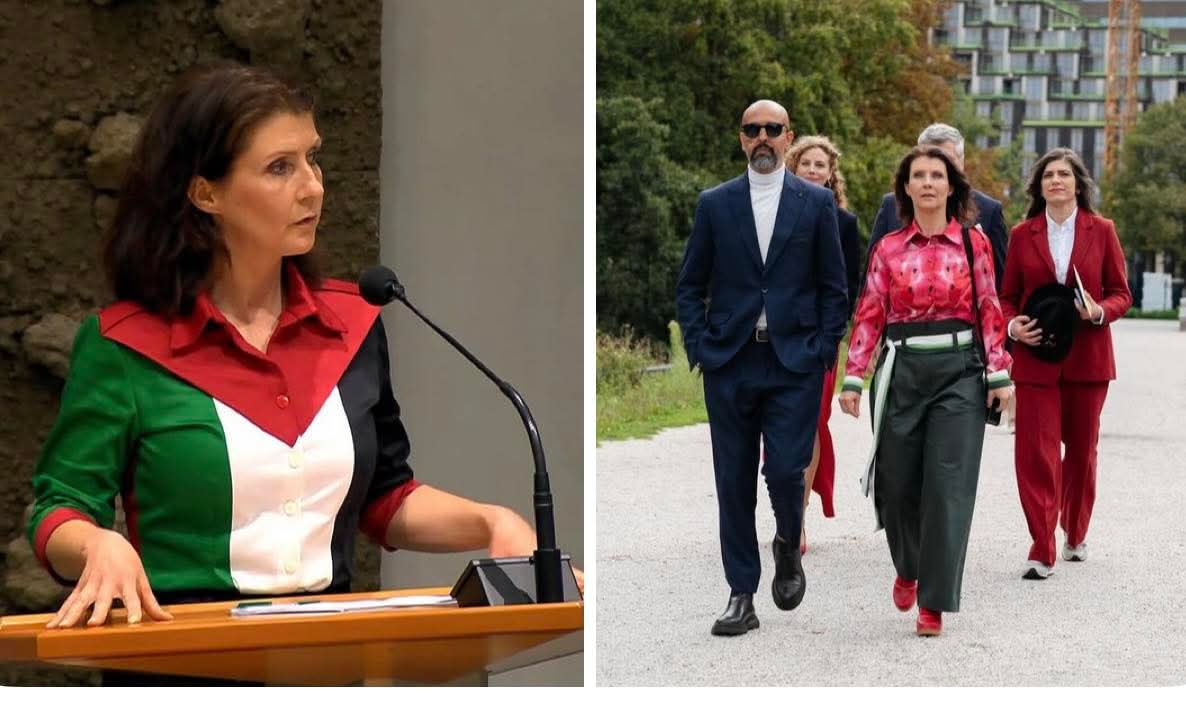
THE HAGUE – A Dutch Member of Parliament who was recently expelled from a parliamentary budget debate for wearing clothing in the colors of the Palestinian flag has returned to the chamber in a new sartorial protest. The MP, Maaike van der Werf, arrived for the debate on a new budget wearing a black t-shirt with a watermelon print.
The incident occurred during a parliamentary discussion on the country’s national budget. Van der Werf, a member of the socialist party, had previously been told to leave the assembly for wearing a traditional Palestinian keffiyeh. When she returned, she was wearing a top with a pattern featuring the colors of the Palestinian flag. This led to a heated exchange with the speaker of the parliament, who insisted that “a parliament is a place for the exchange of ideas, not for political symbols.”
The new watermelon-themed attire is a subtle yet powerful gesture of protest. The watermelon has become a global symbol of Palestinian solidarity, as its colors—red, black, white, and green—are the same as those of the Palestinian flag. This symbol gained prominence during periods when the Israeli government had banned the public display of the Palestinian flag. Activists have since adopted the watermelon as a form of non-verbal protest against the occupation.
Van der Werf’s actions have drawn both criticism and praise. Her supporters argue that she is using her platform to shed light on a human rights issue and to stand in solidarity with the Palestinian people. Critics, however, argue that her actions violate parliamentary decorum and distract from the legislative process. The incident highlights the ongoing debate about the role of political symbols in formal settings and the deep-seated emotions surrounding the Israeli-Palestinian conflict.