Beirut, Lebanon:
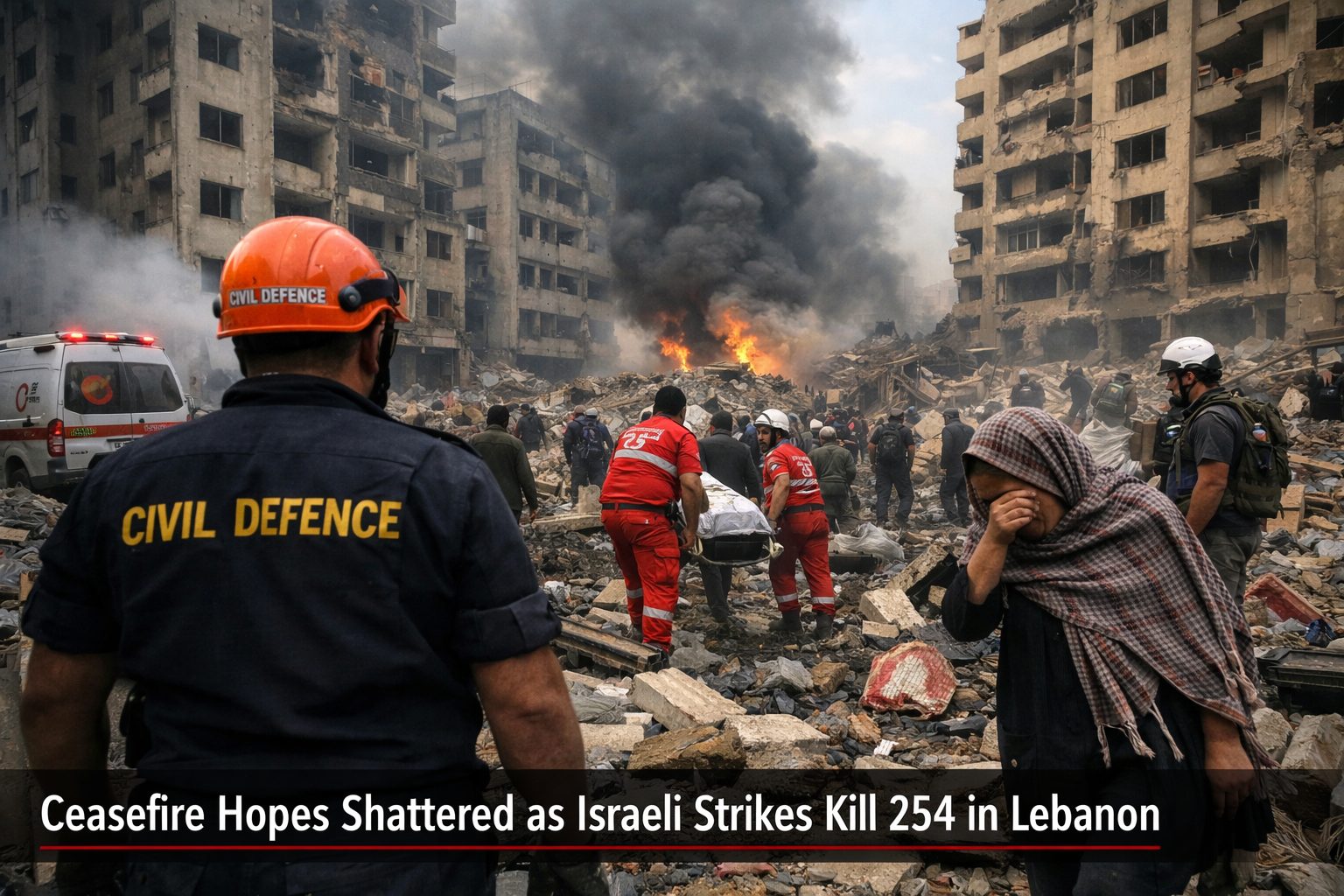
Hopes for a ceasefire in the Middle East were severely undermined after Israel launched a series of intense airstrikes on populated areas across Lebanon, resulting in the deaths of at least 254 people and injuring more than a thousand others, according to Lebanese authorities.
Escalation Amid Ceasefire Expectations
The attacks occurred shortly after diplomatic efforts raised expectations of a temporary ceasefire in the region. However, Israeli officials clarified that Lebanon was not included in the proposed truce, leading to continued military operations targeting what Israel described as Hezbollah positions.
Airstrikes were reported in several regions, including Beirut, southern Lebanon, and the Bekaa Valley, causing extensive destruction to residential neighborhoods and critical infrastructure.
Heavy Civilian Toll
Lebanon’s Civil Defence and health authorities reported that many of the victims were civilians, as several residential buildings were struck during the bombardment. Hospitals in the affected regions have been overwhelmed with casualties.
“The casualty figures are appalling and deeply concerning,” a United Nations spokesperson said, calling for an immediate de-escalation and protection of civilians.
Emergency responders indicated that rescue operations were ongoing, with fears that the death toll could rise as teams continue to search through the rubble.
Israel’s Position
The Israeli military stated that the strikes were aimed at Hezbollah military infrastructure, asserting that the operations were necessary to neutralize security threats.
“We targeted Hezbollah’s operational sites and command centers,” the Israel Defense Forces (IDF) said in an official statement, emphasizing that measures were taken to minimize civilian harm.
International Reactions
The international community has expressed grave concern over the escalation. The United Nations condemned the scale of the violence and urged all parties to exercise restraint.
Volker Türk, the UN High Commissioner for Human Rights, stated:
“The level of destruction and the loss of civilian life are deeply alarming.”
Several countries have also warned that the escalation could destabilize the broader Middle East and derail ongoing diplomatic efforts aimed at securing peace.
Humanitarian Concerns
Aid organizations have described the situation as a growing humanitarian crisis, with thousands of residents displaced and essential services severely disrupted. Medical facilities are struggling to cope with the influx of injured civilians, while shortages of supplies are being reported.
A humanitarian worker in Beirut described the situation as:
“Complete chaos, with families fleeing and emergency teams racing against time to save lives.”
Summary
- Death toll: At least 254 people
- Injured: More than 1,000
- Locations affected: Beirut, southern Lebanon, Bekaa Valley
- Target claimed by Israel: Hezbollah military infrastructure
- International response: Strong condemnation and calls for restraint
- Humanitarian impact: Mass displacement and overwhelmed hospitals
Sources
- Reuters – Reports on UN condemnation and casualty figures.
- The Guardian – Coverage of the scale and continuation of Israeli military operations.
- The Washington Post – Details on ceasefire diplomacy and regional implications.
- Al Jazeera – Regional reporting on casualties and humanitarian conditions.