Murali Kottakkal
It was long ago, in the intoxicating days of youth and literature, that I first read M. Mukundan’s novel, ‘Haridwaril Manimuzhangunnu’ (The Bell Tolls in Haridwar). Since then, a silent wish had taken root—to visit this place, just like the novel’s character, Rameshan. Years have flown by. Life’s necessities replaced youthful indulgences, and the direction of my journey shifted. Now, after what feels like an eternity, I was finally setting off—to Mukundan’s Haridwar.

Sitting on the train (Thiruvananthapuram to Yog Nagari Rishikesh), the memories flowed. We were a group of eight: Raju, his wife Reena, and daughter Anagha (Raju Mohan from Kottakkal); Co-operator Hareeshwaran and Usha Chechi (from Tirur); Ujjwal (the Chenda artist); and my wife Asha and I. Our compartment was full of children returning from a Goa tour and heading to Jaipur. Amidst their joyful noise, I dreamt of the Haridwar of my memory, the one I’d read and almost forgotten.

Day 1: Gateway to Heaven
On October 5, 2025, we alighted in Haridwar around noon. We had arrived at the ‘Gateway to Heaven’. For lunch, we enjoyed a simple, delicious meal of kanji (rice gruel) and green gram curry at the Ayyappa Temple run by Raju’s acquaintance, Vishnu Namboothiri.
The evening was dedicated to the Holy Ganga: a dip in its sacred waters, a visit to the Mansa Devi Temple atop the hill, and witnessing the spectacular Ganga Aarti. I felt a stirring within me—a desire to pray, a long-dormant wish to see God. Our guide was a Swamiji, a friend of Raju’s, whose sincere guidance made our journey seamless.

The Road to Kedarnath
Day 2: Troubles and Triumphs on the Trail
At 7 a.m. the next day, we left Haridwar for Sona Prayag, a 265 km journey. We had hired a Traveller van. Our lunch, prepared by the Swamiji on the banks of the Ganga, was a unique experience. However, the old van, a real wreck, broke down repeatedly, testing our patience early on.
The Swamiji was insistent that we eat no outside food, leading to us preparing meals by riverbanks or in deserted spots. This turned out to be a blessing, as none of us suffered any stomach trouble. During one of the breakdowns, we sat inside the van, making and baking chapatis—a scene straight out of the movie Parakkum Thalika! We finally abandoned the faulty vehicle, booked a room for the night, and a new van arrived the next morning.
The journey resumed. We stopped to pray at the Triyuginarayan Temple and Guptakashi.

- Triyuginarayan Temple: Here, we saw the Agnikund (sacred fire pit) that is believed to have been burning for three yugas. Legend holds that Shiva and Parvati were married here, with Vishnu as the celebrant. It was a moment of reflection, even noticing the commercial side—\text{₹}100 to place a twig in the eternal fire.

- Guptakashi: The place is named after the legend where the Pandavas sought to atone for their sins after the Kurukshetra war. Shiva appeared here and then vanished (gupta), making it Guptakashi. Later, Shiva appeared in Kedarnath as a bull. The parts of the bull’s body are worshipped at the Panch Kedar sites: the hump at Kedarnath, the arms at Tungnath, the face at Rudranath, the navel/middle at Madhyamaheshwar, and the hair/tail at Kalpeshwar (near the former Chimoli).
We reached Sona Prayag late in the evening and booked accommodation.
The Ascent to Kedarnath
Day 3: The Hard Climb
We woke up at 3:30 a.m. and set off for Kedarnath. A \text{5 km} jeep ride took us from Sona Prayag to Gaurikund.
At Gaurikund, a fascinating sight awaited: a pool of boiling hot water right next to the icy-cold Ganga. This kund is said to have been dug by Rishis for Parvati to bathe in while she performed penance for Shiva. From here, the arduous climb to Kedarnath began.
Everyone was armed with a bamboo stick (₹30 each)—a symbol perhaps that life’s journey, even to the Divine, must be walked on our own two feet, albeit with a support. The climb to Kedarnath is {16 km}. For those who couldn’t walk, there were options: pony rides, kandi (basket carried on the back), or doli (palanquin carried by four people). We were advised to carry only essentials in our shoulder bags, as the load makes the climb difficult.
The path was difficult, but resting points with stone benches, refreshing streams of clear water, and small roadside eateries offered respite. At one point, I questioned why I had undertaken such a hard journey. We started walking at 5 a.m. and reached the summit at 5 p.m.—a {12}-hour trek, including a lunch break of four chapatis and tomato curry.
The trek demanded constant vigilance, especially to avoid the ponies that could easily push one towards the gorge. The path, muddy and filled with horse dung, was challenging, leaving us splattered and smelling of it by the time we reached the top.

The Divine View
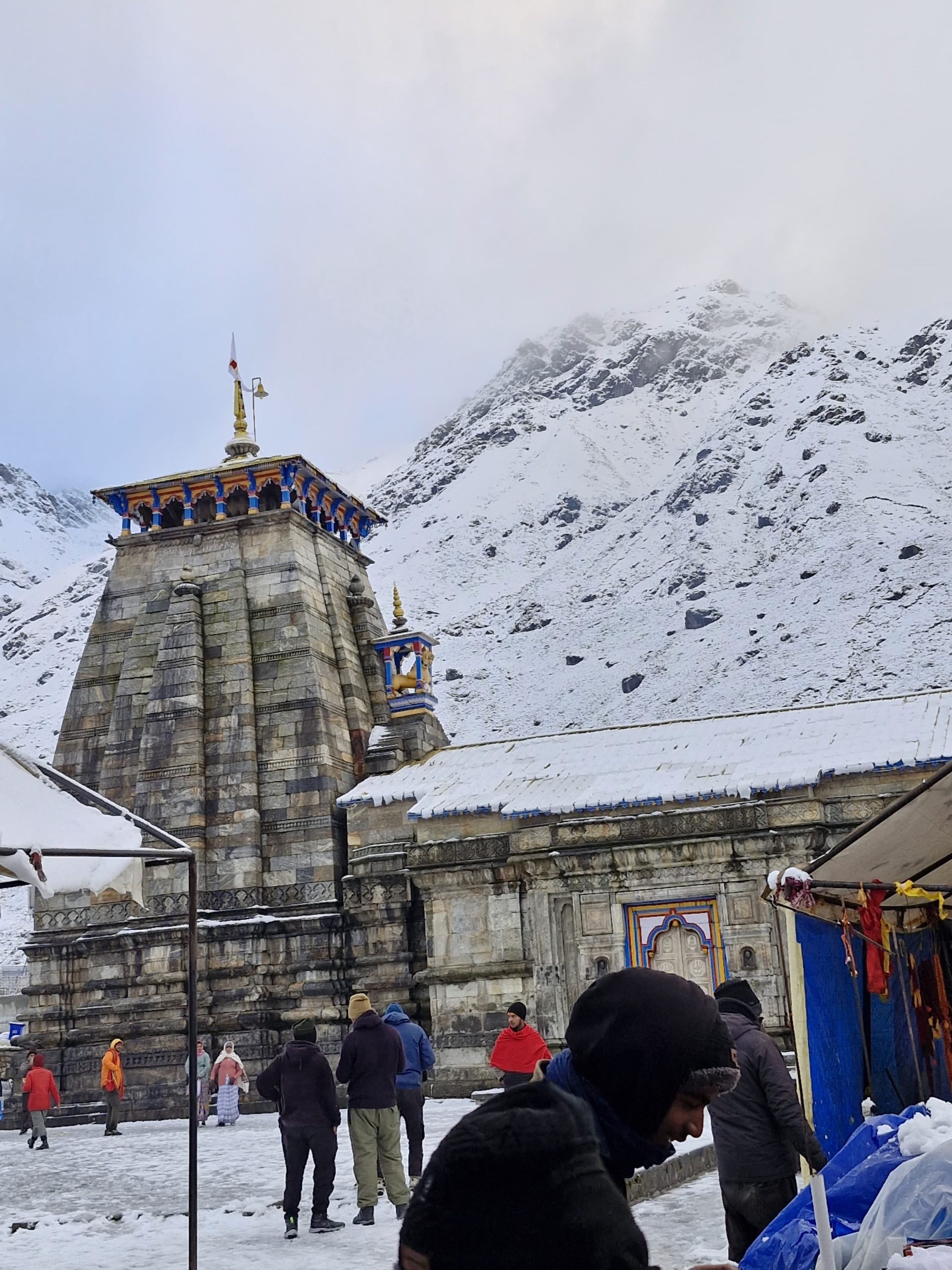
Upon reaching the summit, however, the majestic view of the Himalayas was breathtaking, making us forget all the exhaustion. The snow-capped mountains kept changing colour and form—from white to golden to blue. We encountered rain and snowfall, and the temperature was a chilling minus 4 degrees Celsius.
Despite the occasional unkindness of man, this is truly Devbhumi (Land of the Gods) due to the sheer abundance of nature. Locals believe that when the temples close in October/November due to heavy snow and people descend, the deities themselves ascend to perform worship for the next six months, with the sound of bells occasionally heard in the silence.
We stayed in tents, while the ladies got a tin-roofed room. After witnessing the temple’s deeparadhana (worship with lights), we retired. The night brought heavy snowfall, the sound thudding on the tent, which was a little unsettling.
Day 4: Snow and Spirituality
Waking up, we were surrounded by snow-capped peaks—an unbelievable sight. The path to the temple was blanketed in snow. In the morning, devotees are allowed inside to touch and worship the idol. We also visited the Bhairavnath Temple, located {500 m} above the Kedarnath Temple.
After darshan, we had a satisfying meal of rice and paripu (lentil) curry. We had crossed noon, but surprisingly, none of us felt hungry or tired. Small cups of ginger tea (₹30 per ounce!) kept us going.
We began our descent in the afternoon. The return journey took about nine hours. We rested that night.
Tungnath and Badrinath
Day 5: The Highest Abode and the Road Ahead
The next morning, we headed for Tungnath, the highest Shiva temple in the world, via Chopta. The road through Chopta, often called the ‘Switzerland of India’, was stunningly beautiful.
The climb to Tungnath, though only \text{4 km}, was steep and difficult, taking us two and a half hours. After our darshan, we descended to find the Swamiji had prepared a meal for us in the valley. We ate and proceeded towards Badrinath. Given the perils of night driving on the mountain roads, especially with roads damaged by floods, we stopped and took a room en route.
Day 6: A Land of Conflict and Legend
The journey to Badrinath, via Chamoli, showed us roads and mountains ravaged by floods. It was a stark reminder of the perpetual conflict between nature and man here, making us truly appreciate why our own Kerala is called “God’s Own Country.”
We first visited Mana Village, the last Indian village on the Indo-China (Tibet) border, \text{2 km} from Badrinath.

- Vyas and Ganesha Caves: We visited the Vyasa Cave (above) and the Ganesha Cave (below). Legend states that Vyasa dictated the Mahabharata here, and Ganesha transcribed it.
- Next to the Ganesha Cave is the ‘First Tea Shop of India’ (earlier perhaps the ‘Last Tea Shop,’ a title changed by the Modi government). We had tea and biscuits from there, along with some pokka vada (pakora) courtesy of Usha Chechi.
- The road to the caves is lined with huts of local weavers, who craft sweaters and socks—a cottage industry.
- Nearby is the source of the River Saraswati and a large statue of the Pandavas, Draupadi, and the dog embarking on the Mahaprasthana (final journey). Looking at the scene, one truly feels that Paradise must lie beyond.
In Badrinath, we stayed and ate at the guesthouse of Raju’s acquaintance, Shankarettan. In the evening, we trekked up the Neelkanth Peak. Below the mountain, facing the Badrinath Temple, we saw the Vishnu Paduka (footprint) and, nearby, the Gupta Ganga. We descended into a small cave and heard the sound of the Ganga flowing; the Swamiji even collected water for us from a tiny channel.
We met a sanyasi (ascetic) at an ashram nearby, who introduced himself as being from the Shankaracharya tradition. However, his reluctance when it came to dakshina (donation) made me wonder if asceticism had become another profession here.
Inside the Badrinath Temple, Vishnu is in a yoga nidra (meditative sleep) posture. The temple was crowded, but we managed to offer our prayers. It is believed that thunder and lightning here are only soft rumbles and flashes, never disruptive, so as not to disturb the sleeping deity. Dogs are also said not to bark in Badrinath.
Badrinath was the coldest part of our entire journey. 
The Farewell
The next morning, we set off for Haridwar—a journey of over \text{300 km}. We reached Haridwar in the evening and stayed and ate at Vishnu Namboothiri’s guesthouse.
I must thank Raju, who was the catalyst for this trip. I’m generally indolent, but he enthusiastically pushed me to join. Missing this journey would have been a great loss.
Usha Chechi, a retired veterinary doctor, was the most senior member of our group, yet she has devoted her retirement to tireless travel. Raju’s daughter, Ammu, was the youngest. Their enthusiasm fuelled us all, making us forget our exhaustion.
I was most amazed by my wife, Asha. At home, she often complained of knee pain climbing the stairs, yet she completed both mountain treks without much difficulty. Ujjwal deserves special mention for his hard work and cheerful assistance, adhering to all the Swamiji’s instructions.
This journey in the company of such good-hearted people has been truly fulfilling. Our week-long pilgrimage concluded. We took the train from Yog Nagari to Delhi and a flight back home.
Farewell, Haridwar! Farewell to this holy land, a repository of ancient memories. This return is only temporary. I will come again. I will return to this sacred, ancient land, if only to shed the ‘ego’ in my heart. I will surely return.