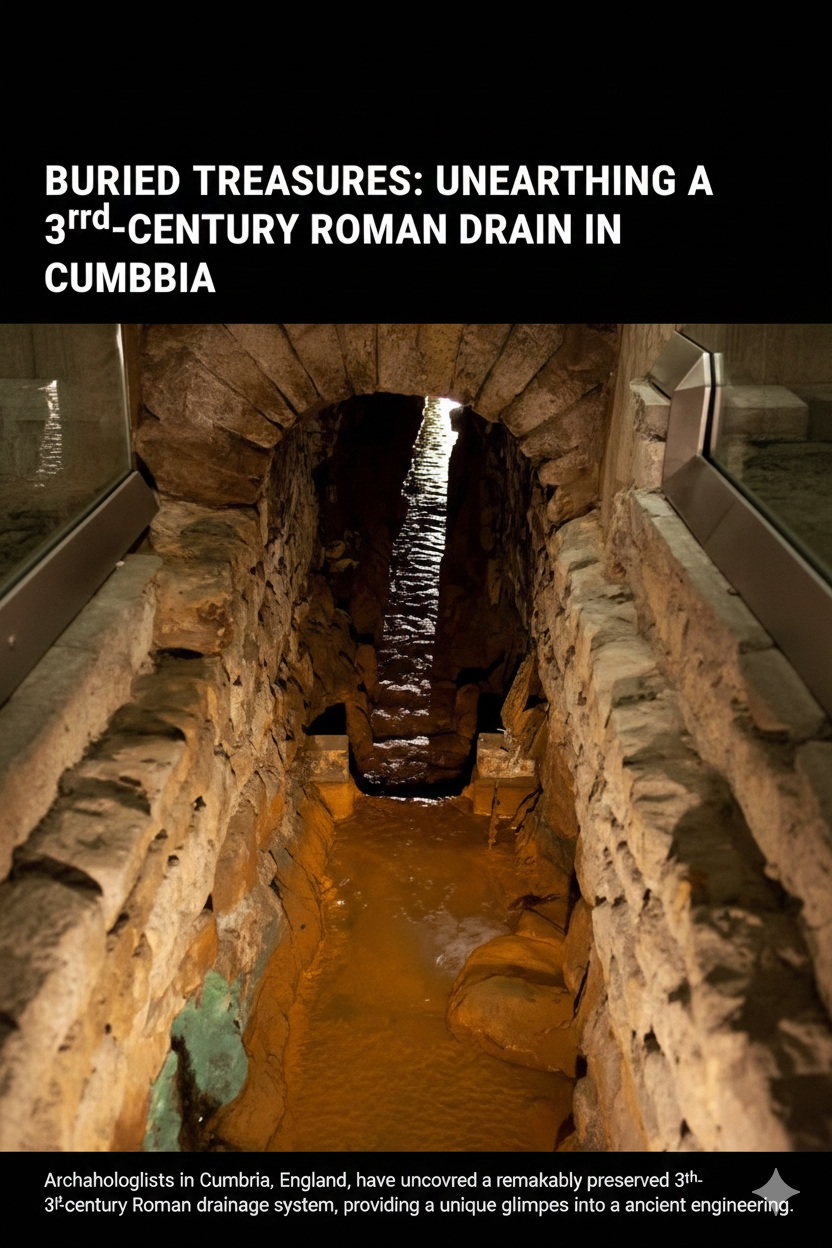
Beneath the modern streets of Carlisle, Cumbria, an extraordinary relic of Roman Britain has emerged—an almost four-meter-deep (around 13 feet) Roman drain dating back to the 3rd century CE. Discovered at the site of a Roman bathhouse, this remarkably preserved structure offers a vivid glimpse into the sophisticated urban planning and engineering expertise that sustained life on the north-western frontier of the Roman Empire.
A Hidden World Below Modern Carlisle
At first glance, the image of the drain is striking for its sheer depth. From the base of the stone-lined channel to the present-day ground level above, nearly four meters of accumulated soil, debris, and history separate modern Carlisle from its Roman predecessor. This vertical distance is more than a physical measurement—it symbolizes centuries of continuous human occupation layered one atop another.
Carlisle, known in Roman times as Luguvalium, was a key settlement and military hub near Hadrian’s Wall. Its strategic importance demanded not only strong defenses but also reliable civic infrastructure. The drain uncovered at the bathhouse site demonstrates that Roman planners paid as much attention to sanitation and water management as they did to fortifications.
Engineering Excellence on the Edge of Empire
Roman drains were not crude channels but carefully designed systems. Constructed from stone and engineered with precise gradients, they ensured the steady flow of wastewater away from public buildings such as bathhouses—centers of social, cultural, and hygienic life in Roman towns. The Cumbria drain reflects these principles: robust masonry, thoughtful alignment, and durability sufficient to survive nearly 1,800 years underground.
The depth of the structure suggests long-term planning. Roman engineers anticipated the need for effective drainage even as ground levels changed over time due to rebuilding, flooding, and urban development. Such foresight underscores the Romans’ advanced understanding of civil engineering, even in distant provincial towns far from Rome itself.
Insights into Daily Roman Life
Beyond its technical brilliance, the drain provides valuable clues about everyday life in Roman Britain. Bathhouses were among the most important communal buildings in any Roman settlement, serving not only for bathing but also for socializing, conducting business, and relaxation. A well-maintained drainage system was essential to keep these spaces clean and functional.
Archaeologists often find discarded objects—pottery fragments, coins, organic waste—within drains, making them accidental time capsules. Although details of associated finds may vary, such structures frequently help researchers reconstruct patterns of diet, trade, and domestic habits among Roman inhabitants.
From Roman Luguvalium to Modern Carlisle
The discovery also highlights how deeply Roman Carlisle lies beneath the modern city. Over centuries, buildings collapsed, were rebuilt, or repurposed, gradually raising ground levels. The Roman drain, now far below street level, reminds us that today’s urban landscape is built directly atop ancient foundations.
This continuity reinforces Carlisle’s significance as one of Britain’s longest-inhabited urban centers. Each archaeological find adds another chapter to the story of how Roman military outposts evolved into medieval towns and, eventually, modern cities.
Why This Discovery Matters
Finds like the 3rd-century Roman drain are not merely architectural curiosities. They reshape our understanding of Roman Britain as a place of advanced infrastructure, administrative order, and everyday comfort—even on the empire’s fringes. Such discoveries also emphasize the importance of urban archaeology in revealing hidden histories beneath familiar surroundings.
As excavation and research continue, the Carlisle bathhouse drain stands as a powerful reminder: beneath our feet lie the remnants of civilizations whose ingenuity still impresses, whose daily routines echo faintly through stone channels, and whose legacy continues to shape the cities we inhabit today.