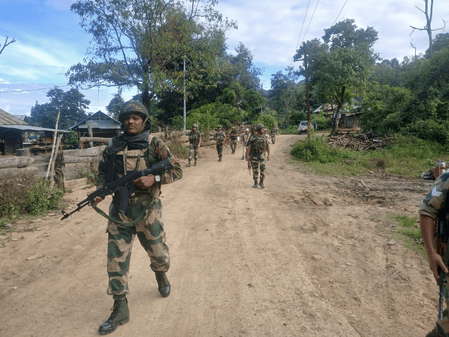
NAMSAI, October 23, 2025: In a major breakthrough for counter-insurgency efforts in Northeast India, a senior militant leader of the banned United Liberation Front of Assam-Independent (ULFA-I) was killed in a joint operation conducted by the Indian Army and Assam Rifles in Namsai district, Arunachal Pradesh.
The slain insurgent, identified as Iwon Axom (also known by his alias Abhikeshwar Moran), held the rank of self-styled Sergeant Major within the ULFA-I hierarchy. He was neutralized during the early hours of Wednesday, following a fierce exchange of fire in the MS-6 area of Namsai.
Security officials confirmed that Axom was a key operational figure and is suspected to have played a major role in the October 17 attack on an Army camp in Kakopathar, Assam, in which three soldiers were injured.
Following the encounter, the joint team recovered one rifle, an RPG (Rocket-Propelled Grenade) round, and several rucksacks from the site, indicating the militant’s preparedness for a potential offensive. The successful operation reflects the security establishment’s sustained momentum in neutralizing insurgent threats along the Assam–Arunachal border, a region long exploited by armed groups for cross-border movements and logistics.
Expert Analysis: Sustaining Peace Beyond the Battlefield
While the elimination of a top ULFA-I operative is a tactical success, counter-insurgency experts emphasize that lasting peace in the Northeast demands a broader, multidimensional approach that integrates military, political, socio-economic, and diplomatic strategies.
1. Military Precision Coupled with Diplomacy
- Targeted Operations: Intelligence-driven, small-unit operations like the Namsai encounter are critical for dismantling command structures of groups such as ULFA-I and NSCN-KYA, particularly those operating from trans-border sanctuaries in Myanmar.
- Peace Dividend through Dialogue: Analysts stress the need to complement military successes with sustained political dialogue, similar to the Mizo Peace Accord (1986) and the Bodo Peace Accord (2020). Genuine engagement addressing political and ethnic grievances remains essential to achieve lasting reconciliation.
2. Socio-Economic Integration and Governance Reform
- Accelerated Development: Insurgencies often thrive amid economic marginalization and youth unemployment. Experts argue for greater investment in infrastructure, education, and skill-building in remote districts to “win hearts and minds” and prevent the re-emergence of militant support bases.
- Good Governance: Strengthening local governance, ensuring transparency, and reducing corruption are vital to restore faith in state institutions and minimize insurgent influence.
- Rehabilitation Policies: Comprehensive surrender and rehabilitation programs can encourage militants to return to mainstream society through education, vocational training, and livelihood opportunities.
3. Border and Diplomatic Cooperation
- Enhanced Border Security: The porous frontiers with Myanmar, Bangladesh, and Bhutan continue to serve as escape routes and supply corridors for insurgent groups. Advanced surveillance tools — including drones and smart fencing systems — are being deployed to counter such movement.
- Cross-Border Coordination: India’s ongoing cooperation with neighboring governments, particularly Bangladesh and Myanmar, has been pivotal in dismantling rebel hideouts. Continuous diplomatic engagement is viewed as essential to maintaining this strategic advantage.
Conclusion: A Step Forward, A Long Road Ahead
The Namsai operation represents a decisive blow to ULFA-I’s regional network and reaffirms India’s evolving counter-insurgency doctrine that blends precise military action with long-term peace-building initiatives.
However, experts caution that the path to enduring peace in the Northeast lies not merely in defeating insurgent factions, but in addressing the socio-political and economic roots that fuel militancy in the first place.
Source: Indian Army & Assam Rifles Joint Statement / Field Reports; Expert Inputs Compiled from Defense Analysts and Regional Security Experts (October 23, 2025).