CUSCO, PERU — Standing at the very center of the ancient Inca capital, the Coricancha — also spelled Qorikancha, meaning “Golden Temple” in Quechua — remains one of the greatest architectural and spiritual achievements of pre-Columbian America. Once the most revered temple in the vast Inca Empire, Coricancha was dedicated to Inti, the Sun God, and served as the cosmic and political heart of the Andean world.
Today, even in its partially ruined state, the site’s mortared stonework — or rather, the lack thereof — continues to astonish archaeologists and engineers. The seamless, mortarless masonry of Coricancha is regarded as among the finest examples of ancient precision stone-cutting and seismic-resistant construction in human history.
The Temple of the Sun: A Spiritual and Political Nexus
Built during the reign of Pachacuti Inca Yupanqui (1438–1471 CE), Coricancha was the most sacred temple in the Inca realm — the axis mundi, or “center of the world,” where heaven, earth, and the underworld were believed to converge.
According to 16th-century Spanish chroniclers, its interior walls were once lined with sheets of pure gold, reflecting the sun’s rays in dazzling brilliance. The temple complex also contained shrines dedicated to the Moon (Mama Killa), Venus (Chaska), the Thunder God (Illapa), and the Rainbow deity (K’uychi) — symbolizing the cosmic order that governed Inca religion and governance.
High priests and astronomer-priests known as willka umu performed celestial observations here, tracking the solstices and equinoxes. These observations regulated the empire’s agricultural calendar and reinforced the divine authority of the Sapa Inca (emperor), believed to be the living child of the Sun.
Mortarless Stonework: The Genius of Inca Engineering
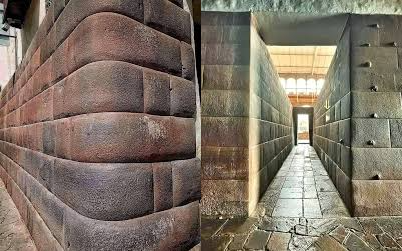
What makes Coricancha an enduring mystery of ancient engineering is its perfectly interlocking stonework — constructed entirely without mortar or cement.
Each stone was hand-carved to fit precisely with its neighbors, often with multiple angled cuts that lock together like a three-dimensional puzzle. The fit is so precise that not even a single sheet of paper or blade of grass can be inserted between the stones.
Modern engineers and seismologists have found that this mortarless technique, known as ashlar masonry, was not merely aesthetic but seismically functional. The trapezoidal doorways and inwardly inclined walls allowed the structures to flex and absorb seismic energy, an essential adaptation in earthquake-prone Cusco, which lies on the Andean fault line.
Even after centuries of powerful earthquakes, the Inca foundations of Coricancha remain perfectly aligned — while the colonial structures built atop them have repeatedly collapsed and required rebuilding.
Spanish Conquest and Transformation into the Church of Santo Domingo
When the Spanish conquistadors captured Cusco in 1533, they were astounded by the temple’s wealth and precision. The gold lining of Coricancha was stripped and melted down, and its sacred idols were seized.
To impose the dominance of Christianity, the Spaniards constructed the Convent and Church of Santo Domingo directly atop the temple’s Inca foundations — a powerful symbol of colonial appropriation.
Yet, ironically, it was the Inca masonry that preserved the church itself: when major earthquakes struck Cusco in 1650, 1950, and 1986, the colonial walls crumbled, but the Inca stone base stood firm.
Scientific Studies and Modern Research
Contemporary research into Coricancha’s construction techniques has yielded extraordinary insights.
- Material Science: Studies reveal the Incas used andesite and diorite stones, quarried miles away and transported via an elaborate system of ramps, rollers, and manpower — without the use of the wheel or iron tools.
- Precision Cutting: Microscopic analysis suggests abrasive sand and water polishing methods were used to grind surfaces to millimeter accuracy.
- Seismic Design: Structural engineers studying Coricancha’s resilience have described it as a “pre-modern seismic isolation system,” anticipating principles used in today’s earthquake-resistant architecture.
The temple’s layout also reflects astronomical alignments, with walls and niches oriented to the sunrise during solstices — linking the physical and cosmic dimensions of Inca architecture.
Cultural Legacy and Modern Reverence
For the modern Quechua people and Peruvians alike, Coricancha is far more than an archaeological site. It remains a symbol of endurance, representing the resilience of Andean identity and spirituality despite centuries of colonization.
Each year, during the Inti Raymi (Festival of the Sun) — one of the largest traditional festivals in South America — Cusco’s residents reenact ancient Inca rituals honoring the Sun, with Coricancha as the ceremonial starting point.
Tourists and scholars alike continue to visit the site, marveling at its union of engineering, spirituality, and artistry — a lasting reminder that the Incas, often dismissed by early European chroniclers as “primitive,” were in fact among the most sophisticated engineers and astronomers of the ancient world.
Sources:
- Peruvian Ministry of Culture
- Cusco Archaeological Office
- Journal of Archaeological Science (2023)
- UNESCO World Heritage Centre
- Reports from Universidad Nacional de San Antonio Abad del Cusco (UNSAAC)