By Adinath — compiled from reports in Phys.org, Popular Science— December 15, 2025
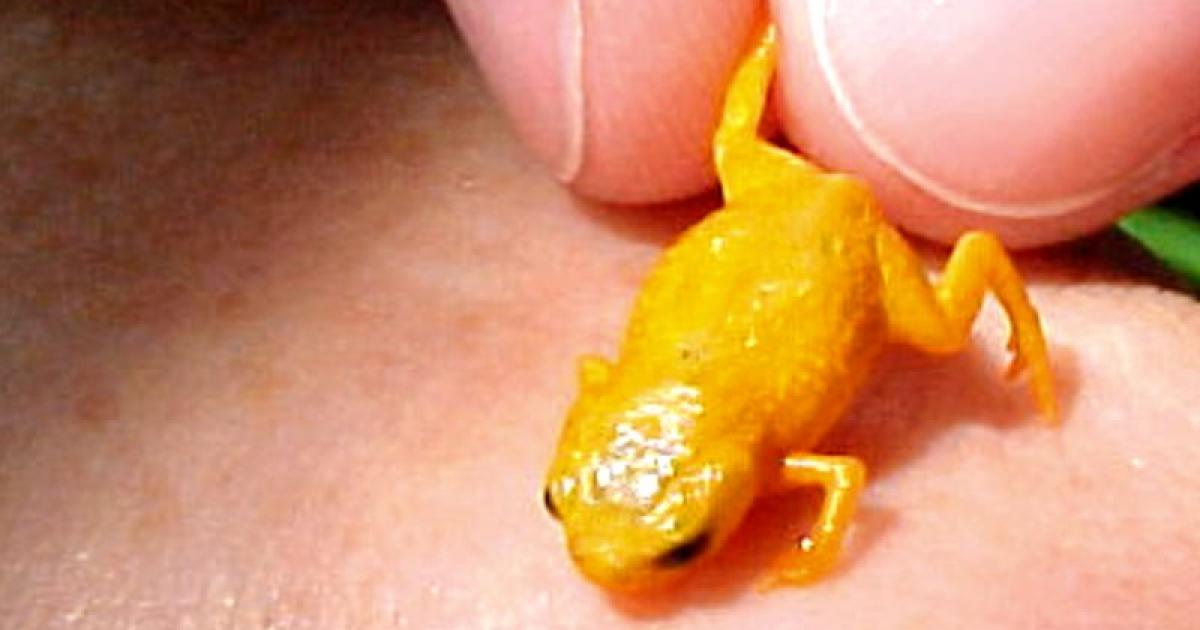
Researchers in southern Brazil have formally described a previously unknown species of miniature frog that is bright orange, no larger than a pencil tip, and hidden in the damp leaf litter of cloud forests in the Serra do Quiriri mountain range. The frog, Brachycephalus lulai, adds to the extraordinary diversity of Brazil’s endemic amphibians and underscores the unique biodiversity of the Atlantic Forest.
The adults of B. lulai measure between approximately 8.9 and 13.4 millimeters in length — making them some of the smallest four-legged vertebrates on Earth — and are distinguished by their vivid orange coloration with small green and brown freckles.
“This new species is unique due to a combination of many characteristics,” said Dr. Marcos R. Bornschein, a biologist at São Paulo’s Universidade Estadual Paulista and co-author of the study published in PLOS One. “But it stands out because of its orange coloration and particular features of its advertisement call, including the presence of four pulses per note.”
The frog’s mating call — a key part of how scientists detected its presence — differs in structure from those of other known Brachycephalus species, helping confirm it as a distinct species in combination with detailed morphological measurements and genetic analysis.
The newly identified frogs inhabit a very limited range at elevations above 750 meters in the misty cloud forests of Serra do Quiriri, a rugged area that straddles the Brazilian states of Santa Catarina and Paraná. These forests are part of the Atlantic Forest biodiversity hotspot, one of the most species-rich but highly threatened ecosystems on the planet.
Scientists named the species Brachycephalus lulai in honor of Brazil’s President Luiz Inácio Lula da Silva. “Through this tribute, we seek to encourage the expansion of conservation initiatives focused on the Atlantic Forest as a whole, and on Brazil’s highly endemic miniaturized frogs in particular,” the authors wrote in their paper.
Although B. lulai currently inhabits relatively pristine and difficult-to-access forest, researchers caution that its extremely limited distribution makes it potentially vulnerable to habitat loss from human activities such as deforestation, grassland burning, and cattle grazing, as well as climate change. They are advocating for stronger protections for the Serra do Quiriri region to preserve its unique amphibian fauna.