Kutch, Gujarat — A Landmark Moment in Global Conservation
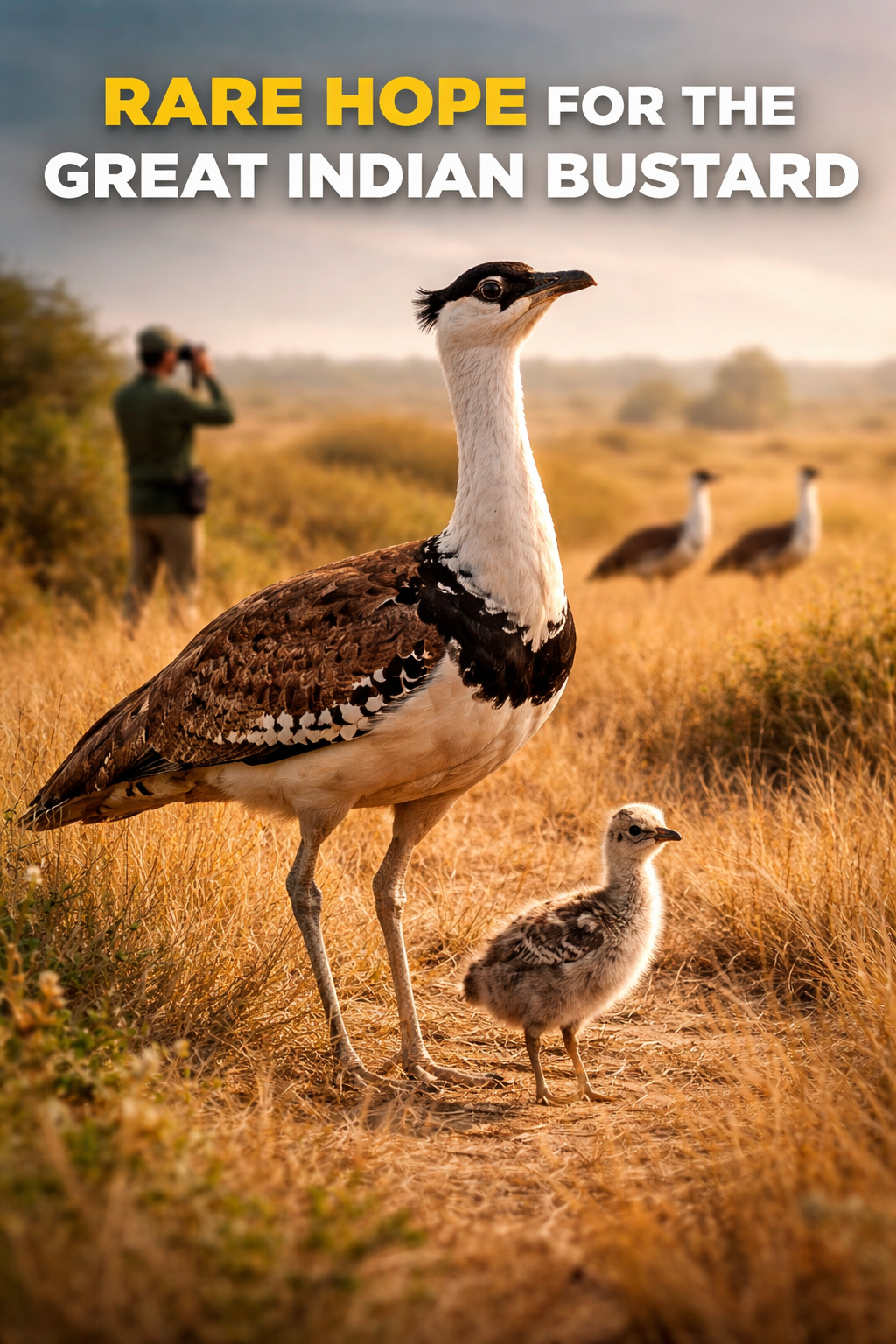
In a remarkable breakthrough for wildlife conservation, India has witnessed a rare and hopeful event in the arid grasslands of Kutch, Gujarat. One of the world’s most endangered bird species, the Great Indian Bustard (GIB), has successfully hatched a chick in the region after a gap of nearly ten years.
This development is not merely a local success story but a globally significant conservation milestone, offering renewed optimism for a species teetering on the brink of extinction.
A Species on the Edge
The Great Indian Bustard, once widespread across the Indian subcontinent, is now critically endangered. With fewer than 150 individuals believed to remain in the wild, its survival is under severe threat.
The bird faces multiple challenges:
- Habitat loss due to expanding agriculture and infrastructure
- Collisions with overhead power lines, a leading cause of mortality
- Extremely low reproductive success, particularly in fragmented populations
Kutch, historically a part of its habitat range, had witnessed a sharp decline in the species, especially due to the absence of male birds—making natural breeding nearly impossible.
The Scientific Breakthrough: ‘Jump Start’ Conservation
To overcome this biological deadlock, conservationists adopted an innovative technique known as the “Jump Start” method, a carefully designed intervention that blends science with the bird’s natural instincts.
How the Operation Unfolded
- An egg, artificially incubated and prepared at a breeding center in Rajasthan, was selected for transfer
- It was transported over a 19-hour road journey under controlled conditions to Kutch
- In the wild, a female bustard had laid an infertile egg due to the absence of a male
- Scientists carefully replaced this egg with the transported viable one
- Crucially, the natural incubation behavior of the female was left undisturbed
On March 26, the effort bore fruit: the egg hatched successfully, marking a rare instance of assisted natural breeding in the wild.
Collaboration Behind the Success
This achievement reflects a high level of coordination among multiple agencies:
- India’s Ministry of Environment, Forest and Climate Change
- State Forest Departments of Gujarat and Rajasthan
- Wild life Institute of India
Their combined expertise in field ecology, captive breeding, and wildlife management played a decisive role in ensuring the success of the operation.
Policy Vision and Conservation Efforts
The breakthrough is closely tied to Project GIB, a flagship initiative launched in 2016 to save the species from extinction.
The project traces its conceptual roots to Narendra Modi , during his tenure as Chief Minister of Gujarat. It continues to receive strong backing from current leadership, including:
- Bhupendra Patel
- Bhupender Yadav
The initiative focuses on habitat protection, captive breeding, threat mitigation, and community involvement.
Why This Moment Matters Globally
Conservationists around the world view this success as a model for saving critically endangered species with extremely low reproductive rates.
Key takeaways include:
- Scientific intervention can complement natural processes without disrupting wildlife behavior
- Interstate collaboration is essential for species that cross ecological boundaries
- Targeted innovation can revive failing populations
The “Jump Start” approach may now serve as a blueprint for similar conservation challenges worldwide.
The Road Ahead
Despite this success, experts caution that the Great Indian Bustard remains in grave danger. Sustained efforts are required to:
- Underground or modify hazardous power lines
- Restore and protect grassland ecosystems
- Expand breeding programs and monitoring
Currently, a dedicated wildlife monitoring team is closely observing the mother and chick to ensure their safety and survival.
A Symbol of Resilience
The birth of this single chick carries immense symbolic weight. It represents not just the continuation of a species, but the success of human determination to correct ecological imbalances.
In a world where biodiversity loss often dominates headlines, the skies over Kutch now carry a rare message of hope—
that even the most fragile life forms can be given a second chance, if science, policy, and commitment come together.
Sources
- official reports
- Ministry of Environment, Forest and Climate Change, Government of India
- Gujarat Forest Department field updates
- Wild Life Institute of India
- Project GIB conservation programme documentation