New Delhi:
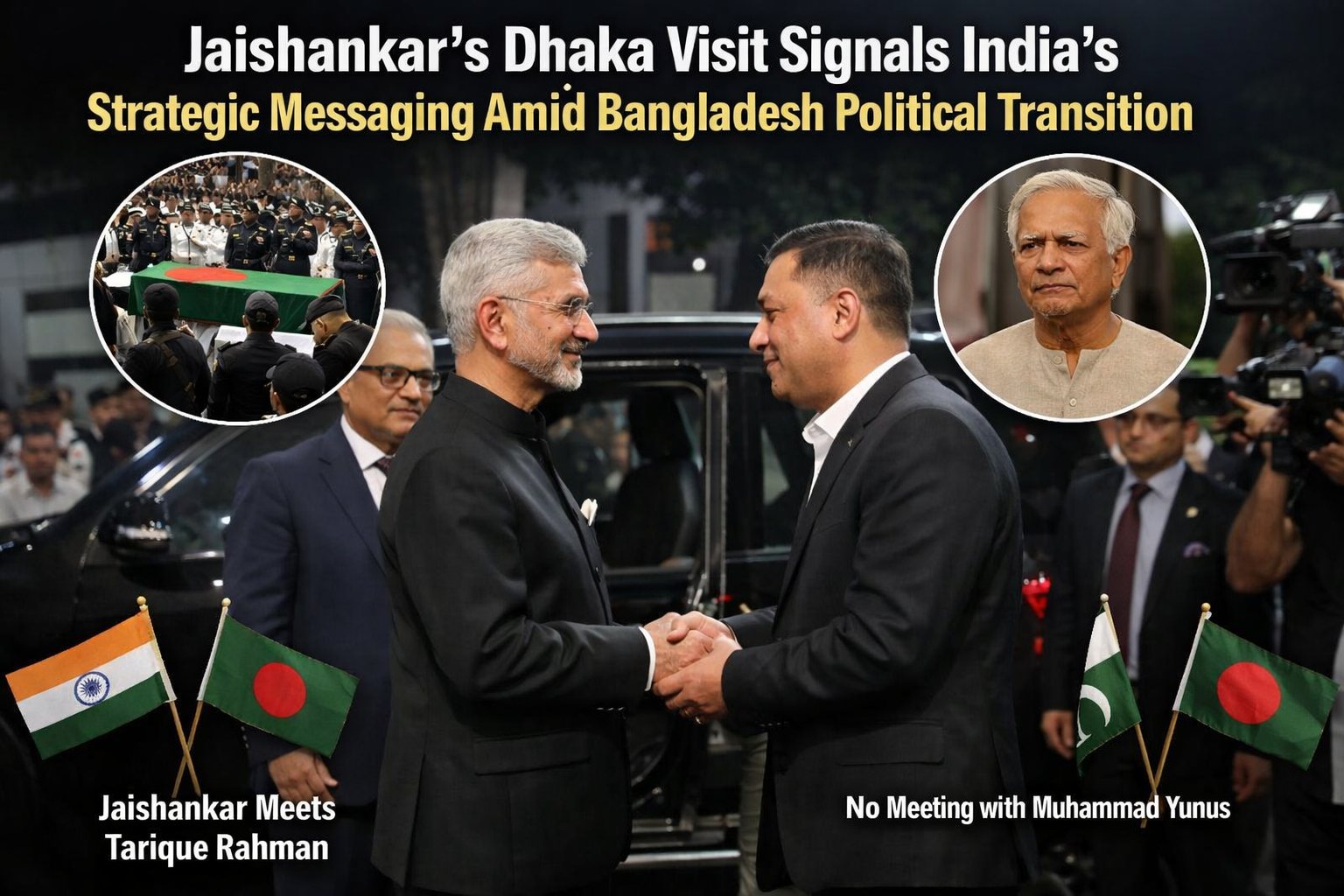
India’s External Affairs Minister S. Jaishankar attended the funeral of former Bangladesh Prime Minister Begum Khaleda Zia in Dhaka on Wednesday, underlining New Delhi’s intent to remain engaged with key political stakeholders in Bangladesh during a sensitive phase of transition.
Jaishankar represented the Government of India and the Indian people at the funeral ceremony. On arrival in Dhaka, he was received by Indian High Commissioner to Bangladesh Pranay Verma. The Indian government described the visit as a mark of respect to a leader who played a significant role in Bangladesh’s political history.
During the visit, Jaishankar met Tarique Rahman, senior leader of the Bangladesh Nationalist Party (BNP) and son of Khaleda Zia. The meeting has drawn attention in diplomatic circles, as it took place against the backdrop of evolving political equations in Bangladesh.
Notably, no meeting was held between Jaishankar and Bangladesh’s interim government Chief Adviser Muhammad Yunus. Foreign policy observers in India view this as a carefully calibrated diplomatic signal, rather than a protocol lapse. Indian analysts point out that New Delhi remains concerned about the security of religious minorities in Bangladesh and has been closely watching the interim administration’s response to recent incidents of violence.
From an Indian perspective, the interaction with Tarique Rahman is significant. The BNP leader has in recent months publicly distanced himself from hardline Islamist allies, including Jamaat-e-Islami, and articulated a “Bangladesh First” approach. Indian strategic commentators believe New Delhi is assessing whether the BNP, under Rahman’s leadership, could offer a more stable and non-adversarial partnership compared to the current interim arrangement.
Indian officials maintain that New Delhi’s long-standing policy is to engage with all major democratic forces in Bangladesh, while prioritising regional stability, counter-terror cooperation, and the protection of minorities. Jaishankar’s presence at Khaleda Zia’s funeral, coupled with his meeting with the BNP leadership, is seen as reinforcing India’s readiness to adapt its diplomacy to changing political realities in Dhaka.
As Bangladesh moves towards its next electoral phase, India is expected to continue a measured and pragmatic engagement, signalling its interests clearly while avoiding overt interference in the country’s internal political process.