Date: February 28, 2026
Category: International War Report
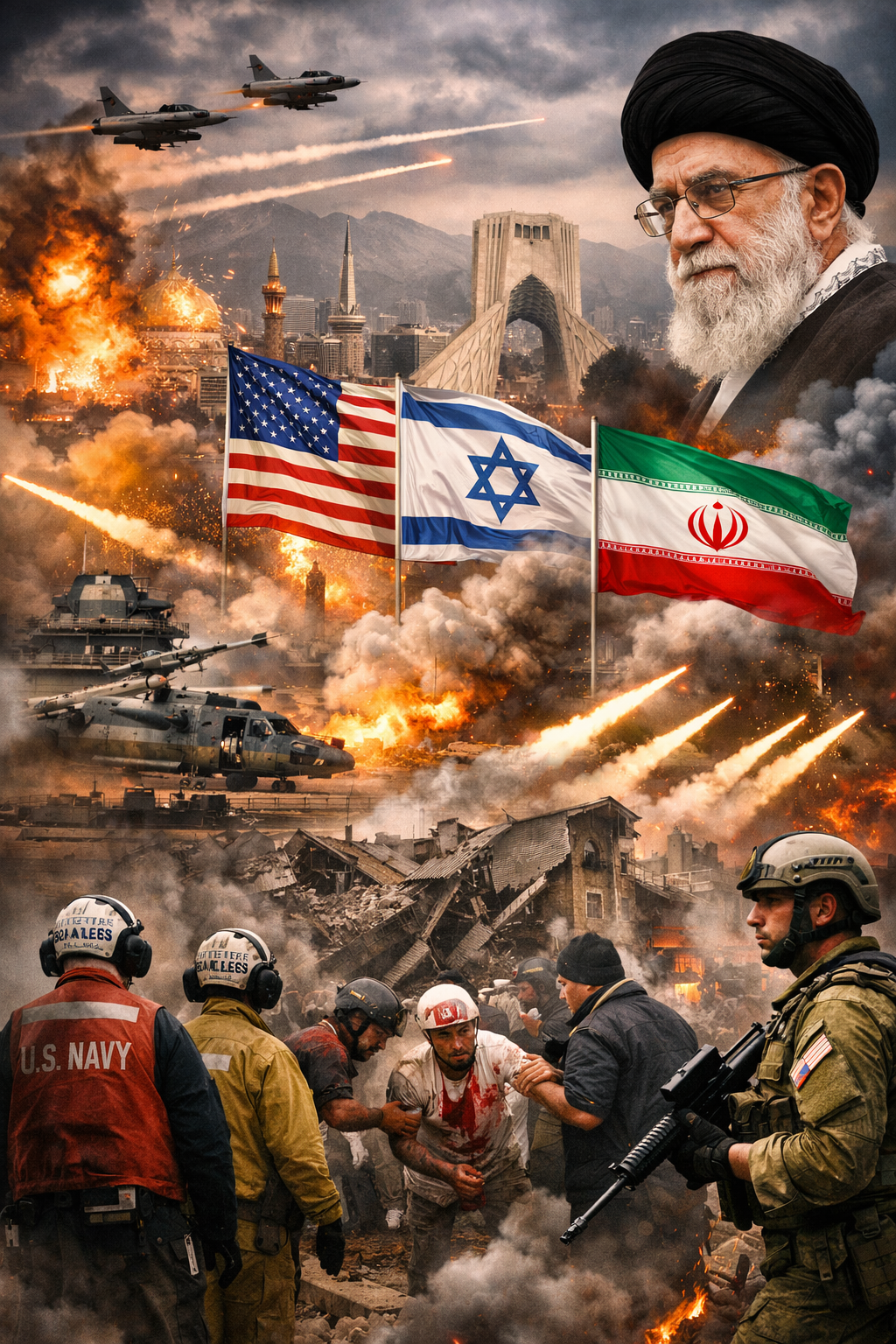
The Middle East has entered one of its most dangerous phases in recent years as open military confrontation between Iran and Israel, with direct involvement from the United States, spreads beyond national borders and into the wider Gulf region. What began as targeted military strikes has rapidly evolved into a multi-front escalation involving missile exchanges, airspace shutdowns, and urgent international diplomatic reactions.
1. The Opening Strike: US–Israel Joint Offensive
On February 28, 2026, the United States and Israel launched coordinated air and missile strikes on Iranian military infrastructure. According to international media reports, the attacks targeted strategic sites in and around Tehran , including facilities allegedly linked to ballistic missile development and defense operations.
The U.S. President described the operation as a “necessary defensive measure,” stating:
“This action is intended to dismantle Iran’s nuclear and ballistic missile capabilities and to protect regional and global security.”
Israel’s Prime Minister echoed similar sentiments, emphasizing national security:
“This is not a political or economic move. It is an operation undertaken to ensure the safety and survival of our people.”
Israeli defense sources indicated that the strikes were designed to weaken Iran’s long-range missile capacity and disrupt military coordination networks.
2. Iran’s Retaliation: Missile Barrages Across the Region
Within hours, Iran responded with a large-scale missile operation reportedly named “Truthful Promise 4.” The retaliation included ballistic missile launches aimed at Israeli territory and U.S. military facilities in the Gulf.
Iranian strikes reportedly targeted areas near U.S. bases in:
- Bahrain(home to the U.S. Navy’s Fifth Fleet)
- Kuwait
- Qatar
- United Arab Emirates
Iranian state media claimed that dozens of ballistic missiles were launched toward Israeli military sites. While damage assessments remain ongoing, air defense systems in Israel were reportedly activated to intercept incoming projectiles.
A senior commander of the Islamic Revolutionary Guard Corps warned:
“Any further aggression will be met with a stronger and more decisive response.”
3. The Gulf Becomes a Secondary Theater
As missile exchanges intensified, the Gulf region quickly felt the consequences.
Airspace Closures and Aviation Disruption
Several Gulf states temporarily closed their airspace amid fears of further missile strikes. Commercial aviation was significantly disrupted, with multiple international carriers suspending or rerouting flights. Airports in Abu Dhabi, Doha, and Kuwait reported precautionary restrictions.
The ripple effects extended beyond the region, affecting global flight corridors and raising concerns over international air safety.
Incident Near U.S. Naval Facilities
Reports also indicated missile activity near the U.S. Navy’s Fifth Fleet base in Bahrain. While no major casualties were immediately confirmed, the incident heightened fears of direct U.S.–Iran confrontation.
Military analysts note that targeting or threatening U.S. naval assets in the Gulf represents a serious escalation with unpredictable consequences.
4. Civilian Impact and Conflicting Reports
Emerging reports from Iranian sources claimed civilian casualties following the initial strikes, including damage to non-military structures. However, independent verification of these claims remains limited, and international observers are urging caution until further confirmation becomes available.
Humanitarian agencies have expressed concern over potential civilian displacement should hostilities continue. The possibility of infrastructure damage — including power grids, communication systems, and fuel supply lines — adds to the uncertainty facing millions across the region.
5. International Reactions: Condemnation and Calls for Restraint
The global response has been swift and divided.
Russia
Russia condemned the strikes, with Foreign Minister Sergey Lavrov describing the attacks as:
“An act that risks plunging the entire region into humanitarian and economic catastrophe.”
United Nations
United Nations Secretary-General Antonio Gutierrez called for immediate de-escalation:
“Continued military exchanges could ignite a broader regional war with global repercussions.”
Western and Asian Powers
European nations including the United Kingdom and France, along with China, urged “maximum restraint” and immediate diplomatic engagement to prevent a prolonged conflict.
Energy markets reacted sharply, with oil prices fluctuating amid fears that instability could threaten shipping routes near the Strait of Hormuz — a critical artery for global energy supply.
6. International Journalists and Security Analysts Weigh In
War correspondents and global security experts have characterized the situation as one of the most volatile confrontations in decades.
An international security analyst noted:
“If this conflict continues to widen, it could reshape alliances in the Middle East and disrupt global energy flows.”
A senior Middle East correspondent observed:
“The Gulf is no longer a peripheral theater — it has become central to the unfolding confrontation.”
Many analysts warn that proxy groups in neighboring countries could become involved, further complicating the regional security landscape.
Timeline of Escalation (Simplified Overview)
- US–Israel joint strikes target Iranian military infrastructure.
- Iran retaliates with ballistic missile attacks toward Israel and U.S. bases.
- Gulf airspace closures and aviation disruptions occur.
- Reports of civilian impact emerge, though verification remains ongoing.
- Global leaders react, issuing condemnations and calls for restraint.
- Security analysts warn of potential regional war and economic fallout.
Conclusion
What began as a targeted military operation has rapidly escalated into a regional crisis affecting multiple Gulf states. With missile exchanges crossing borders, airspace closures disrupting international travel, and global powers weighing in diplomatically, the risk of broader confrontation remains high.
The coming days will be critical. Whether diplomatic channels can reopen or further escalation follows will determine not only the future of Iran–Israel relations but also the stability of the wider Middle East and global security order.