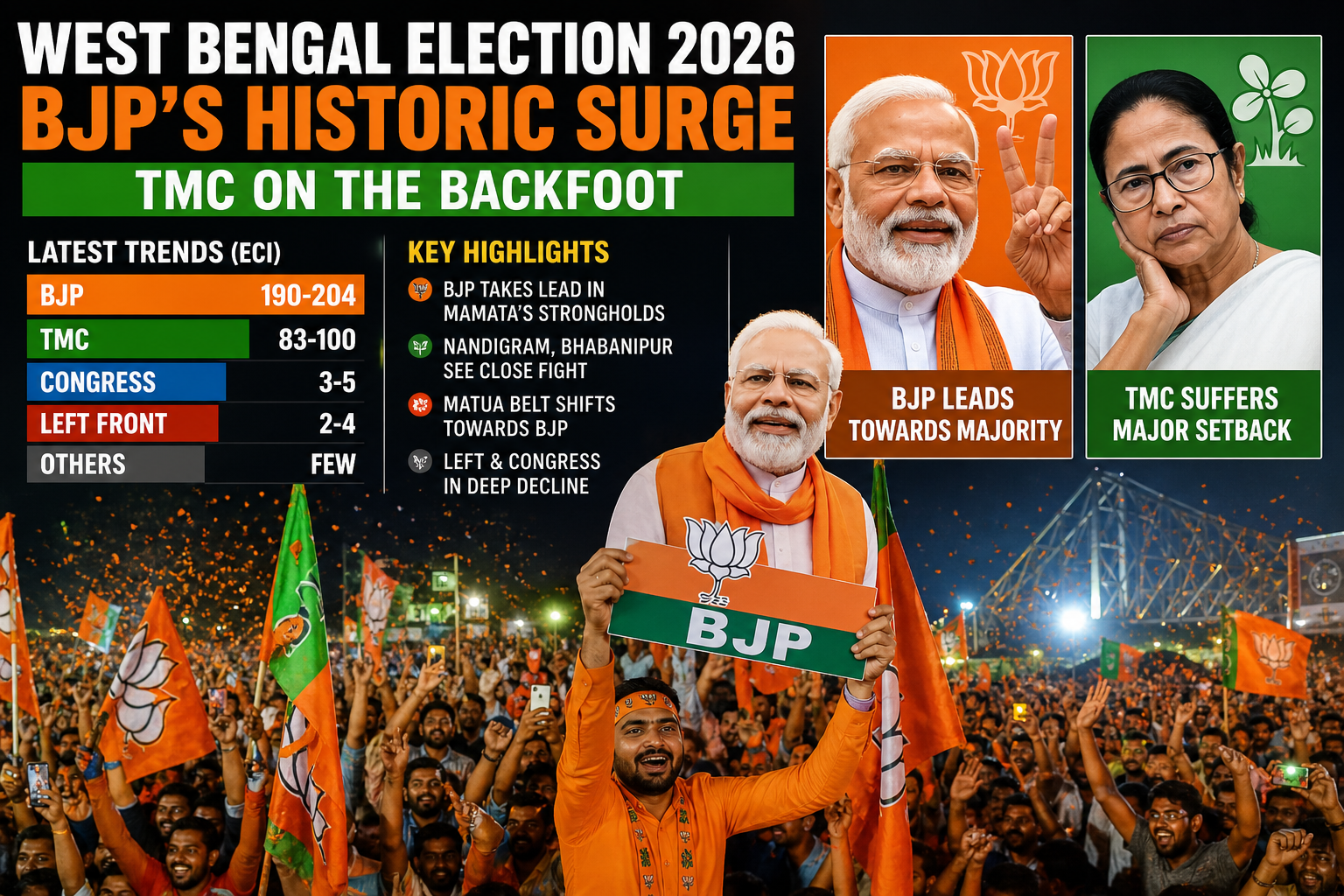
The results of the 2026 West Bengal Assembly elections are being viewed not merely as a change of government in one state, but as a political development with far-reaching national consequences. If the Bharatiya Janata Party (BJP) succeeds in forming the government in Bengal, analysts believe it could fundamentally redraw the political balance of power in eastern India.
1. BJP Opens the “Gateway to Eastern India”
Until now, the BJP’s strongest political base has largely been concentrated in northern, western, and central India. A victory in West Bengal would significantly expand the party’s footprint in the east.
If the BJP captures Bengal:
- It could consolidate dominance across eastern India.
- Political influence may deepen across Assam, West Bengal, and Tripura.
- The party is likely to adopt a more assertive stance on Bangladesh-border politics and national security.
Political observers describe the development as “the BJP’s biggest ideological victory outside the Hindi heartland.”
2. A Major Blow to Mamata Banerjee’s National Opposition Ambitions
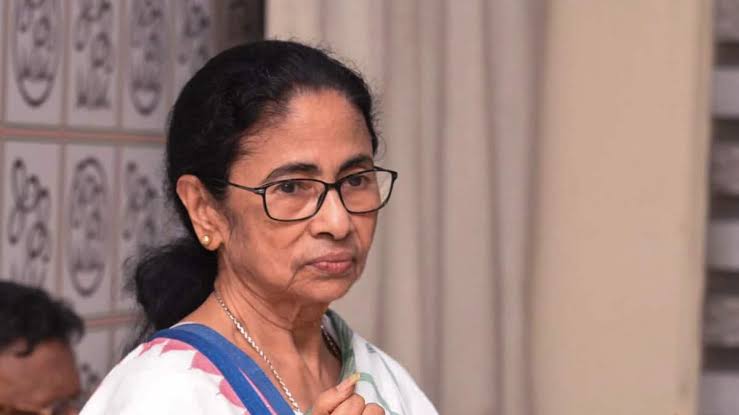
West Bengal Chief Minister Mamata Banerjee has, over the past few years, emerged as one of the most prominent faces of opposition unity politics in India.
A defeat in Bengal could:
- Reduce the Trinamool Congress’ influence within the INDIA opposition bloc.
- Allow the Congress party to reclaim a more central role in opposition politics.
- Weaken the bargaining power of regional parties in national coalition discussions.
Following the 2024 Lok Sabha elections, there had been discussions in opposition circles projecting Banerjee as a possible prime ministerial face. A loss in Bengal would significantly dent those ambitions.
3. BJP’s Confidence Ahead of the 2029 General Elections
Under Prime Minister Narendra Modi’s leadership, the BJP is expected to project a Bengal victory as proof that the party has successfully expanded beyond its traditional strongholds.
The party could use the result to strengthen narratives around:
- National security
- NRC and citizenship policies
- Border control and anti-infiltration measures
Political commentators are already calling Bengal “a semi-final before the 2029 Lok Sabha elections.”
The BJP may also attempt to replicate the “Bengal model” in other border states.
4. NRC, Citizenship and Border Politics Could Return to the Centre Stage
Issues such as:
- NRC (National Register of Citizens)
- SIR (Special Intensive Revision of electoral rolls)
- Illegal immigration
- Bangladesh border security
became major talking points during the election campaign.
BJP leaders argued that voter-list verification and stricter citizenship scrutiny were necessary. Critics, however, accused the party of using these issues to polarize voters and target minorities.
If the BJP forms the government:
- NRC debates could intensify again.
- Border-security measures may become stricter.
- Citizenship laws and related policies could return to the national spotlight.
5. Historic Setback for the Left in Bengal
The CPI(M)-led Left Front was once the defining political force in West Bengal.
Political dominance in the state has shifted dramatically over the decades:
| Period | Dominant Political Force |
|---|---|
| 1977–2011 | Left Front |
| 2011–2026 | Trinamool Congress |
| 2026 onward | BJP surge (projected) |
Analysts see this transformation as one of the clearest symbols of the long-term decline of Left politics in India.
6. Rise of Religious and Cultural Politics?
The BJP’s campaign strongly emphasized themes such as:
- “Protection of Sanatan Dharma”
- “Revival of Bengal’s cultural heritage”
- “Jai Shri Ram” slogans
This could lead to:
- Greater influence of Hindutva politics in Bengal
- A stronger emphasis by the Trinamool Congress on Bengali identity politics
- Fresh polarization among different voting blocs
At the same time, political observers caution that religion-based narratives remain highly contentious and that maintaining social harmony will be crucial.
7. Economic and Industrial Implications
If the BJP comes to power:
- Centre-state cooperation could improve significantly.
- Large-scale infrastructure, port, and industrial projects may be announced.
- Kolkata could be repositioned as a major economic hub for eastern India.
However, critics warn that:
- Rising social tensions could discourage investment.
- Political polarization may affect governance and stability.
8. Impact on Northeast Indian Politics
The BJP government in Assam has already taken a strong stand on border security and illegal immigration.
If Bengal also comes under BJP rule:
- The party would gain a consolidated political corridor across the Northeast.
- National security discourse could become even more prominent.
- Political dynamics in Bangladesh-border states may undergo major shifts.
Conclusion
The 2026 West Bengal election is being seen as much more than the defeat of a state government.
It could represent:
- A major shift in India’s national political narrative
- BJP’s biggest strategic breakthrough in eastern India
- A defining moment ahead of the 2029 Lok Sabha elections
Just as Mamata Banerjee’s “Poriborton” movement ended 34 years of Left rule in 2011, the BJP is now attempting to project the idea of a “New Bengal” in 2026.
If the current trends hold, analysts believe the political map of India heading into 2029 could be significantly reshaped.