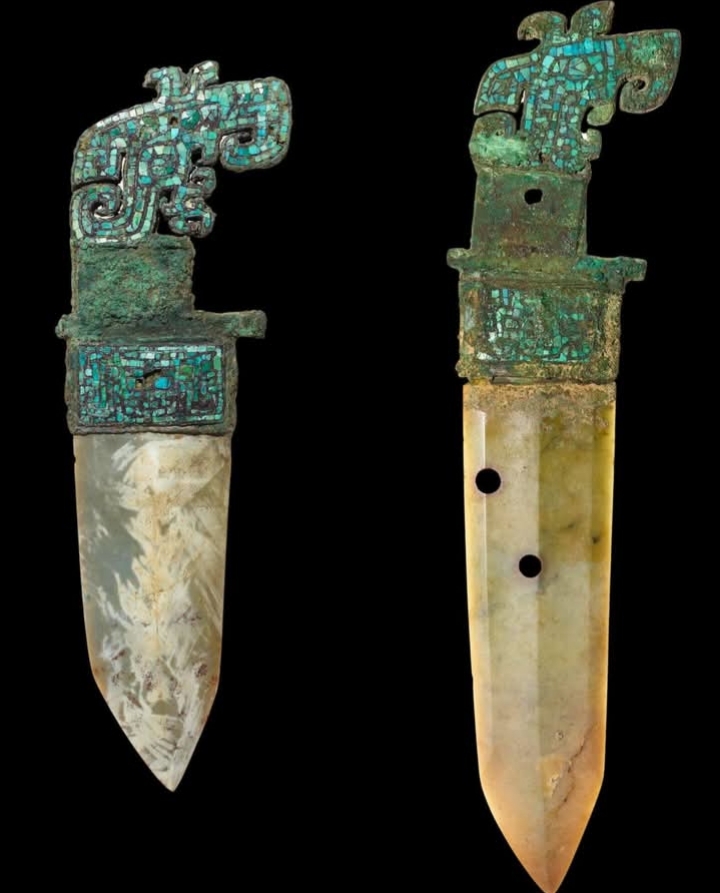
A pair of ceremonial jade dagger-axes dating back to China’s Shang dynasty (1600–1046 BCE) have been brought into focus by historians and archaeologists. These artifacts, featuring jade blades, bronze handles, and intricate turquoise inlays, represent a rare fusion of artistry, metallurgy, and ritual symbolism from one of China’s earliest civilizations.
Historical Context
The dagger-axe, known as ge in ancient China, was first used as a weapon of war during the Shang dynasty. Over time, its role shifted from the battlefield to the ceremonial stage, becoming a powerful emblem of authority, divine legitimacy, and social status. Shang rulers often employed jade artifacts in rituals, as jade was regarded as a sacred material symbolizing purity, immortality, and a connection to the heavens.
Cultural Significance
The jade blades themselves show exquisite craftsmanship, with smooth finishes and carefully drilled holes that likely allowed them to be fastened onto ritual fittings. The turquoise inlays form intricate geometric and possibly animal-like motifs, suggesting symbolic meanings tied to mythology and spiritual protection. The bronze handles, though now corroded with age, highlight early advances in bronze casting and decorative arts.
Given their fragile jade composition, these dagger-axes were never intended for combat. Instead, they were likely reserved for kings and nobles, used in state ceremonies, ancestral worship, and as burial goods placed alongside the elite to ensure protection and honor in the afterlife.
Expert Insights
Scholars emphasize that such artifacts provide valuable insight into Shang society. They reflect not only the dynasty’s advanced craftsmanship but also its hierarchical structure, where symbols of martial power were closely tied to spiritual authority. The combination of jade, bronze, and turquoise demonstrates the sophistication of Shang artisans and their ability to merge utility with deep cultural meaning.
Lasting Legacy
Over 3,000 years after their creation, the ceremonial dagger-axes remain a powerful reminder of the Shang dynasty’s influence on Chinese culture. They embody the dynasty’s enduring legacy of ritual practice, artistry, and the intertwining of politics with the spiritual world.