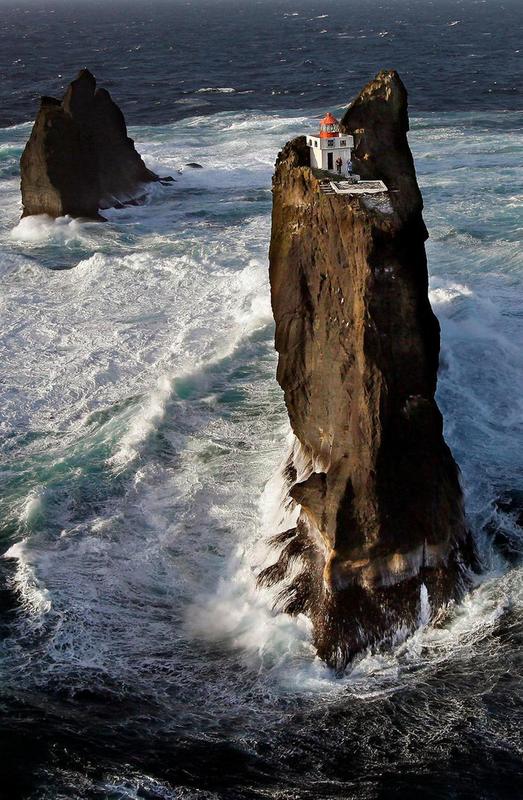
Iceland:One of the world’s most surreal and isolated man-made structures is capturing global attention once again — the Þrídrangar(three rock pillars) Lighthouse, perched dramatically atop a narrow sea stack near Iceland’s Westman Islands. Rising nearly 120 feet above the raging Atlantic, this tiny beacon has become an online sensation for its unbelievable location and the extraordinary history behind its creation.
A Lighthouse Built on a Rock in the Middle of the Ocean
Located about 7.2 km off Iceland’s southwest coast, the lighthouse stands on Stóridrangur( big boy), the tallest of three volcanic sea stacks known collectively as Þrídrangar (“Three Rock Pillars”). Formed by ancient volcanic activity and sculpted over millennia by powerful oceanic erosion, these basalt towers look more like nature’s artwork than a place for construction.
A Daredevil Construction Story
What astonishes viewers is that the lighthouse was built between 1938 and 1939, at a time when Iceland had no helicopters, no advanced cranes, and almost no modern climbing equipment.
Under the supervision of engineer Árni Þórarinsson( aarni toraarinson), skilled local climbers scaled the sheer vertical rock face by hand. Construction materials were brought by boat and passed up the rock ledge by ledge in a dangerous human chain.
One legendary account from the project says that a climber had to stand on another man’s shoulders to make the very first move up the slippery basalt surface — the only way to begin the ascent.
World War II Delayed the First Light
Although the structure was completed in 1939, the lighthouse couldn’t begin operation because lighting equipment was delayed by World War II. It finally lit up on July 5, 1942, becoming a crucial guide for ships navigating one of Iceland’s most hazardous marine zones.
A Lighthouse Without Keepers
Unlike traditional lighthouses, Þrídrangar never had resident keepers. The rock is too small, too dangerous, and too exposed to North Atlantic storms. Today, the lighthouse is fully automated, with maintenance crews visiting only once or twice a year — and always by helicopter.
The Infamous Helipad
In the 1950s, a tiny helicopter landing pad was added. Landing on it remains an extreme skill test for pilots because of sudden winds, swirling updrafts, and almost no margin for error.
Powered by the Sun Since 1993
A major upgrade in 1993 converted the beacon to solar power, allowing it to run reliably with minimal human intervention.
A Viral Symbol of Isolation
Thanks to drone footage and dramatic photos shared online, the Þrídrangar Lighthouse has become a global viral phenomenon — often dubbed:
- “The Loneliest Lighthouse on Earth”
- “The Most Isolated Building in the World”
- “The Lighthouse on a Needle of Stone”
Its remote location, wild ocean backdrop, and impossible construction story have made it a favorite subject for travel documentaries, adventure enthusiasts, and social media storytellers.
A Testament to Human Willpower
Amid the violence of the North Atlantic, this small concrete structure stands as a powerful reminder of human courage and ingenuity. The Þrídrangar Lighthouse continues to shine — a solitary beacon guarding the edge of the world.