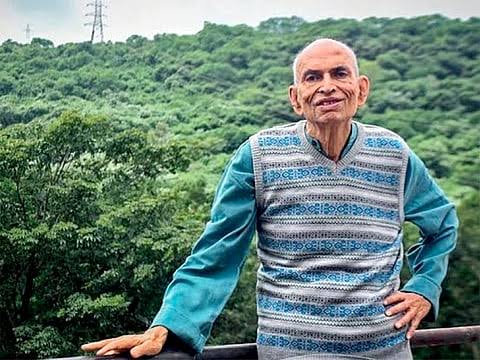
PUNE— Prof. Madhav Dhananjaya Gadgil, one of India’s most respected ecologists, environmental thinkers and conservation scientists, passed away on January 7, 2026, in Pune at the age of 83 after a brief illness. He breathed his last at Prayag Hospital, surrounded by family.
Prof. Gadgil was widely recognised as a “people’s scientist”, whose work spanned over six decades and deeply influenced environmental science, policy and conservation efforts in India.
Life and Career
- Born: May 24, 1942, in Pune, Maharashtra, into a scholarly family — his father, Dhananjay Ramchandra Gadgil, was a noted economist.
- Education: He graduated in biology from Fergusson College and completed his master’s in zoology from the University of Mumbai. He earned a PhD from Harvard University in 1969, focusing on mathematical ecology and animal behaviour.
Prof. Gadgil joined the Indian Institute of Science (IISc), Bengaluru in 1973, where he founded the Centre for Ecological Sciences (CES) and the Centre for Theoretical Studies, institutions that became cornerstones of ecological research in India. He retired from IISc in 2004 but continued active engagement with research and policy.
Major Contributions and Vision
1. Champion of Western Ghats Conservation
Prof. Gadgil’s most impactful work was on the Western Ghats, one of the world’s biodiversity hotspots. In 2010, he was appointed chair of the Western Ghats Ecology Expert Panel (WGEEP), popularly known as the Gadgil Commission. The panel’s 2011 report recommended classifying approximately 64 % of the Western Ghats as Ecologically Sensitive Areas and urged strict regulation of unsustainable development activities to protect biodiversity and fragile ecosystems.
The report also emphasised the role of local communities, gram sabha veto power on major projects, forest restoration, and organic farming — ideas that remain influential in debates on sustainable development. Though its recommendations were not fully implemented by state governments, the report has been widely recognised for foresight, particularly regarding landslide and flood risks in the region.
Prof. Gadgil consistently warned that irresponsible construction, quarrying, deforestation, and poorly planned roads and resorts could weaken hillside stability, especially in ecologically sensitive zones like Kerala’s Western Ghats, contributing to disasters such as landslides and floods.
2. Kerala Landslides and “Man-Made” Calamity Perspective
Even earlier, Gadgil had highlighted that events like the Kerala floods and landslides were not simply acts of nature but were deeply linked to unscientific development and environmental degradation — a perspective that reverberated during crises such as the 2018 Kerala floods and more recent hillside disasters.
Books and Writings
Prof. Gadgil was a prolific author whose books and writings helped shape ecological consciousness in India:
- This Fissured Land: An Ecological History of India — a seminal work blending ecology, history and human society.
- Ecology and Equity: The Use and Abuse of Nature in Contemporary India (with Ramachandra Guha) — discussing the intersection of ecological sustainability and social justice.
- Ecological Journeys — reflections on science, policy and conservation.
- He also published a manual on People’s Biodiversity Registers, used to document and safeguard local ecological knowledge.
He authored over 250 scientific papers and was a regular columnist in both English and Marathi.
Awards and Recognition
Prof. Gadgil’s contributions earned him numerous honours:
- Padma Shri (1981) and Padma Bhushan (2006) — among India’s highest civilian awards.
- Volvo Environment Prize, Tyler Prize for Environmental Achievement, and other international environmental awards.
- In 2024, he received the Champions of the Earth award — the highest environmental accolade from the United Nations Environment Programme (UNEP).
Vision and Legacy
Prof. Gadgil was known for a holistic ecological outlook that placed humans as part of the ecosystem rather than separate from it. He championed grassroots conservation, emphasised the value of traditional ecological knowledge, and criticised development models that ignored long-term ecological costs. His work has inspired generations of environmentalists, scientists, policymakers and grassroots activists to pursue sustainability with scientific rigour and social equity.
His legacy lives on through his writings, the institutions he built, and the environmental policies and public debates he helped shape — a testament to a life devoted to preserving India’s natural heritage.