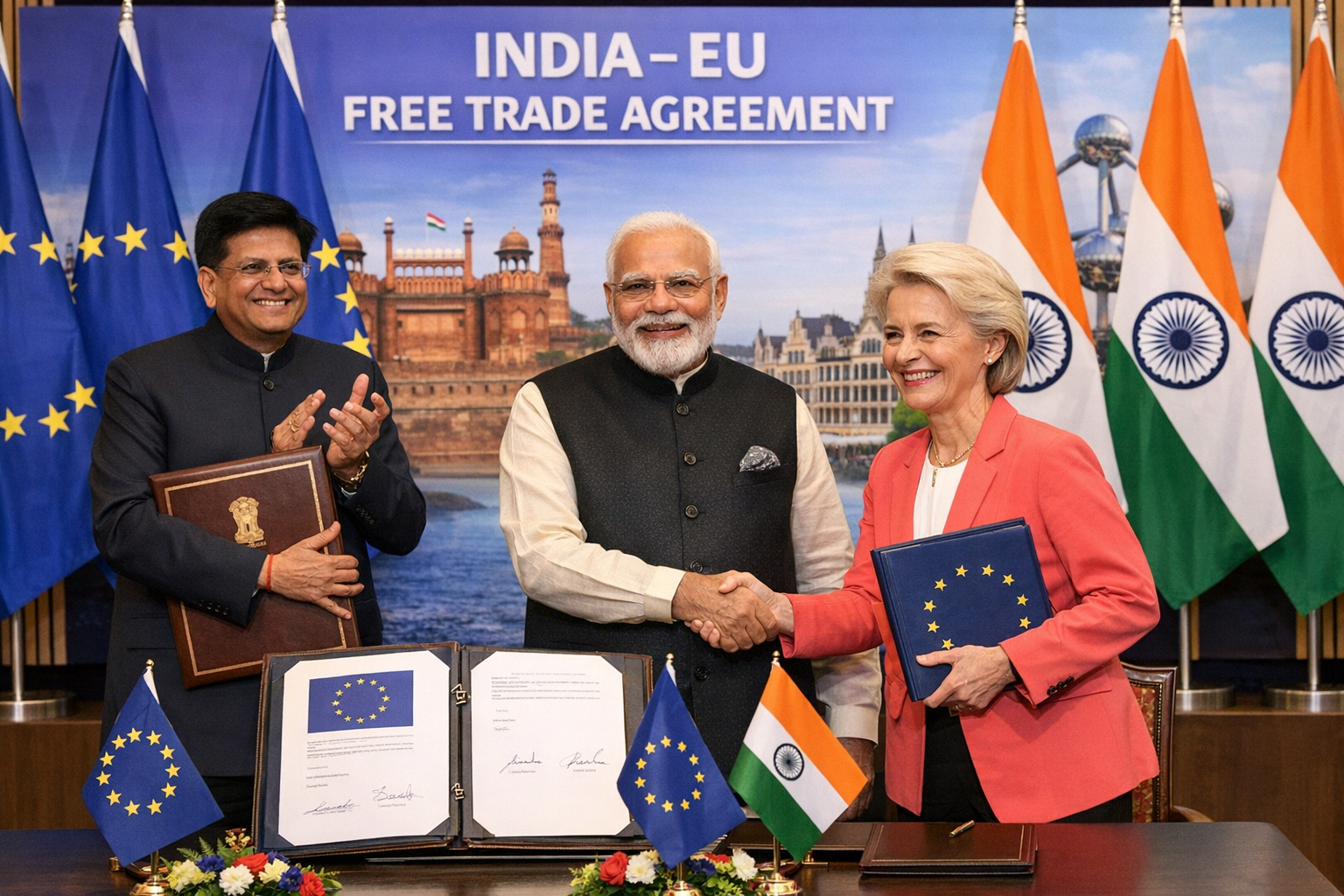
New Delhi — India and the European Union on Tuesday signed a historic Free Trade Agreement (FTA), concluding nearly two decades of negotiations and setting the stage for one of the world’s largest and most ambitious trading partnerships. Leaders on both sides hailed the pact as a watershed moment for global trade, with sweeping tariff cuts, expanded market access, and deeper strategic cooperation.
Indian Commerce Minister Piyush Goyal described the agreement as the “Mother of All Trade Deals,” underscoring its scale and long-term impact on exporters, consumers, and job creation. The deal aims to slash or eliminate tariffs on the vast majority of goods traded between the two economies, dramatically boosting competitiveness and investment flows.
A Deal by the Numbers
Under the agreement, the European Union will cut tariffs on approximately 96.6% of its goods exports to India, spanning machinery, pharmaceuticals, chemicals, and food products. In return, India will see tariff reductions on about 99.5% of its exports to the EU, a move expected to significantly benefit labour-intensive sectors such as textiles, gems and jewellery, leather, and sports goods.
One of the most closely watched provisions involves automobiles. European car imports into India will see duties reduced from around 110% to as low as 10%, implemented gradually under a phased quota system. Tariffs on many processed foods and industrial goods will be eliminated or sharply reduced, while pharmaceutical duties are also set to be removed.
Beyond goods, the pact extends into services, mobility, defence cooperation, investment, energy collaboration, and higher education, signalling a comprehensive economic and strategic partnership.
Leaders React
From Europe, European Commission President Ursula von der Leyen called the pact the “Mother of All Deals,” saying it proves that rules-based cooperation can still deliver big results in a fragmented world economy. EU leaders stressed that the agreement opens access to one of the world’s fastest-growing major markets, offering European firms long-term growth opportunities.
In India, Prime Minister Narendra Modi said the agreement positions India as a key global economic partner for Europe, opening new horizons for Indian businesses from jewellery to sports equipment. He added that farmers, small manufacturers, and exporters stand to gain from access to the EU’s 27-nation market.
Commerce Minister Goyal emphasized that bringing 99% of Indian products within the deal’s tariff framework would provide a powerful boost to exports, manufacturing, and employment, aligning with India’s broader industrial ambitions.
Global Reactions and Geopolitical Undercurrents
In the United States, some officials and commentators voiced unease, warning that the agreement could encourage Europe to diversify away from U.S. markets, reflecting deeper geopolitical trade tensions. The reaction highlights how the India–EU pact fits into a wider recalibration of global economic alliances.
Analysts worldwide see the agreement as reshaping global trade flows, effectively creating one of the largest free-trade zones, covering nearly two billion consumers and close to a quarter of global GDP. The timing is notable, coming amid persistent trade frictions and as economies seek to reduce over-dependence on any single partner, including China.
Opportunities—and Challenges Ahead
Economists point to clear winners: Indian exporters in textiles, leather, gems, chemicals, steel, and petroleum products, and European firms in machinery, pharmaceuticals, vehicles, and industrial equipment. The deal is also expected to attract greater European investment into India, reinforcing supply chains and technology transfers.
However, challenges remain. Sensitive areas such as agriculture and certain service-sector protections will require careful handling, and the agreement must still pass legal and parliamentary approvals. Full implementation is expected to roll out gradually, potentially over the next year.
Looking to 2030 and Beyond
Long-term projections suggest the pact could double EU exports to India by 2032, saving billions of dollars in duties, while supporting India’s Make in India initiative and job creation goals. With cooperation frameworks extending to 2030 and beyond, officials on both sides say the agreement is not just a trade deal, but a strategic blueprint for shared growth.
In a world marked by economic uncertainty and shifting alliances, the India–EU Free Trade Agreement stands out as a rare, expansive bet on openness—one that could redefine the balance of global commerce for years to come.