The Nanjing Massacre, also known as the Rape of Nanking, remains one of the most documented and controversial war crimes of the twentieth century. Following the capture of Nanjing—then the capital of the Republic of China—by the Imperial Japanese Army on 13 December 1937, the city witnessed weeks of mass killings, sexual violence, looting, and systematic brutality against civilians and disarmed soldiers. This article examines the historical causes of the massacre, documented atrocities supported by diary evidence, the debate over casualty figures, international legal findings, and the role the memory of Nanjing plays in China’s present-day domestic and foreign policy.
Historical Background: Causes of the War
The Nanjing Massacre occurred during the Second Sino-Japanese War (1937–1945), a conflict rooted in Japan’s imperial expansion and militarism in East Asia.
The immediate trigger was the Marco Polo Bridge Incident on 7 July 1937, a skirmish between Japanese and Chinese troops near Beijing. What began as a localized clash rapidly escalated into a full-scale invasion. Japan’s military leadership, driven by expansionist ideology, resource demands, and a belief in racial and civilizational superiority, pursued aggressive warfare with minimal regard for civilian protection.
After fierce fighting in Shanghai, Japanese forces advanced inland along the Yangtze River and reached Nanjing in December 1937. The Chinese government had already relocated the capital to Chongqing, leaving the city largely undefended.
The Fall of Nanjing and the Pattern of Atrocities
On 13 December 1937, Japanese troops entered Nanjing. What followed over the next several weeks constituted a breakdown of military discipline and the emergence of systematic violence.
Mass Killings
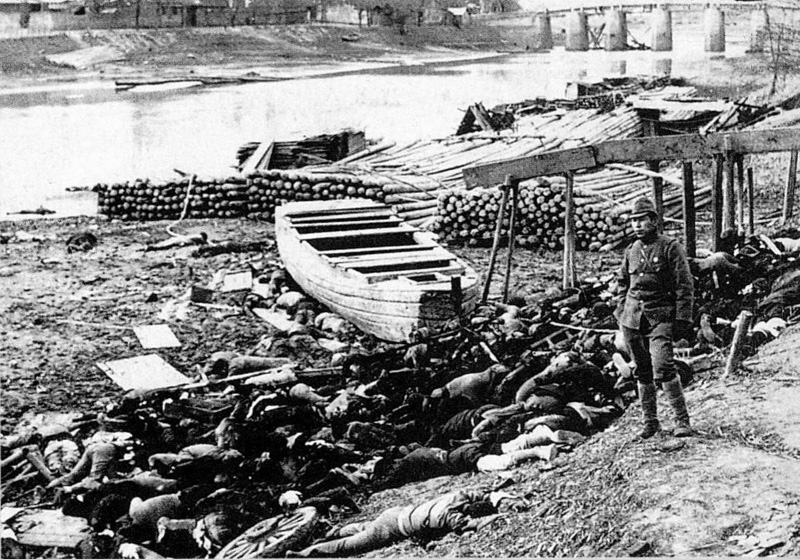
Thousands of Chinese soldiers who had surrendered or discarded their uniforms were executed. Civilians—men, women, and children—were also killed in mass shootings, beheadings, bayonet attacks, and burning operations. Executions occurred at riverbanks, open fields, and city outskirts.
Sexual Violence
Sexual violence was widespread and indiscriminate. Women and girls, including the elderly and minors, were raped—often gang-raped—frequently followed by murder. Many victims were abducted from their homes or refugee shelters.
Looting and Destruction
Homes, shops, hospitals, and temples were looted and burned. Entire neighborhoods were destroyed, leaving survivors without food or shelter.
Diary Evidence and Eyewitness Testimony
One of the strongest bodies of evidence for the massacre comes from Western and Chinese civilian diaries, many preserved in archives and used during post-war trials.
Minnie Vautrin (American missionary, Ginling College)
“There probably is no crime that has not been committed in this city today.”
(Diary, December 1937)
Vautrin sheltered thousands of women and children and documented daily abductions, rapes, and killings. Her diaries are preserved at Yale University and are considered among the most reliable firsthand accounts.
John Rabe (German businessman, leader of the Nanjing Safety Zone)
Rabe, a member of the Nazi Party, paradoxically used his status to protect civilians. His diary records repeated protests to Japanese officers and detailed descriptions of killings and assaults within the Safety Zone.
Chinese Civilian Diaries
Chinese residents, including Tsen Shui-fang, described soldiers dragging women from homes, executions in streets, and the terror of nightly raids. These accounts corroborate Western testimony and Japanese military records.
Casualty Figures and Historical Debate
The number of victims remains contested.
- International scholarly estimates: approximately 100,000–200,000 deaths
- Chinese official position: 300,000 victims
Differences arise from:
- Geographic scope (city proper vs. surrounding counties)
- Time frame (weeks vs. several months)
- Inclusion of civilians only or also executed prisoners of war
Despite numerical disputes, mainstream historians overwhelmingly agree that mass atrocities unquestionably occurred.
International Legal Findings
The International Military Tribunal for the Far East (IMTFE), commonly known as the Tokyo Trials (1946–1948), concluded that large-scale killings and rapes occurred in Nanjing. Several Japanese military leaders were convicted, though many perpetrators were never prosecuted.
The tribunal recognized the massacre as a war crime and a crime against humanity, establishing its place in international legal history.
China’s Contemporary Memory and Policy (2020s–2025)
State Memory and Education
China has institutionalized remembrance through:
- The Memorial Hall of the Victims in Nanjing Massacre
- National education curricula
- Annual state-led commemorations on 13 December
In 2014, China designated the date as a National Memorial Day, reinforcing historical consciousness.
Foreign Policy Dimension
The memory of Nanjing continues to shape China–Japan relations, especially during disputes over history textbooks, war shrines, and apologies. Chinese leaders frame remembrance as both a moral obligation and a warning against militarism.
Recent Developments
In December 2025, China marked the 88th anniversary of the massacre with official ceremonies, media coverage, and renewed calls for historical accountability—highlighting how Nanjing remains politically and emotionally relevant.
Global Significance
The Nanjing Massacre is not only a Chinese or Japanese historical issue but a global case study in:
- Civilian vulnerability during total war
- The limits of military ethics
- The role of memory in post-conflict reconciliation
It stands alongside Auschwitz and My Lai as a defining example of why historical documentation and remembrance matter.
Conclusion
The Nanjing Massacre represents a convergence of unchecked militarism, dehumanization, and the collapse of moral restraint. Through diaries, photographs, tribunal records, and survivor testimony, history preserves what happened in Nanjing—not merely as an account of suffering, but as a lasting warning. China’s continued remembrance underscores how the past remains inseparable from present identity and international politics.
Sources & Further Reading
- International Military Tribunal for the Far East (IMTFE), Judgment (1948)
- Iris Chang, The Rape of Nanking (1997)
- Joshua A. Fogel (ed.), The Nanjing Massacre in History and Historiography
- John Rabe, The Good Man of Nanking (Diaries)
- Minnie Vautrin Diaries, Yale Divinity Library Archives
- Encyclopaedia Britannica – “Nanjing Massacre”
- Memorial Hall of the Victims in Nanjing Massacre (Official Publications)
- Reuters News Reports on Nanjing Commemorations (2020–2025)